
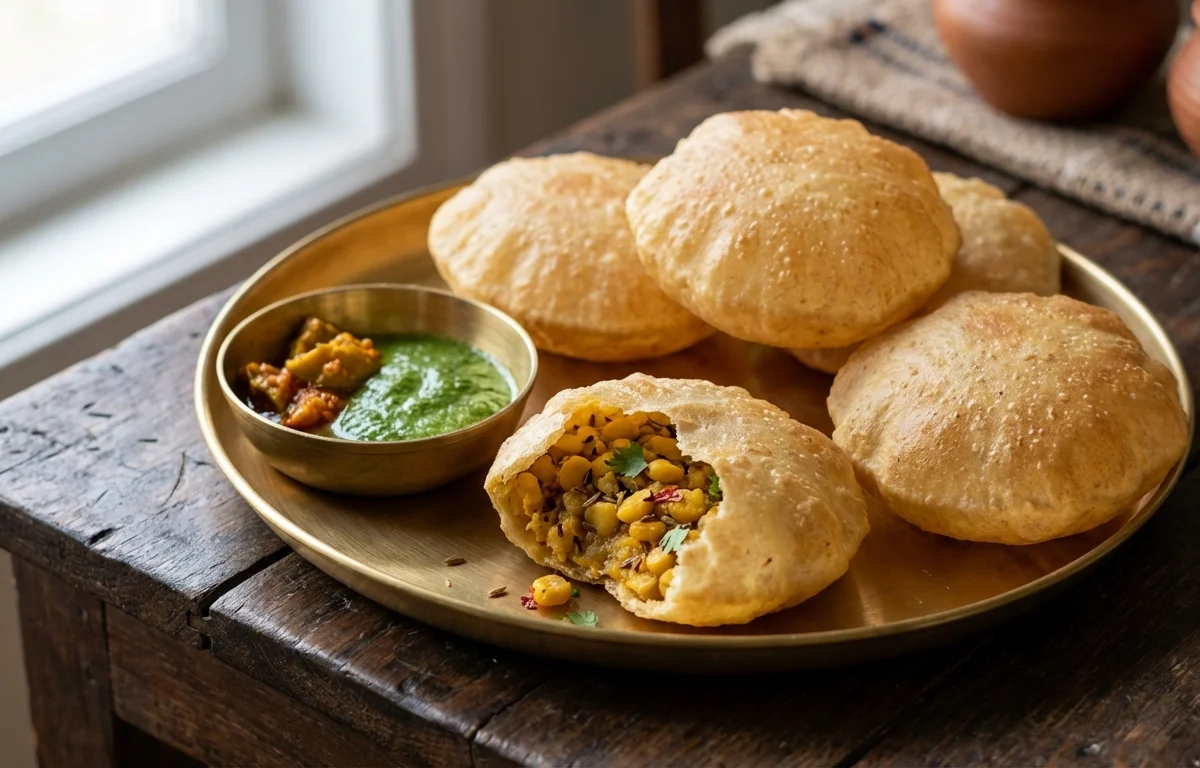
Dal Puri
Crisp, flaky deep-fried puris stuffed with a spiced lentil filling, Dal Puri is a festive favorite across eastern India. The dough stays light while the roasted dal center adds a warm, earthy bite in every puffed piece.
For 8 servings
- boil · ~15 min
Boil the chana dal until just tender.
1.Drain the soaked chana dal.2.Add the dal to a pot with water and bring to a boil.3.Cook until the grains are soft but still hold their shape, about 12 to 15 minutes.4.Drain very well and let the dal cool completely.TIPDo not overcook the dal or the filling will turn pasty and hard to stuff. - knead · ~20 min
Knead the dough.
Mix the all-purpose flour, 2 tbsp oil, and half of the salt in a bowl. Add the water little by little and knead into a smooth, medium-firm dough. Cover and rest for 20 minutes.
TIPA medium-firm dough helps the puris hold the filling and puff better in hot oil. - roast · ~2 min
Roast and crush the whole spices.
Dry roast the fennel seeds and cumin seeds in a small pan over low heat until fragrant, about 1 minute. Cool slightly, then crush them coarsely.
- saute · ~6 min
Make the dal filling.
1.Heat 1 tbsp oil in a pan over medium heat.2.Add the boiled chana dal and stir for 1 minute to dry out excess moisture.3.Add the crushed fennel seeds, crushed cumin seeds, red chili powder, garam masala, and the remaining salt.4.Cook, stirring and lightly mashing, until the mixture looks dry and crumbly, 4 to 5 minutes.5.Cool the filling completely, then divide it into 8 small portions.TIPThe filling should feel dry, not wet, so it spreads evenly inside the puri without tearing the dough. - assemble · ~15 min
Stuff and roll the puris.
1.Divide the rested dough into 8 equal balls.2.Flatten one ball into a small disc and place one portion of filling in the center.3.Bring the edges together and pinch to seal.4.Gently flatten and roll into a small puri without pressing too hard.5.Repeat with the remaining dough and filling.TIPRoll gently from the center outward so the filling stays evenly spread and the puri does not burst while frying. - fry · ~10 min
Deep fry the dal puris.
1.Heat the oil for deep frying in a kadai over medium heat.2.Slide in one rolled puri and press lightly with a slotted spoon as it rises.3.Fry until puffed and golden on both sides, about 1 to 2 minutes total.4.Remove and drain well.5.Fry the remaining puris the same way.TIPKeep the oil medium-hot; very hot oil browns the outside too fast before the layers crisp properly. - serve
Serve the dal puri hot.
What to keep in mind.
7 tips from the recipe — small details that make a real difference to the final dish.
- 1Drain the boiled chana dal thoroughly and let it air-dry a bit before cooking the filling, or the puris may tear while rolling.
- 2Crush the roasted fennel and cumin coarsely, not to a powder, so the filling keeps its characteristic textured bite.
- 3Cool the filling completely before stuffing; warm filling creates steam and makes the dough sticky.
- 4Seal each dough ball tightly after stuffing and pinch off any thick top knot so the puri rolls out evenly.
- 5If a rolled puri springs back, let it rest for 5 minutes before frying so the dough relaxes.
- 6Fry one puri first as a test; if it browns too fast without puffing, lower the oil heat slightly.
- 7Dal puri is best served right after frying, but you can keep finished puris on a rack instead of paper towels to preserve crispness.
Adapt it for your goals.
Milder-spice
Skip the red chili powder and lean on fennel and cumin for a gentler version that keeps the filling aromatic without heat.
atta mixAtta-mix
Replace part of the all-purpose flour with whole wheat flour for a nuttier taste and a slightly heartier puri.
ajwain flavoredAjwain-flavored
Add a pinch of ajwain to the dough for a more robust, savory aroma that pairs well with the chana dal filling.
festive sideFestive-side
Serve with aloor dum or cholar dal instead of plain accompaniments for a more traditional celebratory Bengali meal.
Why this is on our healthy list.
Protein from Chana Dal
The split chickpea filling adds plant protein and makes the puri more sustaining than plain fried bread.
Fiber in the Filling
Chana dal contributes fiber, which adds texture and helps balance the richness of the fried outer layer.
Digestive Spice Support
Fennel and cumin bring aroma and are traditionally used in Indian cooking to make legume dishes feel lighter.
Frequently asked questions
The filling was likely too moist, the seal was weak, or the puri was rolled too thin in one spot. Keep the filling dry and crumbly, seal well, and roll gently.



-curry.webp)
.webp)