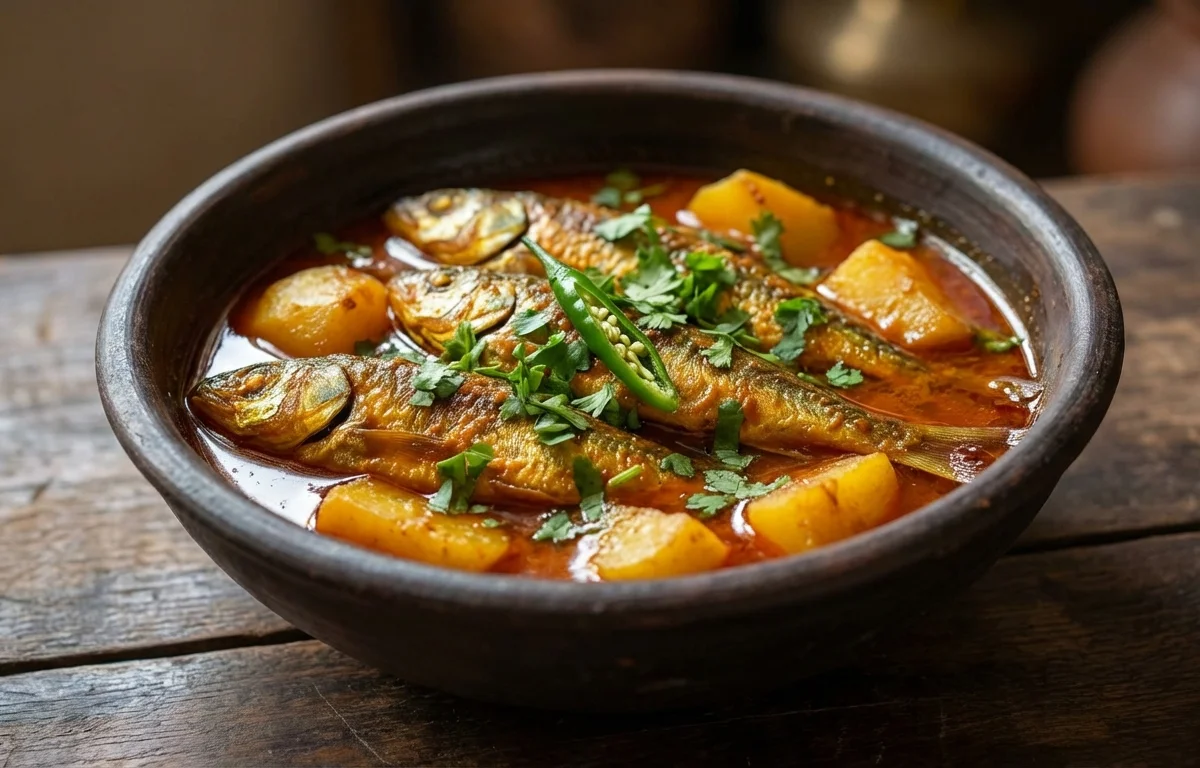
Assamese Small Fish Curry
A light, home-style Assamese curry made with small fish, eggplant, and potato in a gently spiced gravy. Mustard oil and a little turmeric give it its familiar flavor, making it especially good with plain rice.
For 4 servings
- prep · ~7 min
Season the fish and vegetables.
1.Rub the small fish with half the turmeric powder and 1 pinch of salt.2.Cut the potato into wedges and the eggplant into thick wedges.3.Chop the onion and tomato, slit the green chili, and crush the ginger.TIPHandle the fish gently so it stays whole while frying. - fry · ~6 min
Fry the fish lightly.
1.Heat mustard oil in a kadai over medium heat until it just begins to smoke lightly.2.Add the fish in a single layer and fry gently until lightly golden on both sides.3.Remove the fish to a plate without overcooking.TIPA light fry helps the fish hold its shape in the curry. - saute · ~10 min
Cook the vegetables and base.
1.In the same oil, add the potato and eggplant and cook for 3 to 4 minutes.2.Add the onion and sauté until softened.3.Add the ginger, green chili, tomato, remaining turmeric powder, red chili powder, and remaining salt.4.Cook until the tomato turns soft and the mixture looks lightly mashed.TIPKeep the heat medium so the mustard oil stays fragrant and the spices do not burn. - simmer · ~10 min
Simmer the curry.
Pour in the water and bring the curry to a gentle simmer. Cover and cook until the potato is tender and the broth takes on the flavor of the vegetables and spices.
- simmer · ~5 min
Add the fish and finish the curry.
Slide the fried fish into the simmering curry and cook gently for 4 to 5 minutes so the flavors come together. Shake the pan lightly instead of stirring hard.
TIPAvoid vigorous stirring once the fish is in the pan. - garnish
Garnish with cilantro.
- serve
Serve hot with plain rice.
What to keep in mind.
7 tips from the recipe — small details that make a real difference to the final dish.
- 1Heat the mustard oil until it just smokes, then lower the heat; this mellows its raw sharpness without losing the signature Assamese flavor.
- 2Pat the small fish dry before rubbing with turmeric and salt so they fry lightly instead of steaming in the kadai.
- 3Do not crowd the fish while frying; a single layer helps them stay intact and develop a light crust.
- 4Cut the eggplant in thick wedges so it softens in the broth without collapsing before the potatoes are done.
- 5Once the fish goes back into the curry, shake the pan gently rather than stirring with a spoon to avoid breaking the fish.
- 6Keep the gravy light and brothy rather than reducing it too much; this curry is meant to be delicate and served with plain rice.
- 7This curry tastes even better after a short 10 to 15 minute rest, which lets the fish and vegetables settle into the broth.
Adapt it for your goals.
Low-oil
Shallow-fry the fish in less oil and sauté the vegetables with a splash of water as needed for a lighter everyday version.
no onionNo-onion
Skip the onion for a plainer, more delicate broth where mustard oil, ginger, and fish remain the dominant flavors.
spicierSpicier
Add an extra green chili or a slightly larger pinch of red chili powder if you want more heat without changing the basic character.
vegetable forwardVegetable-forward
Increase the potato and eggplant for a heartier rice curry with more broth-soaked vegetables and a milder fish presence.
Why this is on our healthy list.
Protein from Small Fish
Small fish make this curry satisfying and nourishing while providing a wholesome protein base for the meal.
Vegetable-Rich Broth
Potato, eggplant, tomato, onion, chili, and cilantro add plant nutrients and make the curry more balanced than fish alone.
Includes Anti-Inflammatory Spices
Turmeric and ginger bring traditional flavor along with beneficial plant compounds commonly valued in home-style cooking.
Frequently asked questions
Use tender small whole fish that can be lightly fried and simmered without turning mushy. Any local small fish commonly used for jhol-style curries will work.