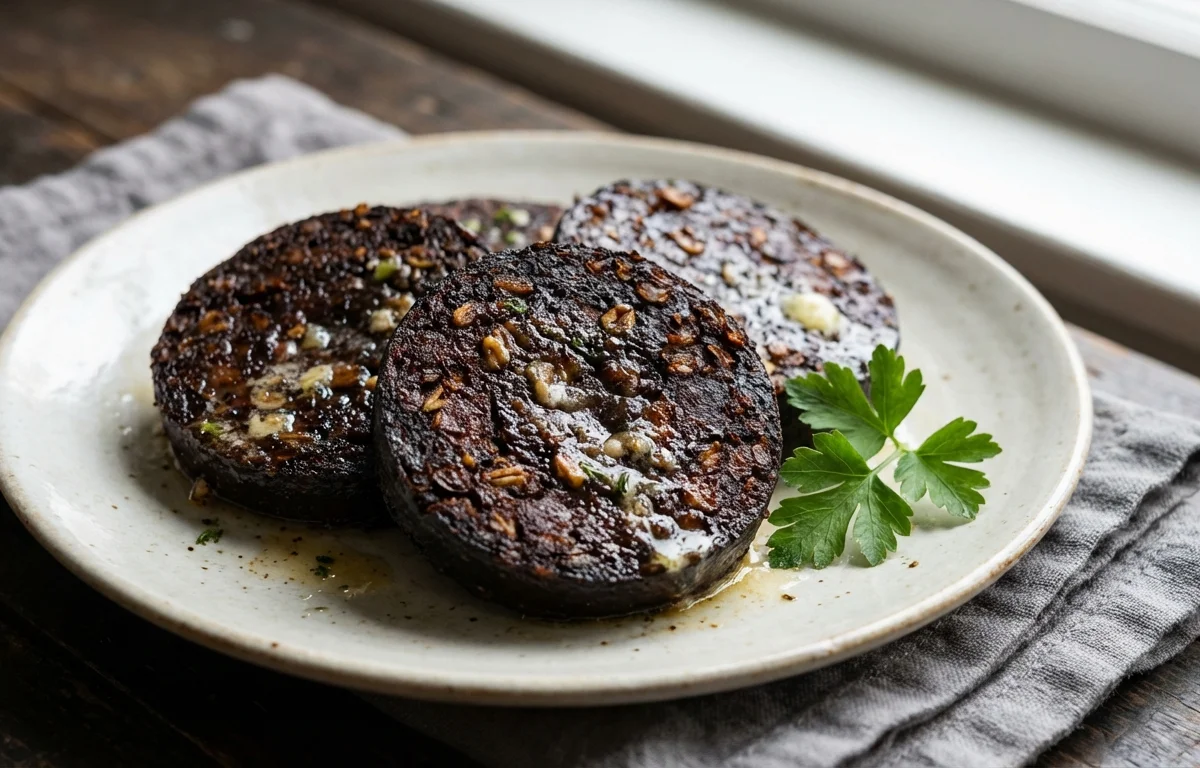
Black Pudding
A richly savory blood sausage with a deep, earthy flavor, made with pork blood, oatmeal, and pork fat. This traditional Irish and British classic is sliced and pan-fried until crisp on the outside and tender within, perfect for a full breakfast or as a hearty side.
For 4 servings
- prep · ~15 min
Prepare the oatmeal and casings.
1.Toast the steel-cut oats in a dry pan over medium heat until lightly golden and fragrant, about 5 minutes.2.Transfer the toasted oats to a bowl, pour in the milk, and let soak for 15 minutes.3.Soak the natural hog casings in warm water for 30 minutes, then rinse thoroughly inside and out. - saute · ~7 min
Cook the onion and pork fat.
1.Heat a skillet over medium heat, add the diced pork fat cubes, and cook gently until they render some fat and become translucent.2.Add the chopped onion to the rendered fat and sauté until soft and lightly golden, about 5 to 7 minutes.3.Remove from heat and let cool slightly.TIPDon't crisp the fat — it should stay soft to create a tender texture in the finished pudding. - mix · ~5 min
Combine the pudding mixture.
1.In a large bowl, combine the soaked oatmeal, sautéed onion and pork fat, and all the rendered fat from the pan.2.Season with salt, black pepper, and allspice, then stir everything together well.3.Slowly pour in the strained pork blood while stirring continuously until the mixture is uniform and well combined. - assemble · ~10 min
Stuff the sausages.
1.Thread one end of a prepared hog casing onto the sausage stuffer, tying a knot at the far end.2.Fill the casing with the black pudding mixture, taking care not to overfill — leave a little room for expansion.3.Tie the open end securely, then gently prick any visible air pockets with a clean needle.TIPKeep the mixture warm if possible — it flows better and prevents the fat from solidifying. - simmer · ~35 min
Poach the black pudding.
1.Bring a large stockpot of water to a very gentle simmer — tiny bubbles, not a rolling boil.2.Carefully place the stuffed pudding into the water and poach for 30 to 35 minutes.3.The pudding is cooked when it feels firm to the touch and a needle inserted comes out clean.TIPNever boil black pudding — rapid bubbles will burst the casings. Keep the water just barely trembling. - rest · ~120 min
Cool and rest the pudding.
1.Remove the poached pudding from the water and lay it flat on a tray to cool for 15 minutes.2.Transfer to the refrigerator to chill completely, at least 2 hours or overnight to firm up. - fry · ~8 min
Slice and fry the black pudding.
1.Remove the chilled pudding from the fridge and slice into rounds about half an inch thick.2.Heat oil in a non-stick skillet over medium heat and fry the slices for 3 to 4 minutes per side.3.Cook until each side is deeply browned and slightly crisp on the edges.TIPDon't crowd the pan — fry in batches to get a proper crust on each slice. - serve
Serve hot as part of a full breakfast or a savory side.
What to keep in mind.
8 tips from the recipe — small details that make a real difference to the final dish.
- 1Toast the steel-cut oats until fragrant to deepen their nutty flavor and improve texture.
- 2Keep the pork fat cubes soft during rendering — crispy fat creates a gritty, tough pudding.
- 3Strain the pork blood through a fine sieve to remove clots for a silky, smooth mixture.
- 4Keep the stuffing mixture warm so the fat stays liquid and flows easily through the stuffer.
- 5Prick air pockets in the stuffed casing with a needle to prevent bursting during poaching.
- 6Poach at a bare simmer — never boil — or the casings will split and the filling will leak.
- 7Chill the poached pudding overnight for clean, neat slices that hold their shape when fried.
- 8Fry slices in a single layer without crowding to achieve a deep, crisp crust on both sides.
Adapt it for your goals.
Gluten-free
Replace steel-cut oats with certified gluten-free oats or cooked quinoa for a celiac-friendly version that still holds together beautifully.
herb infusedHerb-infused
Stir in 1 tablespoon of fresh chopped thyme or sage with the onion and fat to add an aromatic, earthy layer that complements the blood's richness.
spicierSpicier
Add 1/2 teaspoon of cayenne pepper or 1 finely chopped red chili to the mixture for a warming kick that cuts through the savory fat.
lower fatLower-fat
Reduce pork fat to 100g and replace half with finely chopped mushrooms cooked in a little oil — lowers saturated fat while keeping moisture and umami.
Why this is on our healthy list.
Rich in Iron
Pork blood is a concentrated source of heme iron, which is highly absorbable and helps prevent anemia and support healthy blood oxygen levels.
Good Source of Protein
The combination of pork blood, pork fat, and oats provides a complete protein profile that supports muscle maintenance and satiety.
Contains Dietary Fiber
Steel-cut oats offer resistant starch and soluble fiber, which aid digestion and help maintain stable blood sugar levels after eating.
Provides B Vitamins
Pork blood is rich in B vitamins like B12 and folate, essential for energy metabolism and nervous system function.
Frequently asked questions
Yes, you can use refrigerated or frozen pork blood sold at Asian or specialty markets — just be sure it's pure blood with no added coagulants.