
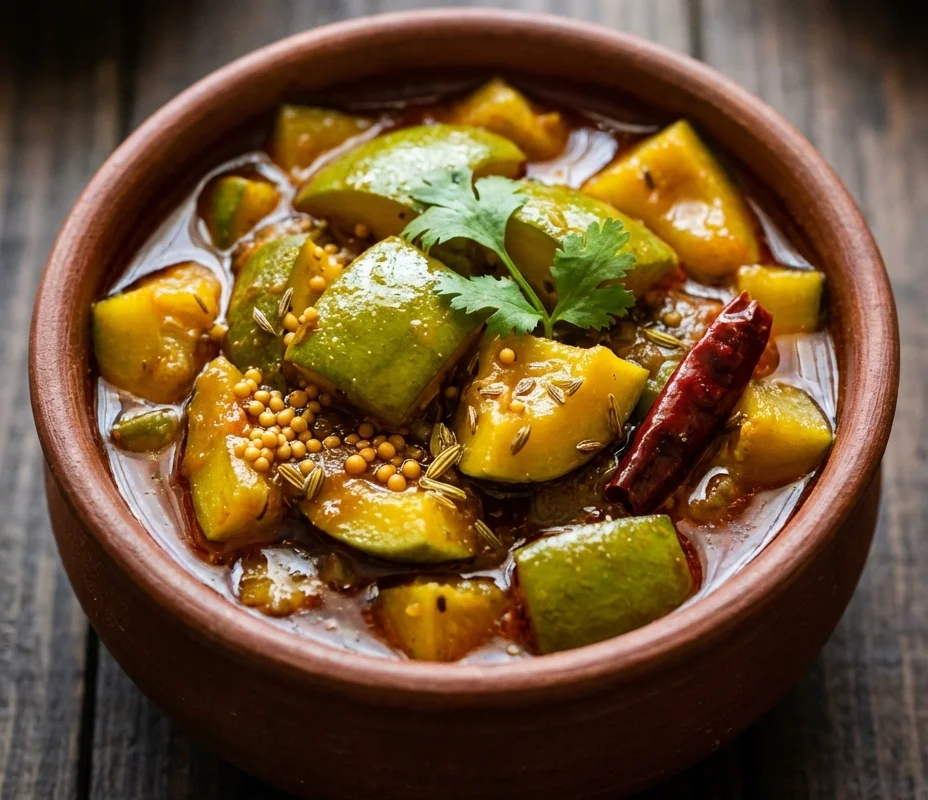
Kairi ki Sabzi
A tangy, sweet-spiced raw mango stir-fry from Rajasthan that celebrates the king of summer fruits in its greenest form. Thin strips of kairi are slow-cooked with jaggery and a handful of warming spices until tender and glossy — the kind of simple homestyle dish that instantly perks up a dal-chawal meal.
For 4 servings
- prep
Prep the raw mangoes.
1.Wash and peel the raw mangoes with a sharp peeler.2.Cut flesh away from the pit and slice into thin, 2-inch long strips.3.Set aside in a bowl.TIPChoose firm, fully green mangoes — semi-ripe ones release too much water and turn mushy. - temper · ~2 min
Make the tempering.
1.Heat oil in a heavy-bottomed kadhai over medium heat.2.Add cumin seeds and let them splutter (30 seconds).3.Add fennel seeds, fenugreek seeds, and asafoetida. Sauté until fragrant (15 seconds).TIPDon't let fenugreek seeds turn dark — they turn bitter fast. Pull the pan off briefly if needed. - saute · ~3 min
Add spices and mango strips.
1.Lower the heat and immediately add turmeric powder, red chili powder, and coriander powder. Stir for 10 seconds to bloom the spices.2.Add the mango strips and salt. Toss everything to coat the mango well with the spice mix.3.Sauté for 2 minutes until the mango edges just start to soften. - simmer · ~12 min
Cook with jaggery until tender.
1.Sprinkle the grated jaggery over the mango and add water.2.Stir, cover with a lid, and cook on low heat for 10-12 minutes.3.Check halfway — stir gently to prevent sticking. Add a teaspoon of water if too dry.4.Cook until the mango strips are tender and the jaggery forms a light glaze.TIPThe sabzi should be glossy and just moist, not swimming in liquid. If there's excess water, uncover and cook off for 1-2 minutes. - garnish
Finish and serve.
Taste and adjust salt or jaggery if needed. Transfer to a serving bowl, garnish with chopped coriander leaves, and serve warm.
What to keep in mind.
7 tips from the recipe — small details that make a real difference to the final dish.
- 1Choose firm, fully green raw mangoes with no give — semi-ripe mangoes turn mushy and make the sabzi watery.
- 2Grate the jaggery finely so it melts quickly and evenly coats the mango strips during slow cooking.
- 3Don't skip the fenugreek seeds — a pinch adds a subtle bitterness that balances the sweet jaggery and sour mango.
- 4Cook covered on the lowest possible heat to let the mango strips soften in their own steam without burning.
- 5If the sabzi looks dry before the mango is tender, add 1–2 teaspoons of water; if it's too wet, remove the lid and cook on high for a minute.
- 6Let the sabzi rest for 5 minutes after cooking — the flavors deepen and the glaze thickens slightly.
- 7Serve this sabzi at room temperature or warm; it tastes even better the next day as the spices meld.
Adapt it for your goals.
No-jaggery (low-sugar)
Skip the jaggery and finish with a pinch of sugar (or omit entirely) for a purely sour-spicy sabzi. This works well for those watching sugar intake or pairing with a sweet dal.
with peanutsWith peanuts
Add 2 tablespoons of crushed roasted peanuts along with the spices for a nutty crunch and extra texture. Popular in some Rajasthani homes for a more substantial side.
green chili heatGreen chili heat
Slit 2 green chilies and add them with the mango strips for a fresh, sharp heat that complements the sour mango. Skip the red chili powder if you prefer milder spice.
sweet sour (Gujarati style)Sweet-sour (Gujarati-style)
Add 1/2 teaspoon of mustard seeds in the tempering and increase the jaggery to 1.5 tablespoons. This gives a more pronounced sweet-and-sour balance similar to Gujarati kadhi.
Why this is on our healthy list.
Rich in Vitamin C
Raw mangoes are an excellent source of vitamin C, which supports immune function and collagen production. This dish retains much of it since the mangoes are cooked for a short time.
Digestive Aid from Spices
Fennel seeds, fenugreek seeds, and asafoetida are traditional digestive aids — they help reduce bloating and stimulate appetite, making this sabzi a perfect side for heavy grain-based meals.
Low in Fat
With only 2 tablespoons of oil for the entire dish, this is a light preparation compared to many Indian sabzis. The jaggery provides natural sweetness without refined sugar.
Iron with Absorption Boost
Jaggery contains trace amounts of iron, and the vitamin C in raw mango enhances non-heme iron absorption, making this a smart pairing with iron-rich foods like lentils.
Frequently asked questions
Yes, but thaw them completely and pat dry before cooking. Frozen mango releases more water, so you may need to cook uncovered for a couple of extra minutes to achieve the right glaze.



.webp)
.webp)
.webp)