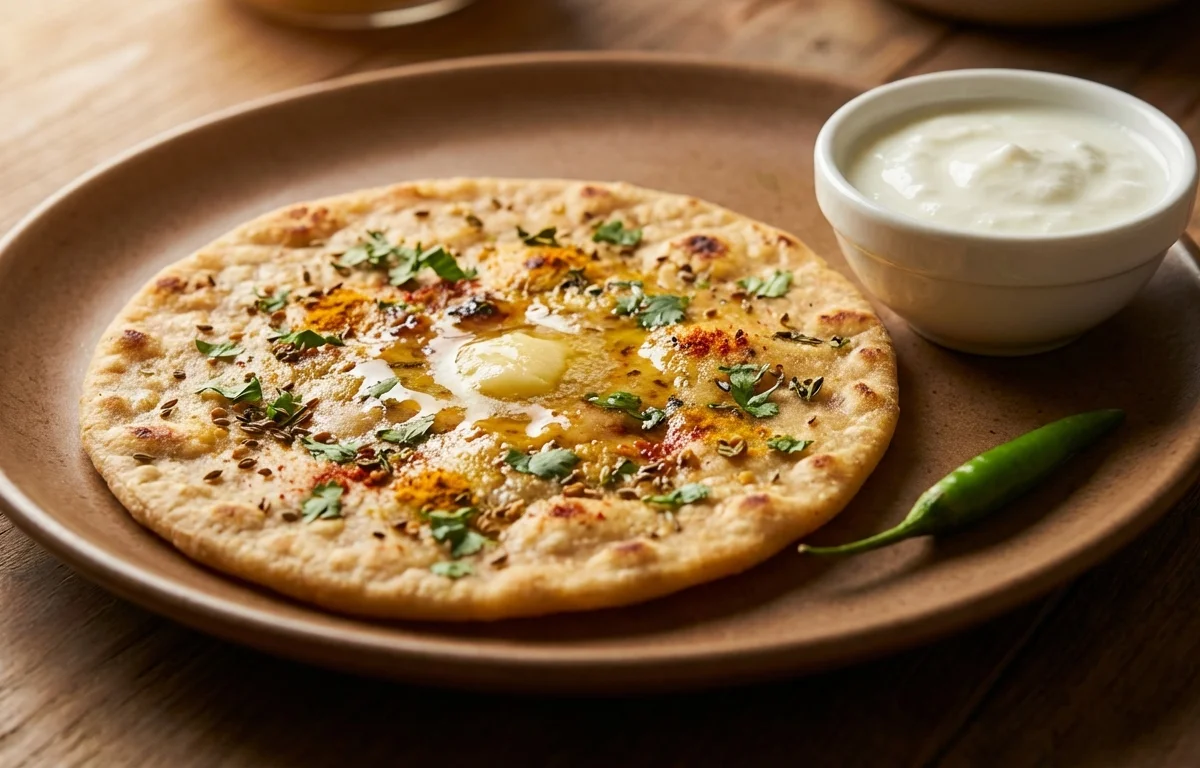
Masala Roti
This everyday Indian flatbread gets extra flavor from onions, green chili, coriander leaves, and warm spices mixed right into the dough. Soft in the center with little toasted spots, it pairs beautifully with yogurt, pickle, or a simple sabzi.
For 8 servings
- prep · ~5 min
Prepare the masala mix.
1.Finely chop the onion, green chili, and coriander leaves.2.Measure the cumin seeds, red chili powder, turmeric powder, coriander powder, garam masala, and salt.3.Keep the water, oil, and extra flour for dusting ready. - knead · ~7 min
Knead the dough.
1.Add whole wheat flour, chopped onion, green chili, coriander leaves, cumin seeds, red chili powder, turmeric powder, coriander powder, garam masala, and salt to a wide bowl.2.Mix well so the onion and spices are evenly spread through the flour.3.Add oil and rub it in lightly.4.Pour in water little by little and knead to a soft, smooth dough.TIPIf the onion releases extra moisture, hold back some water so the dough does not turn sticky. - rest · ~10 min
Cover and rest the dough.
Cover the dough and let it rest for 10 minutes. This helps the flour hydrate and makes the rotis easier to roll.
- prep · ~3 min
Divide and shape the dough.
1.Knead the rested dough briefly until smooth.2.Divide it into 8 equal portions.3.Roll each portion into a smooth ball. - other · ~5 min
Roll the rotis.
1.Dust one dough ball lightly with whole wheat flour.2.Roll it into a thin round roti, about 5 to 6 inches wide.3.Repeat with the remaining dough balls, using a little flour as needed.TIPRoll gently and evenly so the onion pieces stay inside the dough and the roti cooks uniformly. - fry · ~12 min
Cook the masala rotis.
1.Heat a tawa or flat pan over medium heat.2.Place one rolled roti on the hot tawa and cook until small bubbles appear (30 to 40 seconds).3.Flip and cook the second side until light golden spots appear.4.Brush a little ghee on both sides and cook, pressing lightly, until the roti has brown toasted spots and is fully cooked.5.Repeat with the remaining rotis.TIPKeep the heat at medium so the rotis cook through before the onion bits start to scorch. - serve
Serve hot.
What to keep in mind.
7 tips from the recipe — small details that make a real difference to the final dish.
- 1Chop the onion very fine; larger pieces tear the dough and make rolling uneven.
- 2After mixing in the onion, wait a minute before adding all the water since the onion releases moisture.
- 3If the dough feels sticky, dust lightly with flour rather than kneading in too much extra flour.
- 4Roll with a gentle hand so the chili and onion stay embedded and do not poke through.
- 5Cook on medium heat only; high heat can burn the onion bits before the roti cooks through.
- 6Stack cooked rotis in a cloth-lined container to keep them soft and stop them from drying out.
- 7For lunchboxes, half-cook the rotis first, cool, then finish with ghee just before serving.
Adapt it for your goals.
Low-oil
Skip the ghee on the tawa and dry-roast the rotis, then brush very lightly after cooking if needed.
jainJain
Omit onion and use finely chopped cabbage or grated bottle gourd with adjusted water for a similar textured masala roti.
spicierSpicier
Add extra green chili and a little more red chili powder if you want a sharper, hotter everyday roti.
ajwain flavoredAjwain-flavored
Replace part of the cumin with ajwain for a more robust, dhaba-style flavor that pairs well with yogurt and pickle.
Why this is on our healthy list.
Whole Grain Goodness
Made primarily with whole wheat flour, this roti offers more fiber and a steadier, more filling base than refined flatbreads.
Herb and Spice Rich
Coriander leaves, cumin, turmeric, and coriander powder add flavor depth along with plant compounds from everyday Indian spices.
Moderate, Satisfying Meal Base
Because the dough is flavored directly with onion, chili, and spices, the rotis feel satisfying even with a simple side like curd or sabzi.
Frequently asked questions
The chopped onion releases water into the dough. Add water gradually and dust with a little flour if needed rather than overwatering at the start.



.webp)