New York Cheesecake
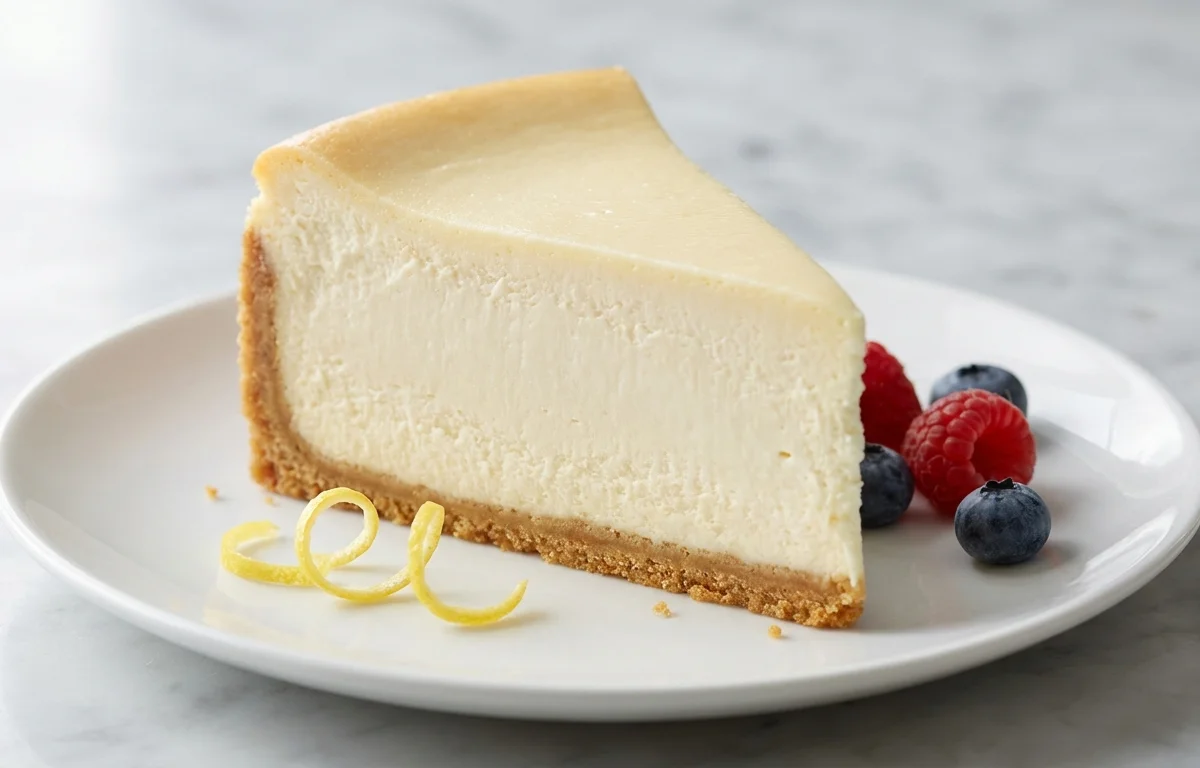
Tall, dense, and impossibly creamy, this New York Cheesecake is the gold standard of baked cheesecakes. A buttery graham cracker crust supports a rich, tangy cream cheese filling that's baked low and slow in a water bath for that signature silky-smooth texture. Topped with nothing more than a whisper of sour cream glaze, it's pure, unadulterated perfection in every slice.
For 12 servings
- prep
Bring all cold ingredients to room temperature.
Set out the cream cheese, sour cream, eggs, and egg yolks. Let them come to room temperature, about 2 hours. Cold ingredients cause lumps and overbeating.
TIPCut the cream cheese into small cubes to speed up tempering. Properly tempered ingredients are the #1 secret to lump-free cheesecake. - prep
Prepare the springform pan and preheat oven.
1.Position oven rack to the lower-middle position. Preheat to 350°F (175°C).2.Wrap the outside bottom and sides of a 9-inch springform pan with two layers of heavy-duty aluminum foil to prevent water leakage.3.Lightly butter the inside bottom and sides of the pan. - mix · ~10 min
Make the graham cracker crust.
1.Combine graham cracker crumbs, 50 g sugar, and melted butter in a mixing bowl.2.Stir with a fork until the mixture resembles wet sand and holds together when pressed.3.Transfer to the prepared springform pan and press firmly into an even layer on the bottom and about 1 inch up the sides.4.Bake at 350°F for 10 minutes until fragrant and slightly darkened. Remove and let cool on a wire rack. Reduce oven temperature to 325°F (160°C).TIPUse the flat bottom of a glass or measuring cup to compress the crumbs into a dense, even crust that won't crumble when sliced. - mix · ~4 min
Beat the cream cheese until perfectly smooth.
1.In the bowl of a stand mixer fitted with the paddle attachment, beat the cream cheese on medium-low speed until completely smooth and no lumps remain, about 4 minutes.2.Scrape down the bowl and paddle thoroughly with a silicone spatula.TIPKeep the speed on medium-low. High-speed beating whips air into the batter, which causes the cheesecake to rise and then crack. - mix · ~2 min
Incorporate sugar and salt.
1.Add the remaining 150 g sugar and salt to the cream cheese.2.Beat on medium-low speed until fully combined and the mixture feels silky, about 2 minutes.3.Scrape the bowl and paddle again. - mix · ~1 min
Blend in sour cream, cream, lemon juice, and vanilla.
1.Add 115 g of the sour cream, heavy cream, lemon juice, and vanilla extract.2.Mix on low speed until just combined and uniform, about 1 minute.3.Scrape the bowl thoroughly. - mix · ~5 min
Add eggs one at a time.
1.With the mixer on low speed, add the whole eggs one at a time, letting each incorporate fully before adding the next.2.Add the 2 egg yolks and mix just until the yellow streaks disappear.3.Remove the bowl from the mixer and give the batter a few gentle folds by hand with a spatula, scraping the bottom to catch any unmixed cream cheese.TIPThe moment the egg yolks disappear into the batter, stop mixing. Overmixed eggs fill the batter with air bubbles that cause cracks. - assemble · ~5 min
Pour batter over the crust and prepare the water bath.
1.Pour the filling over the cooled crust and spread into an even layer with a spatula.2.Tap the pan firmly against the counter 3 to 5 times to release any trapped air bubbles.3.Place the foil-wrapped springform pan inside the large roasting pan.4.Place the roasting pan on the oven rack and carefully pour boiling water into the roasting pan until it reaches about halfway up the sides of the springform pan.TIPMake absolutely sure no water seeps through the foil layers. A leaky water bath makes a soggy crust. - bake · ~70 min
Bake the cheesecake.
Bake at 325°F for 60 to 70 minutes. The cheesecake is done when the edges are set and puffed but a 2- to 3-inch circle in the center still wobbles like set gelatin when the pan is gently shaken. An instant-read thermometer inserted 1 inch from the edge should register 150°F (65°C).
TIPDo not open the oven door for the first 45 minutes. A sudden drop in temperature is the fastest way to cause a collapsed center. - bake · ~60 min
Cool the cheesecake slowly in the turned-off oven.
1.Turn off the oven and crack the door open about 2 inches.2.Let the cheesecake cool inside the oven for 1 hour.3.Remove from the oven and carefully lift the springform pan from the water bath. Discard the foil and set the pan on a wire rack.TIPA slow, gradual cooldown prevents the top from cracking as the cake settles. - mix · ~5 min
Apply the sour cream topping.
1.In a small bowl, whisk together the remaining 115 g sour cream and 1 tbsp sugar.2.Spread the topping in a thin, even layer over the top of the warm cheesecake.3.Return to the turned-off oven for 5 minutes to set the glaze. - rest · ~480 min
Chill overnight before serving.
Let the cheesecake cool to room temperature on the wire rack, about 1 hour. Cover loosely with plastic wrap and refrigerate for at least 8 hours, preferably overnight. The texture becomes dense, velvety, and sliceable only after a long, cold rest.
TIPTo slice cleanly, dip a long, thin knife in hot water and wipe it dry between every cut. Cold cheesecake + hot knife = bakery-perfect slices.
What to keep in mind.
8 tips from the recipe — small details that make a real difference to the final dish.
- 1Room-temperature ingredients are non-negotiable—cold cream cheese creates a lumpy batter.
- 2Mix on medium-low speed only; high speed whips in air that causes cracks.
- 3Stop mixing eggs as soon as they disappear—overmixing aerates the batter and leads to cracking.
- 4Use a glass to press the crust firmly into the pan for a dense, even base that won't crumble.
- 5Double-wrap the springform pan with heavy-duty foil to keep the water bath from soaking the crust.
- 6Do not open the oven door during the first 45 minutes of baking; thermal shock causes collapse.
- 7Cool the cheesecake in the turned-off oven with the door cracked to prevent a cracked top.
- 8Chill for at least 8 hours (overnight is best) to achieve that dense, velvety, sliceable texture.
Adapt it for your goals.
Low-oil
Substitute the graham cracker crust with a crust made from crushed digestive biscuits and 40 g melted butter to reduce saturated fat while keeping a similar crunch.
veganVegan
Use 900 g vegan cream cheese (e.g., based on cashews or tofu), 230 g coconut cream for sour cream, 7 tbsp flax eggs (7 tbsp water + 2 tbsp ground flaxseed per egg), and a nut-based crust to create a dairy-free, egg-free cheesecake that still bakes beautifully.
jainJain
For Jain-friendly version, omit the onions and garlic from any savory variations; here, replace the lemon juice with an equal amount of pomegranate juice for acidity, and use a nut-based crust with jaggery instead of sugar to avoid root vegetables and certain sweeteners.
high proteinHigh-protein
Replace 200 g of cream cheese with 200 g of plain Greek yogurt (strained overnight) to boost protein content while maintaining a creamy texture—the extra tang complements the sour cream glaze.
ketoKeto
Swap the graham cracker crust with a crust made from 200 g almond flour, 50 g melted butter, and 50 g erythritol; replace the sugar in the filling with 200 g granulated erythritol to create a low-carb cheesecake with minimal net carbs.
Why this is on our healthy list.
Rich in Calcium from Cream Cheese
The cream cheese and sour cream provide a significant amount of calcium, which is essential for strong bones and teeth.
Source of Protein from Eggs
Five whole eggs and two egg yolks add high-quality protein that supports muscle repair and satiety.
Moderate Vitamin A Content
Full-fat dairy and eggs contribute vitamin A, important for immune function and eye health.
Low Carbohydrate Base (No Flour)
Unlike many desserts made with flour, this cheesecake has a custard-like filling that is naturally low in carbs when the crust is adjusted.
Contains Healthy Fats
The butter and cream cheese provide fats that help absorb fat-soluble vitamins and keep you feeling full longer.
Frequently asked questions
Cracks usually happen from overmixing (adding too much air), overbaking, or sudden temperature changes. To avoid them, mix on low speed, stop at the jiggle stage (150°F at the edge), and cool slowly in the turned-off oven.