
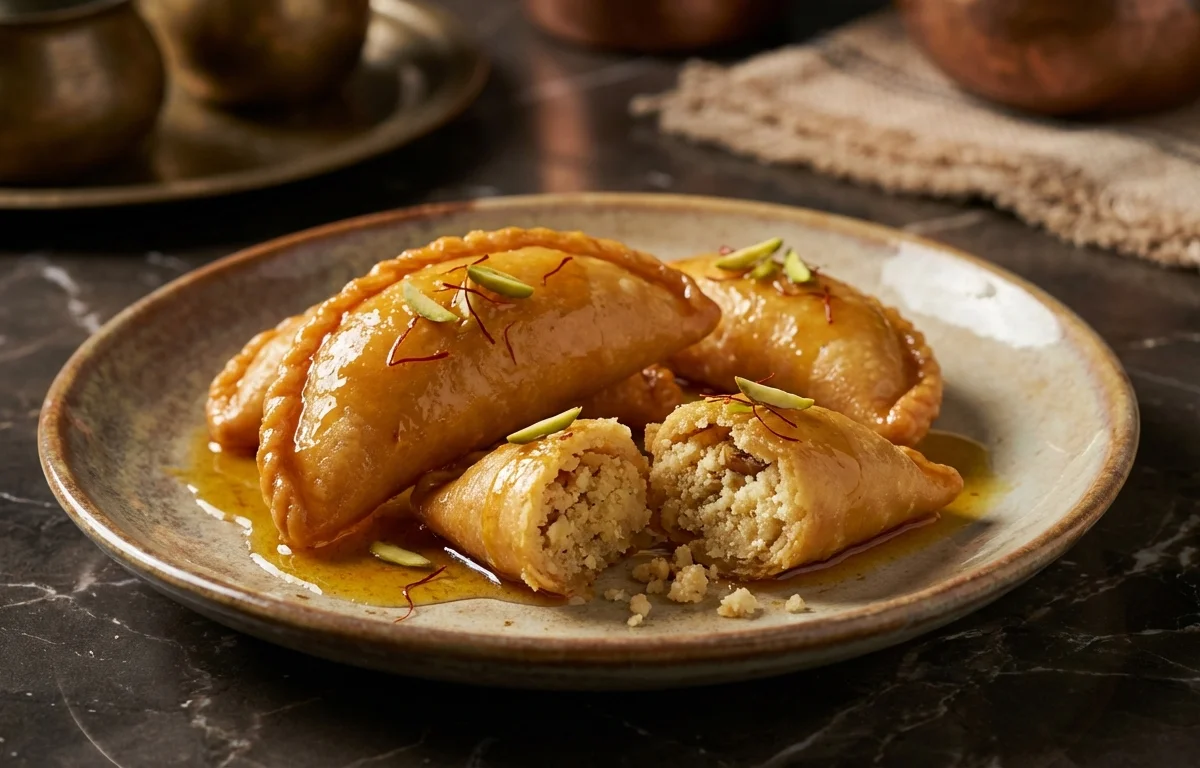
Sindhi Praghree
A treasured Sindhi festive delicacy, Praghree is a multi-layered, flaky pastry filled with sweet, cardamom-scented khoya and nuts. Each piece is meticulously folded, deep-fried to a perfect golden crisp, and then dipped in a fragrant sugar syrup, creating an irresistibly rich and crunchy treat.
For 6 servings
Prepare the Dough (35 minutes)
- In a large mixing bowl, combine 2 cups of maida and 0.25 tsp of salt.
- Add 0.25 cup of melted ghee. Rub the ghee into the flour with your fingertips until the mixture resembles coarse breadcrumbs. This process, called 'moyan', is crucial for a flaky texture.
- Gradually add lukewarm water and knead to form a firm, smooth dough. It should be stiffer than chapati dough.
- Cover the dough with a damp cloth and let it rest for at least 30 minutes.
Prepare the Khoya Filling (10 minutes)
- In a non-stick pan over low heat, gently roast the crumbled khoya for 2-3 minutes until it becomes aromatic and slightly loosens up. Be careful not to brown it.
- Transfer the khoya to a bowl and allow it to cool completely to room temperature.
- Once cooled, add the powdered sugar, chopped almonds, chopped pistachios, and cardamom powder. Mix everything together until well combined.
Create the Layering Paste 'Satha' (2 minutes)
- In a small bowl, whisk together 3 tbsp of ghee and 3 tbsp of maida until you have a smooth, creamy paste. This paste will create the distinct layers in the pastry.
Roll and Layer the Dough (15 minutes)
- After resting, knead the dough for one minute. Divide it into two equal portions.
- Take one portion and roll it out on a clean, large surface into a very thin rectangle, as thin as you can manage without tearing.
- Spread half of the prepared 'satha' paste evenly over the entire surface of the rolled dough.
- Starting from one of the longer sides, roll the sheet up tightly into a firm log.
- Using a sharp knife, cut the log into 1-inch thick slices. You will see a beautiful swirl of layers in each slice.
- Repeat the process with the second portion of dough and the remaining 'satha'.
Shape the Praghree (15 minutes)
- Take one slice of the log and place it cut-side down on your work surface. Gently press it flat with your palm.
- Carefully roll it into a small circle or oval, about 3-4 inches in diameter, ensuring the layers remain visible.
- Place about 1 tablespoon of the khoya filling in the center of the rolled disc.
- Fold the disc in half to form a semi-circle (like a gujiya). Press the edges firmly to seal completely. You can use a fork to crimp the edges for a decorative seal.
- Repeat with all the remaining slices and filling.
Deep Fry the Praghree (25 minutes)
- Heat 3 cups of ghee in a deep kadai or pan over low heat. The ghee should be just warm, not hot. To test, drop a tiny piece of dough; it should sink and then rise slowly with gentle bubbles.
- Carefully slide 3-4 praghris into the ghee, ensuring not to overcrowd the pan.
- Fry on a consistently low flame for 12-15 minutes, turning them occasionally. This slow frying process is key to cooking the inner layers and achieving a perfect crispness.
- Once they are golden brown and crisp on all sides, remove them with a slotted spoon and place them on a wire rack to drain excess ghee.
Prepare the Sugar Syrup (10 minutes)
- While the praghris are frying, prepare the syrup. In a saucepan, combine 1 cup of granulated sugar and 0.5 cup of water.
- Bring the mixture to a boil, then reduce the heat and simmer for 5-7 minutes until it reaches a one-string consistency. To check, cool a drop slightly and press it between your thumb and forefinger; a single thread should form when you pull them apart.
- Stir in the lemon juice (to prevent crystallization) and optional saffron strands. Turn off the heat.
Glaze and Garnish (8 minutes)
- Ensure both the fried praghris and the sugar syrup are warm (not hot).
- Dip each praghree into the warm syrup for about 30-60 seconds, using a spoon to coat it evenly.
- Remove the glazed praghree and place it back on the wire rack to let any excess syrup drip off.
- Immediately garnish with extra chopped pistachios.
- Allow the praghris to cool completely. The sugar glaze will set as they cool. Store in an airtight container.
What to keep in mind.
6 tips from the recipe — small details that make a real difference to the final dish.
- 1The most critical step is frying on very low heat. Rushing this will result in a cooked exterior but raw and soft inner layers.
- 2Ensure your dough is firm. A soft dough will absorb too much ghee during frying and won't become as flaky.
- 3Seal the edges of the pastry very tightly to prevent the sweet filling from leaking out into the ghee.
- 4The one-string consistency of the sugar syrup is essential. If it's too thin, the praghree will become soggy; if too thick, it will crystallize into a hard crust.
- 5Do not overfill the praghris, as this can cause them to burst open while frying.
- 6Let the khoya filling cool completely before using it. A warm filling can make the pastry difficult to seal and can cause it to tear.
Adapt it for your goals.
Filling Variation
Add 2 tablespoons of desiccated coconut or a few drops of rose essence to the khoya filling for a different flavor profile.
Syrup FlavorSyrup Flavor
Instead of saffron, flavor the sugar syrup with 1 teaspoon of rose water or kewra water for a floral aroma. Add it after turning off the heat.
Shape VariationShape Variation
Instead of a semi-circle, you can fold the praghree into a rectangular parcel or a triangular shape for a different presentation.
Why this is on our healthy list.
Instant Energy Source
The combination of carbohydrates from flour and sugar, along with fats from ghee and khoya, provides a quick and substantial source of energy, making it a traditional treat during festive periods.
Rich in Healthy Fats and Protein
Almonds and pistachios are excellent sources of monounsaturated fats, protein, and fiber. Ghee provides fat-soluble vitamins like A, E, and D.
Source of Calcium
Khoya, being a concentrated milk product, is a good source of calcium, which is essential for bone health.
Frequently asked questions
Praghree is a traditional Sindhi sweet pastry. It's known for its many flaky layers, a rich filling of khoya (milk solids) and nuts, and a sweet sugar glaze. It is typically made during festivals like Holi and Diwali.


