
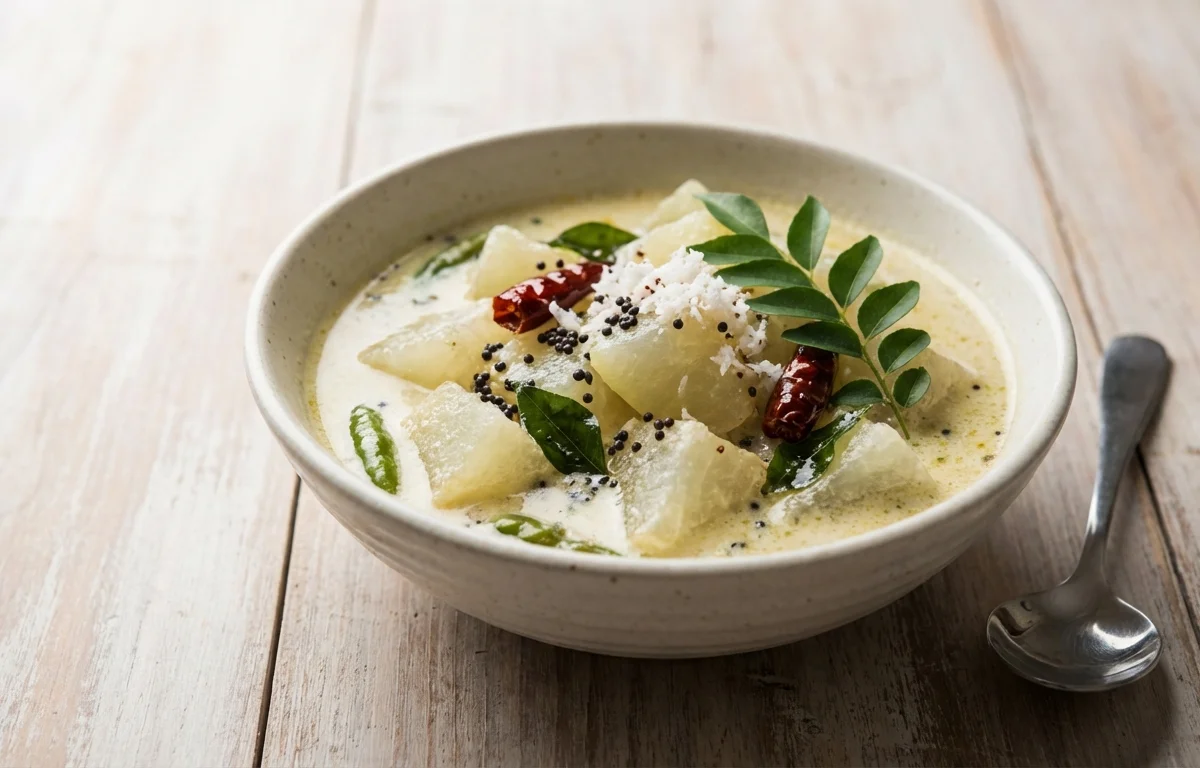
Velli Ambat
A delicate, mildly spiced coconut milk curry from the Konkan coast. Tender seasonal vegetables and lentils swim in a silky, slightly tangy coconut gravy finished with a fragrant tempering of curry leaves and mustard seeds. Light yet deeply comforting, it pairs perfectly with steamed rice.
For 4 servings
- pressure cook · ~15 min
Pressure cook the toor dal.
Wash the toor dal and add it to a pressure cooker with 1 cup water. Cook for 3 whistles until soft. Let the pressure release naturally. Mash lightly and set aside.
- boil · ~10 min
Cook the vegetables.
In a deep pan, add the diced white pumpkin and potato cubes with 1 cup water. Bring to a boil and cook until fork-tender, about 10 minutes.
- prep · ~5 min
Prepare fresh coconut milk.
Grind the grated coconut with 0.5 cup warm water in a blender until smooth. Strain through a muslin cloth to extract thick coconut milk. Set the milk aside. Add another 0.5 cup warm water to the residual coconut, blend again, and strain to get thin coconut milk.
- simmer · ~5 min
Simmer the curry base.
Pour the thin coconut milk into the pan with the cooked vegetables. Add slit green chilies, tamarind pulp, salt, and the mashed toor dal. Stir well and bring to a gentle simmer. Cook for 5 minutes.
- simmer · ~2 min
Add the thick coconut milk.
Lower the heat completely. Pour in the thick coconut milk and stir gently. Warm through for 2 minutes. Do not let it boil or the coconut milk may split.
TIPAlways add thick coconut milk at the end on low heat to keep the gravy silky and prevent curdling. - temper · ~2 min
Temper the mustard seeds and curry leaves.
1.Heat coconut oil in a small tempering pan over medium heat.2.Add mustard seeds and let them splutter completely (30 sec).3.Add dried red chilies and curry leaves. Fry until fragrant and crisp (20 sec). - garnish · ~1 min
Pour the tempering over the curry and serve.
Immediately pour the sizzling tempering over the hot Velli Ambat. Mix gently. Serve hot with steamed rice.
What to keep in mind.
6 tips from the recipe — small details that make a real difference to the final dish.
- 1Use fresh grated coconut for the best flavor and silky texture.
- 2Do not let the thick coconut milk boil or it will curdle and split.
- 3Mash the cooked toor dal well so it blends seamlessly into the curry.
- 4Add salt only after the thin coconut milk is in to avoid curdling.
- 5For a richer taste, roast the grated coconut lightly before grinding.
- 6Use a muslin cloth or fine strainer for smooth coconut milk extraction.
Adapt it for your goals.
Vegan
This dish is already vegan, as it uses no dairy or animal products. For a nut-free version, substitute the coconut with a mixture of raw peanuts and water, ground and strained similarly.
Low OilLow-Oil
Skip the tempering step entirely and instead stir in mustard seeds, curry leaves, and dried red chili directly into the simmering curry for the same aromatic effect with zero added oil.
High ProteinHigh-Protein
Add a handful of cooked chickpeas or sliced paneer (if not vegan) along with the thin coconut milk for a protein boost without altering the delicate flavor profile.
Seasonal VegetableSeasonal Vegetable
Swap white pumpkin and potato with equal parts bottle gourd, chayote, or raw banana for a variation that stays true to the Konkan spirit and uses what's in season.
Why this is on our healthy list.
Rich in Plant Protein
Toor dal (split pigeon peas) provides plant-based protein and dietary fiber, supporting satiety and digestive health.
Low in Fat
With only a small amount of coconut oil for tempering, this curry is naturally low in fat while using coconut milk for creaminess.
Good Source of Potassium
White pumpkin and potatoes contribute potassium, which supports healthy blood pressure and muscle function.
Digestive Support
Tamarind and curry leaves aid digestion, traditionally used in Konkan cuisine to balance the lightness of the dish.
Frequently asked questions
Yes, use 1/2 cup thick canned coconut milk and 3/4 cup thin (diluted with water). Do not let it boil to avoid splitting.



.webp)
.webp)