
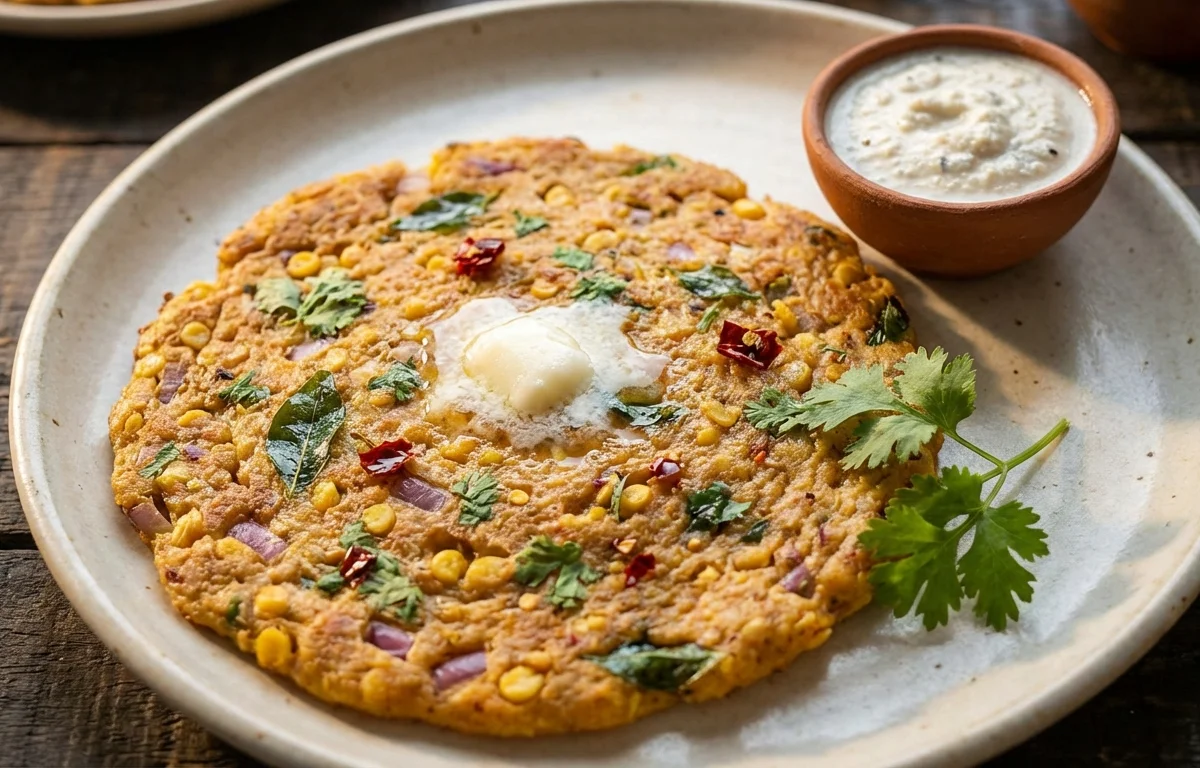
Adai
Hearty South Indian lentil crepes with a rustic texture, gentle heat, and lots of flavor from curry leaves and dried red chilies. They cook up crisp at the edges, soft in the middle, and pair wonderfully with chutney or avial.
For 8 servings
- prep · ~180 min
Soak the rice and lentils.
1.Wash the parboiled rice, chana dal, toor dal, urad dal, and moong dal well.2.Soak them together in enough water for 3 hours.3.Keep the dried red chili aside for grinding later. - mix · ~8 min
Grind the batter.
1.Drain the soaked rice and lentils.2.Add them to a grinder with dried red chili, asafoetida, and water for grinding.3.Grind to a slightly coarse batter, not too smooth.4.Transfer the batter to a bowl.TIPKeep the batter a little coarse for the classic hearty texture. - mix · ~3 min
Season the batter.
1.Add chopped onion, curry leaves, coriander leaves, and salt to the batter.2.Mix well until everything is evenly distributed.3.If needed, add a little more water to make a thick pourable batter. - fry · ~5 min
Cook the adai.
1.Heat a tawa over medium heat and lightly grease it with a little oil.2.Pour a ladle of batter onto the tawa and spread it into a thick circle.3.Drizzle a little oil around the edges and over the top.4.Cook until the bottom turns golden and crisp, then flip and cook the other side.TIPCook on medium heat so the center cooks through before the outside gets too dark. - serve
Serve the adai hot.
What to keep in mind.
8 tips from the recipe — small details that make a real difference to the final dish.
- 1Keep the batter slightly coarse; a smooth batter makes adai lose its rustic bite.
- 2Spread the batter thicker than dosa so the center stays soft while the edges crisp up.
- 3Cook on medium heat only; high heat browns the outside before the lentils cook through.
- 4If the batter feels too dense after adding onion, loosen it with a little water, not all at once.
- 5Chop onions and curry leaves very fine so the adai spreads evenly and doesn't tear on flipping.
- 6Make a small hole in the center after spreading to help the middle cook faster and get crisper.
- 7The tawa should be hot but not smoking; if batter sticks, wipe and re-grease before the next adai.
- 8Batter can be refrigerated for a day; stir well before cooking because the lentils settle at the bottom.
Adapt it for your goals.
Low-oil
Use a well-seasoned cast-iron or nonstick tawa and brush on minimal oil; you still get good browning with less grease.
spicierSpicier
Increase the dried red chilies or add a few crushed black peppercorns for a hotter, more robust adai.
no onionNo-onion
Skip the onion for a simpler adai that keeps well and pairs especially well with avial or coconut chutney.
moringa leafMoringa-leaf
Mix in chopped drumstick leaves for an earthy, traditional variation with extra greens.
Why this is on our healthy list.
Rich in Plant Protein
The combination of chana dal, toor dal, urad dal, and moong dal makes this a satisfying protein-rich South Indian breakfast or meal.
Good Fiber From Lentils
Multiple dals and onion add fiber, which helps make adai more filling than a plain rice-based crepe.
Balanced Grain-and-Legume Meal
Rice and lentils together create a hearty, sustaining dish with a more balanced profile than using rice alone.
Herb and Spice Benefits
Curry leaves, coriander, red chili, and asafoetida add aroma and depth while bringing traditional plant-based ingredients to the dish.
Frequently asked questions
It is usually spread too thick on high heat. Cook on medium heat, make a small center hole, and give it enough time before flipping.


