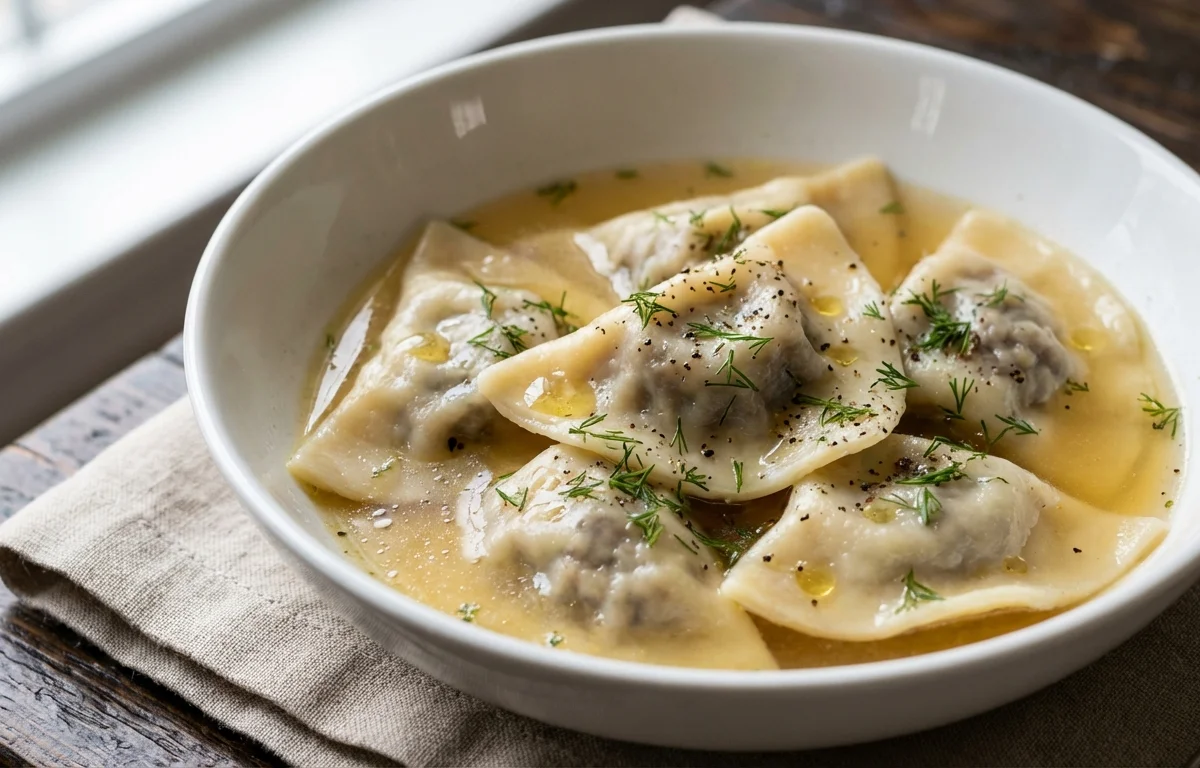
Beef Kreplach
Tender, savory beef-filled dumplings, a cherished classic in Ashkenazi Jewish cuisine. Often called Jewish wontons, these are perfect boiled and served in a warm bowl of chicken soup for a comforting meal.
For 4 servings
Prepare the Beef Filling
- Heat the vegetable oil or schmaltz in a large skillet over medium heat.
- Add the finely chopped onion and sauté for 5-7 minutes until softened and translucent.
- Stir in the minced garlic and cook for another minute until fragrant.
- Add the ground beef to the skillet. Use a spoon to break it apart and cook until fully browned, about 8-10 minutes. Drain any excess fat.
- Remove the skillet from the heat and allow the beef mixture to cool completely, about 20 minutes. This is crucial to prevent the dough from becoming greasy.
- In a medium bowl, combine the cooled beef mixture, 1 large egg, matzo meal, 1 tsp salt, and black pepper. Mix until well combined. Set aside.
Make and Rest the Dough
- In a large bowl, whisk together the all-purpose flour and 1/2 tsp of salt.
- Create a well in the center of the flour and add 2 large eggs and the cold water.
- Using a fork, gradually beat the eggs and water, slowly incorporating the flour from the sides until a shaggy dough forms.
- Transfer the dough to a lightly floured surface and knead for 5-8 minutes, until it is smooth and elastic.
- Wrap the dough tightly in plastic wrap and let it rest at room temperature for at least 30 minutes. This allows the gluten to relax, making it easier to roll.
Assemble the Kreplach
- Unwrap the rested dough and divide it in half. Keep one half covered while you work with the other to prevent it from drying out.
- On a well-floured surface, roll out the dough as thinly as possible (about 1/16-inch thick) into a large rectangle. A pasta machine can be very helpful for this.
- Using a sharp knife or a pizza cutter, cut the dough into 3-inch squares.
- Place about 1 teaspoon of the beef filling in the center of each square. Do not overfill.
- Lightly brush the edges of a square with a fingertip dipped in water. Fold one corner over to the opposite corner to form a triangle. Press the edges firmly to seal, ensuring there are no air pockets.
- For the traditional shape, you can bring the two long points of the triangle together and pinch them to seal. Repeat with all dough and filling.
Cook the Kreplach
- Bring a large pot of water to a rolling boil and add 1 tbsp of salt.
- Carefully add the kreplach to the boiling water, working in batches to avoid overcrowding the pot.
- Boil for 8-10 minutes. They are done when they float to the surface and the dough is tender with a slight chew.
- Use a slotted spoon to remove the cooked kreplach and transfer them to a colander to drain briefly.
Serve
- For a classic presentation, serve the boiled kreplach immediately in a hot bowl of chicken soup.
- Alternatively, for fried kreplach, heat butter or oil in a skillet and pan-fry the boiled dumplings until they are golden brown and crispy on both sides.
What to keep in mind.
5 tips from the recipe — small details that make a real difference to the final dish.
- 1For the thinnest, most uniform dough, use a pasta roller if you have one. Start on the widest setting and gradually decrease to the second-to-last setting.
- 2Ensure the beef filling is completely cool before assembling the kreplach to prevent the dough from becoming oily and difficult to seal.
- 3Seal the edges of the kreplach very tightly to prevent them from bursting open during boiling.
- 4Kreplach can be frozen for later. Arrange uncooked kreplach on a baking sheet in a single layer, freeze until solid, then transfer to a freezer-safe bag. Boil directly from frozen, adding 2-3 minutes to the cooking time.
- 5Don't overcrowd the pot when boiling. This lowers the water temperature and can cause the kreplach to stick together and cook unevenly.
Adapt it for your goals.
Filling
Substitute the beef with ground chicken or turkey. For a vegetarian option, use a filling of mashed potatoes with caramelized onions and cheese, similar to pierogi.
Serving StyleServing Style
Instead of serving in soup, toss boiled kreplach with caramelized onions and a sprinkle of fresh dill for a delicious side dish.
DoughDough
For a slightly richer dough, you can replace the 2 tablespoons of water with an additional egg yolk.
Why this is on our healthy list.
High in Protein
The ground beef filling provides a significant amount of high-quality protein, which is essential for muscle repair, immune function, and overall body maintenance.
Provides Sustained Energy
The dough, made from flour, is rich in complex carbohydrates. These are broken down slowly by the body, providing a steady and sustained release of energy.
Rich in Iron
Beef is an excellent source of heme iron, a form of iron that is easily absorbed by the body. Iron is crucial for forming red blood cells and preventing anemia.
Frequently asked questions
A serving of six beef kreplach contains approximately 630-650 calories, depending on the leanness of the beef and whether they are served in soup or fried.