
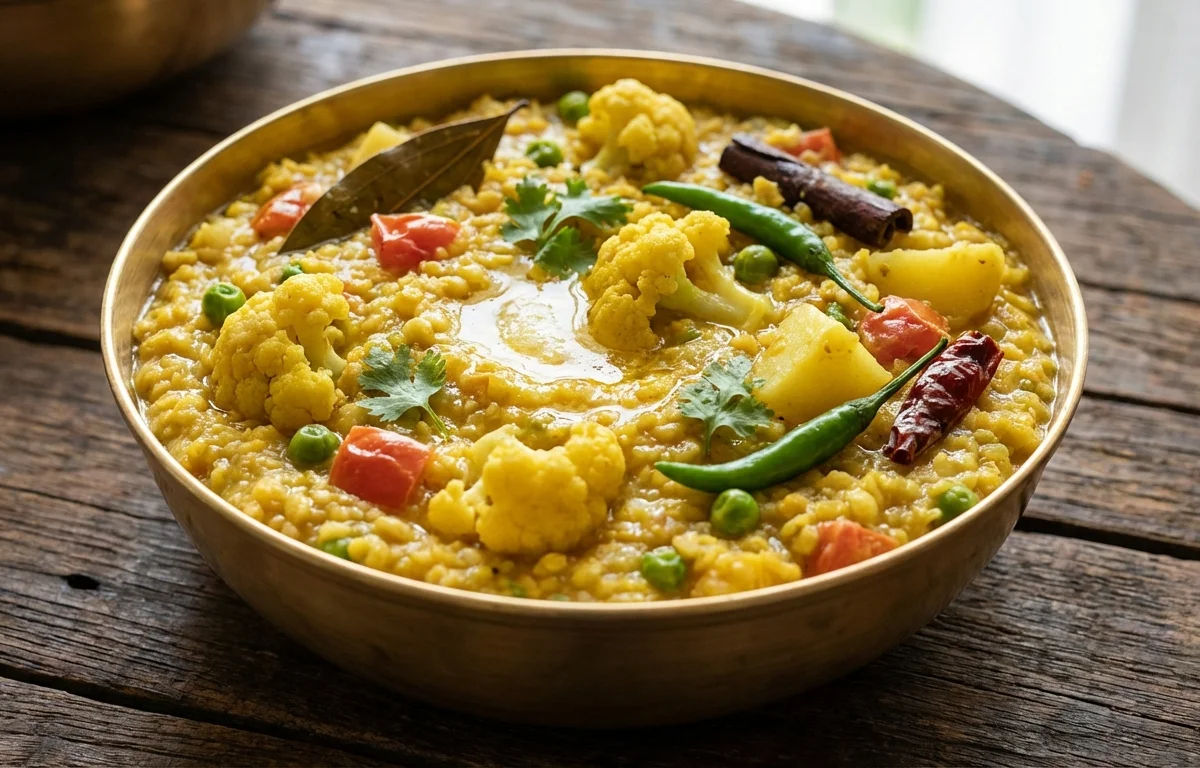
Bhaja Moong Dal Khichuri
A comforting, golden-hued one-pot rice and lentil dish from Bengal. Roasted moong dal adds a deep nutty aroma while seasonal vegetables and a gentle ghee tempering make it soul-warming. Perfect with a spoonful of ghee and a side of pickles on a rainy afternoon.
For 4 servings
- prep · ~20 min
Wash and soak the rice.
Wash gobindobhog rice in 2-3 changes of water until water runs clear. Soak in fresh water for 20 minutes. Drain before using.
- roast · ~7 min
Dry roast the moong dal until fragrant.
1.Heat a heavy-bottom pan over low-medium heat.2.Add the moong dal and dry roast, stirring continuously (5-7 min).3.Roast until the dal turns golden brown and releases a nutty aroma.4.Transfer to a bowl immediately to stop it from burning.TIPKeep the flame low and stir constantly — moong dal burns quickly. - prep · ~5 min
Wash the roasted dal and prep vegetables.
Wash the roasted dal in 2 changes of water. Peel and cube the potato, cut cauliflower into small florets, and slit green chilies.
- temper · ~1 min
Temper whole spices in ghee.
1.Heat 2 tbsp ghee in the pressure cooker over medium heat.2.Add bay leaves and cumin seeds.3.Let cumin seeds crackle and turn aromatic (30 sec). - saute · ~4 min
Sauté ginger and add vegetables.
1.Add grated ginger to the tempered ghee and sauté until fragrant (30 sec).2.Add cubed potatoes and cauliflower florets.3.Stir and sauté the vegetables for 2-3 minutes until lightly coated with ghee. - saute · ~2 min
Add rice, dal, and spices.
1.Drain the soaked rice and add it to the pressure cooker.2.Add the washed roasted moong dal.3.Add green peas, turmeric powder, sugar, salt, and slit green chilies.4.Stir gently and sauté everything together for 1-2 minutes. - pressure cook · ~15 min
Add water and pressure cook.
Pour 4 cups of hot water into the cooker. Stir once, close the lid, and pressure cook on medium heat. Wait for 2 whistles, then lower the flame and cook for 5 more minutes. Turn off heat and let the pressure release naturally.
TIPLetting pressure release naturally gives you the perfect mushy khichuri texture — don't rush it. - assemble · ~2 min
Mash lightly and adjust consistency.
Open the cooker once pressure releases. Use the back of a ladle to mash lightly, combining everything. If too thick, stir in a splash of hot water. The texture should be soft and porridge-like but not runny.
- serve · ~1 min
Serve hot topped with ghee and coriander.
Ladle into serving bowls. Top each katori with half a teaspoon of raw ghee and a sprinkle of fresh coriander leaves. Serve immediately with begun bhaja or mango pickle on the side.
TIPA dollop of cold ghee on piping hot khichuri melts into a glorious pool of flavor.
What to keep in mind.
7 tips from the recipe — small details that make a real difference to the final dish.
- 1Roast the moong dal on low heat, stirring constantly, until golden brown to unlock its nutty aroma.
- 2Soak Gobindobhog rice for 20 minutes; this ensures even cooking and the signature soft, mushy texture.
- 3Use hot water for pressure cooking to maintain consistent heat and reduce cooking time.
- 4Let the pressure release naturally for 10-15 minutes—this gives the khichuri its classic creamy consistency.
- 5For extra depth, add a pinch of garam masala or crushed black pepper just before serving.
- 6Khichuri thickens as it cools; stir in a splash of hot water when reheating to restore the perfect porridge-like texture.
- 7Serve with a dollop of cold ghee on top—the contrast of warm khichuri and melting ghee is the soul of the dish.
Adapt it for your goals.
Vegan
Replace the ghee with coconut oil or a neutral vegetable oil for both the tempering and the finishing dollop. The dish remains comforting and aromatic, perfect for plant-based diets.
low carb / high proteinLow-carb / high-protein
Reduce the rice to 1/2 cup and increase moong dal to 1 cup. Add extra paneer cubes or tofu for protein. This makes a more lentil-heavy, lower-carb khichuri that is still delicious and filling.
gluten free (naturally)Gluten-free (naturally)
This recipe is already gluten-free as written. Just ensure your store-bought moong dal is certified gluten-free if cross-contamination is a concern.
khichuri with additional veggiesKhichuri with additional veggies
Add 1/2 cup each of chopped carrots, green beans, and pumpkin (or sweet potato) along with the potatoes. This boosts nutrition, color, and sweetness, making it a complete one-pot meal.
jain / no onion no garlic versionJain / no onion-no garlic version
This recipe already avoids onion and garlic. For a Jain variation, skip the green chili (or use a pinch of black pepper) and ensure all vegetables are free from roots (use only above-ground veggies like pumpkin and bottle gourd).
Why this is on our healthy list.
Rich in Plant Protein
Moong dal is a high-quality source of plant-based protein and essential amino acids, making this dish a great choice for vegetarians and vegans.
Easy to Digest
The combination of roasted moong dal and short-grain rice is naturally light on the stomach, and the cooking process breaks down starches, making it an ideal meal for recovery or sensitive digestion.
High in Dietary Fiber
Moong dal and vegetables like cauliflower and peas provide a good amount of soluble and insoluble fiber, supporting healthy digestion and stable blood sugar levels.
Packed with Vitamins & Minerals
The assortment of vegetables supplies vitamin C, vitamin K, folate, and potassium, while the ghee aids in the absorption of fat-soluble vitamins from the meal.
Balanced Energy Meal
The rice provides complex carbohydrates for sustained energy, while the lentils and vegetables offer protein, fiber, and micronutrients, creating a nutritionally balanced one-pot dish.
Frequently asked questions
Yes. Use a heavy-bottom pot. After sautéing, add 5 cups of hot water and simmer covered on low heat for 25-30 minutes, stirring occasionally, until the rice and dal are soft and mushy.



-curry.webp)
.webp)