
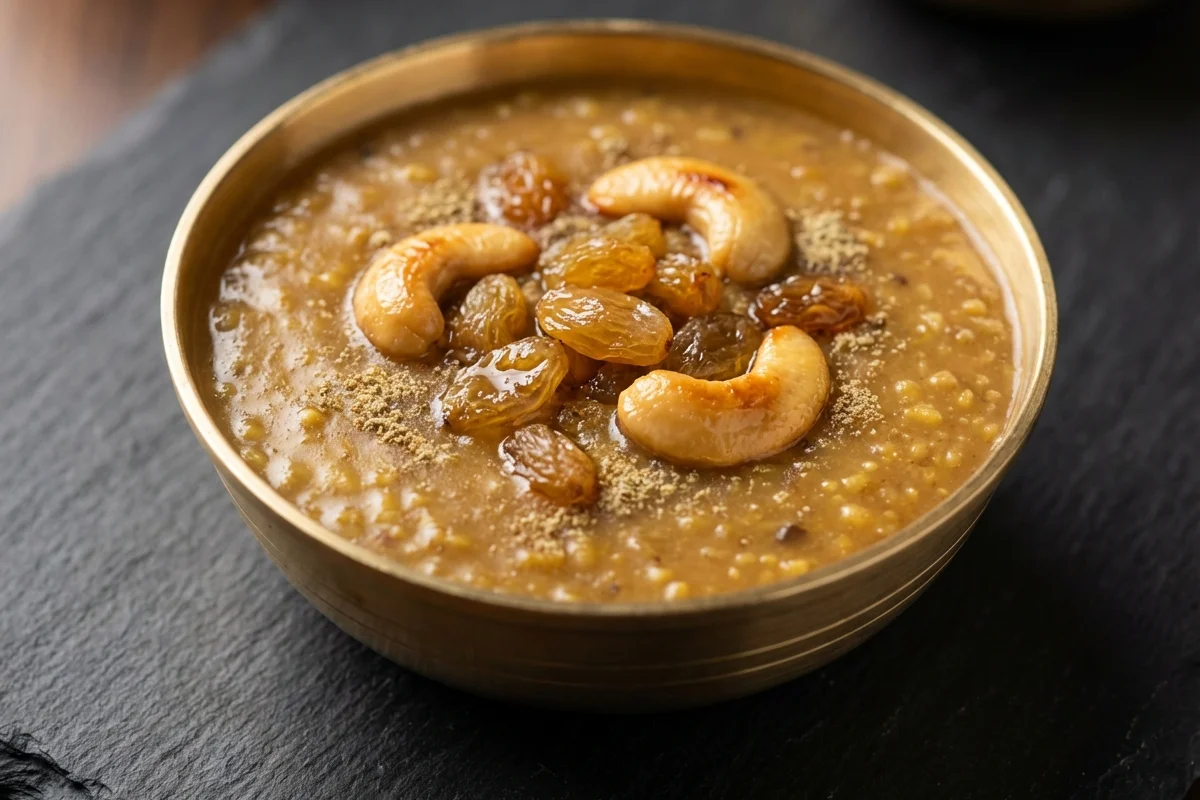
Hesarubele Payasa
A creamy, fragrant lentil-based dessert from Karnataka, slow-cooked with jaggery and coconut milk. Roasted moong dal lends a nutty depth while cardamom and golden raisins add a festive warmth that makes every spoonful comforting.
For 4 servings
- roast · ~6 min
Dry-roast the moong dal.
1.Heat a heavy-bottomed pan over medium-low heat.2.Add washed moong dal and roast stirring continuously for 5-6 minutes.3.Roast until the dal turns light golden and releases a nutty aroma — do not let it brown too much.TIPKeep the flame medium-low; high heat scorches the dal and imparts a bitter taste. - boil · ~25 min
Cook the dal until mushy.
1.Add 2.5 cups of water to the roasted dal.2.Bring to a boil, then reduce heat to low and cover partially.3.Simmer for 20-25 minutes until the dal grains break down and turn completely soft.4.Use the back of a spoon to lightly mash the dal in the pan.TIPThe dal should be fully soft and mashable — undercooked dal will not blend smoothly with the jaggery and coconut milk. - simmer · ~5 min
Add jaggery and dissolve.
1.Add the grated jaggery to the cooked dal.2.Stir continuously over low heat until the jaggery melts completely.3.Simmer for 5 minutes — the mixture will thin slightly, then thicken.TIPWait until the dal cools a little off the boil before adding coconut milk in the next step to prevent curdling. - mix · ~3 min
Stir in coconut milk and simmer gently.
1.Remove the pan from direct heat and wait 1 minute.2.Pour in the thick coconut milk while stirring continuously.3.Return to low heat and warm through for 2-3 minutes — do not let it boil hard.4.Add crushed cardamom powder and a tiny pinch of salt; stir once and turn off the heat.TIPA tiny pinch of salt deepens the sweetness and rounds out the coconut flavor — it will not make the payasa salty. - temper · ~2 min
Make the ghee-roasted nut garnish.
1.Heat ghee in a small tempering pan over medium heat.2.Add split cashew nuts and fry until light golden (1-2 minutes).3.Add raisins and fry just until they puff up (30 seconds).4.Pour the entire tempering — ghee, nuts, and raisins — over the payasa.TIPPour the tempering hot over the payasa; the sizzle releases an amazing aroma right before serving. - serve
Serve Hesarubele Payasa warm or chilled.
Ladle into small katoris. This payasa tastes wonderful both warm on a cool evening and chilled straight from the fridge on a warm day. It thickens on standing — stir in a splash of warm water or coconut milk to loosen if needed.
What to keep in mind.
6 tips from the recipe — small details that make a real difference to the final dish.
- 1Roast the moong dal over medium-low heat until light golden to avoid a bitter taste.
- 2Cook the dal until fully mushy so it blends smoothly with jaggery and coconut milk.
- 3Let the dal cool slightly off the boil before adding coconut milk to prevent curdling.
- 4A tiny pinch of salt deepens the sweetness without making the payasa salty.
- 5Pour the hot ghee tempering over the payasa right before serving for maximum aroma.
- 6This payasa thickens on standing; stir in a splash of warm water or coconut milk to loosen.
Adapt it for your goals.
Vegan
Replace ghee with coconut oil or a neutral vegetable oil for the tempering; the dish remains equally rich and aromatic while becoming fully plant-based.
low oilLow-oil
Skip the ghee tempering entirely and simply fold in raw chopped cashews and raisins; the payasa will still be creamy and sweet, just lighter.
nut freeNut-free
Omit the cashews and use only raisins in the tempering; for crunch, substitute with roasted pumpkin seeds or skip the garnish entirely.
high proteinHigh-protein
Increase the moong dal to 3/4 cup and reduce water slightly; this boosts the protein content while keeping the payasa thick and satisfying.
Why this is on our healthy list.
Rich in Plant Protein
Moong dal is a good source of plant-based protein, making this dessert more nourishing than many refined-sugar sweets.
Natural Sweetener
Jaggery is an unrefined sweetener that retains trace minerals like iron and magnesium, offering a deeper sweetness than white sugar.
Healthy Fats from Coconut
Coconut milk provides medium-chain triglycerides (MCTs), which are a quick source of energy and may support metabolism.
Digestive-Friendly Legume
Moong dal is known for being light and easy to digest, especially when cooked until mushy, making this payasa gentle on the stomach.
Frequently asked questions
Yes, canned coconut milk works well. Use the thick, creamy top layer for best results and shake the can before measuring.



.webp)
.webp)