Peking Duck
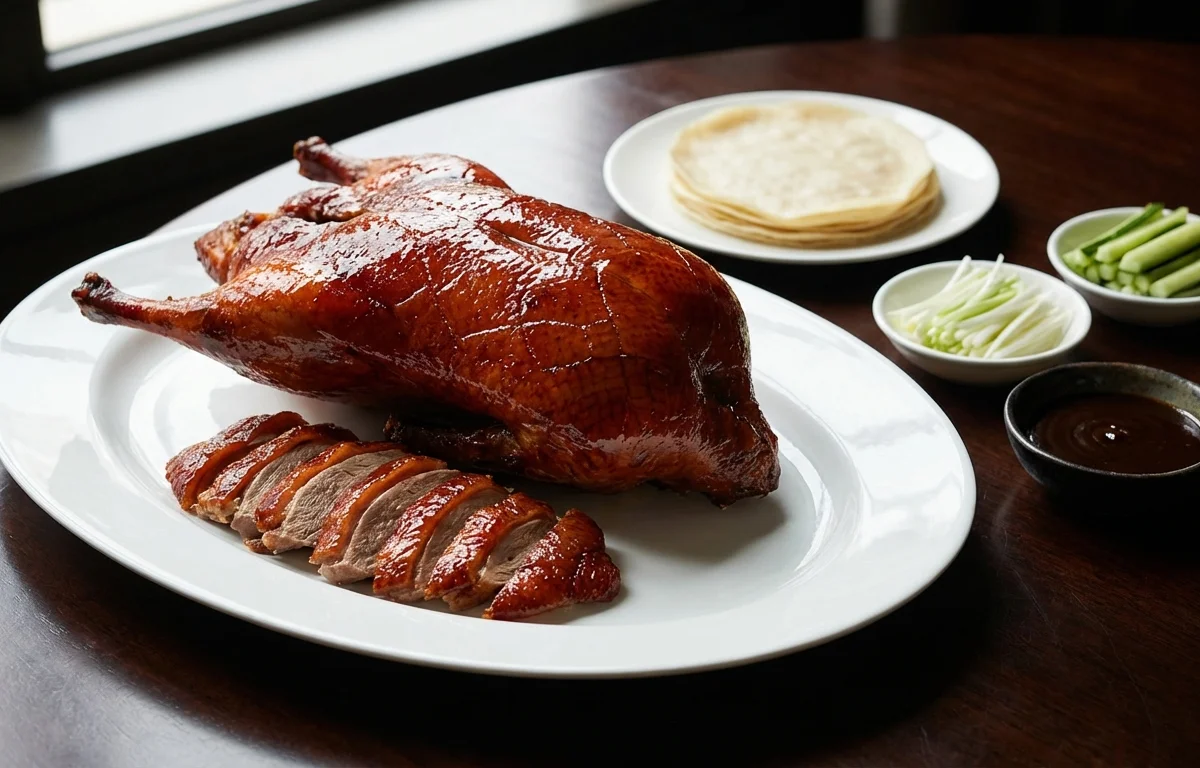
Crispy, lacquered duck with impossibly thin, glass-like skin and tender meat, served with delicate Mandarin pancakes, scallions, and sweet hoisin sauce. A legendary Chinese restaurant dish you can master at home—the secret is air-drying the duck overnight for that signature crackling finish.
For 8 servings
- prep
Separate the skin from the breast.
Insert the air pump nozzle between the skin and meat near the neck opening. Gently inflate until the skin separates from the breast, creating a balloon effect. Work carefully so the skin doesn't tear. This step is critical for the signature crispy skin.
TIPA clean bicycle pump with a needle attachment works perfectly. Insert at an angle and pump slowly. - prep · ~5 min
Blanch the duck for tight, glossy skin.
1.Bring a large pot of water to a rolling boil.2.Hold the duck by the neck and ladle boiling water over the entire bird until the skin tightens and turns white.3.Pat the duck completely dry with paper towels inside and out. - prep · ~2 min
Brush with the maltose glaze.
Dissolve the maltose in 2 tablespoons of hot water, then mix in soy sauce and rice vinegar. Brush this glaze evenly over the entire duck, coating every surface. This will create the signature reddish-brown lacquered skin.
TIPApply the glaze while the duck is still warm so it absorbs better. - rest · ~480 min
Air-dry the duck overnight.
Thread kitchen twine under the duck's wings and hang it in a cool, dry, well-ventilated place. Position a fan on low speed to circulate air. Let dry for at least 8 hours, preferably overnight, until the skin feels dry and papery to the touch—not tacky.
TIPThe skin must feel like parchment paper. If it's humid, point a fan directly at the duck. No shortcuts here—drying defines the duck. - prep · ~1 min
Season the cavity.
Rub a pinch of salt inside the cavity of the dried duck.
- roast · ~60 min
Roast the duck at high heat.
1.Preheat oven to 425°F (220°C) with the roasting rack set in the middle position.2.Place the duck breast-side up on a rack over a roasting pan.3.Roast for 20 minutes until the skin begins to blister and turn deep amber.4.Reduce the heat to 350°F (175°C) and continue roasting for 40 more minutes, until the internal temperature reaches 165°F at the thickest part of the thigh.TIPIf the breast skin browns too fast, tent it loosely with foil. Don't let the sugars in the glaze burn. - prep · ~25 min
Make the Mandarin pancakes.
Place the flour in a heatproof bowl. Pour in boiling water while stirring with chopsticks until a shaggy dough forms. Once cool enough to handle, knead on a floured surface for 5 minutes until smooth. Cover and rest for 20 minutes.
TIPBoiling water is essential—it creates a tender, pliable pancake that won't crack when folded. - prep · ~20 min
Roll and cook the pancakes.
1.Divide dough into 16 equal pieces and roll each into a 4-inch circle.2.Lightly brush one side of each circle with sesame oil and stack two circles, oiled sides together.3.Roll the stacked pair into a thin 6-inch pancake.4.Cook in a dry nonstick skillet over medium heat for 1 minute per side until small bubbles appear.5.Peel the two pancakes apart while warm and stack under a kitchen towel.TIPKeep cooked pancakes covered—they dry out fast and become brittle. - prep · ~5 min
Prepare the garnishes.
Cut the cucumber into thin matchstick-sized batons. Slice the green onions into fine lengthwise strips. Arrange on a serving plate and set out the hoisin sauce in a small bowl.
- rest · ~10 min
Rest the duck before carving.
Remove the duck from the oven and let it rest on a cutting board for 10 minutes. The skin will continue to crisp as it cools.
TIPDon't skip the rest—carving too soon releases all the juices onto the board. - assemble · ~8 min
Carve the duck and assemble pancakes.
1.Using a sharp cleaver, separate the crispy skin from the breast meat. Slice the skin into thin rectangular strips.2.Carve the breast meat into thin slices, keeping skin and meat together where possible.3.Serve the sliced skin and meat on a platter alongside the warm pancakes, cucumber, green onion, and hoisin sauce.4.To eat: spread a small spoonful of hoisin on a pancake, add a strip of skin, some meat, cucumber, and scallion, then roll it up.TIPTraditionally the skin is served separately as the prized first course—dip it in sugar if you want the full Beijing experience.
What to keep in mind.
8 tips from the recipe — small details that make a real difference to the final dish.
- 1Inflate the skin with a pump until translucent—this ensures paper-thin, crackling skin.
- 2Blanch with boiling water until the skin tightens and turns white, then pat bone-dry.
- 3Air-dry overnight with a fan; the skin must feel like parchment, not tacky.
- 4Use maltose for the authentic lacquer; honey works but yields a slightly different sheen.
- 5Monitor the breast skin during roasting; tent with foil if it darkens too quickly.
- 6Rest the duck 10 minutes before carving so the skin stays crisp and juices retreat.
- 7Keep cooked pancakes under a damp towel to prevent them from drying and cracking.
- 8Serve the skin separately with sugar for the classic Beijing first course.
Adapt it for your goals.
Healthier-oven-roast
Trim excess fat from the cavity before inflating, and roast on a V-rack so fat drips away. This reduces overall fat without sacrificing crispiness—ideal for those watching their intake.
gluten freeGluten-free
Replace all-purpose pancakes with rice paper wrappers (moisten briefly in warm water). Serve with tamari instead of soy sauce and ensure hoisin is GF-certified. Perfect for gluten-sensitive diners.
mango habaneroMango-habanero
Swap hoisin for a spicy mango-habanero sauce (blend mango, habanero, lime, and honey). This adds a fruity, fiery kick that cuts through the richness—great for adventurous eaters.
vegetarian duckVegetarian-duck
Use a large king oyster mushroom or seitan instead of duck. Omit the inflation/blanching steps; roast with the glaze at 400°F for 25 minutes. A plant-based alternative that still delivers umami and texture.
jainJain
Use a whole chicken or mock duck (since Jains avoid large animal meat). Replace onions and garlic with asafoetida and fennel. Use jaggery instead of maltose and skip scallions. Suitable for Jain dietary restrictions.
Why this is on our healthy list.
Rich in High-Quality Protein
Duck provides all nine essential amino acids, supporting muscle repair and satiety. A single serving offers a substantial protein boost.
Source of B-Vitamins
Duck meat is rich in niacin, vitamin B6, and vitamin B12, which aid energy metabolism and nervous system function.
Contains Iron and Zinc
Duck provides heme iron (easily absorbed) and zinc, supporting healthy red blood cells and immune function.
High in Selenium
A good source of selenium, an antioxidant that supports thyroid function and protects cells from oxidative damage.
Low-Carb Pancake Wraps
Mandarin pancakes made from flour and water are naturally low in sugar, making this a relatively low-carb indulgence compared to bread wraps.
Frequently asked questions
Yes, but the skin won't be as thin and crispy. Use a metal skewer to make tiny holes between skin and meat to help fat render, then dry thoroughly.