Deep Fried Turkey
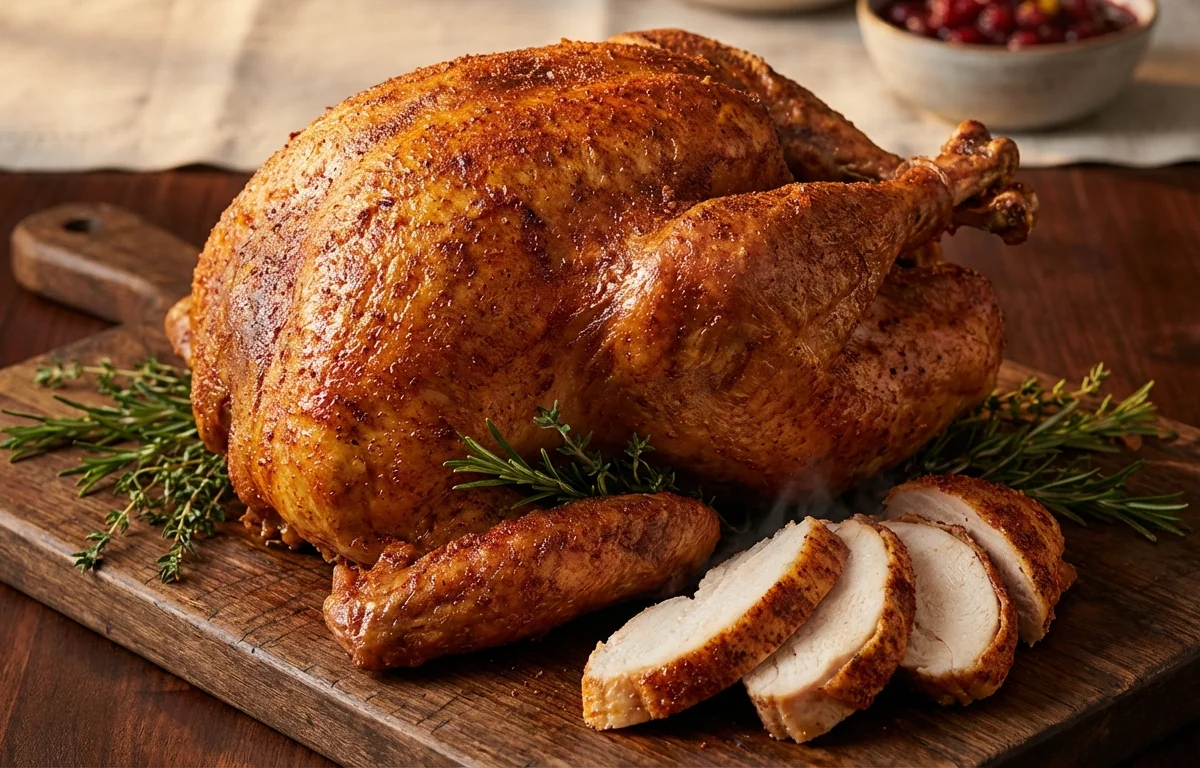
A whole turkey deep-fried to golden perfection, with incredibly juicy meat and shatteringly crispy skin. Using a large outdoor pot, the bird cooks in a fraction of the time it takes to roast, sealing in moisture and creating that signature mahogany-brown crust. A Southern Thanksgiving showstopper that feeds a crowd.
For 8 servings
- prep · ~30 min
Ensure the turkey is completely dry and at room temperature.
Remove neck and giblets from the cavity. Pat every surface of the turkey — inside and out — extremely dry with paper towels. Any moisture will cause violent oil splatter. Let the bird sit at room temperature for 30 minutes so it cooks evenly.
TIPMoisture is the enemy of deep frying. Pat dry twice if needed. - prep · ~5 min
Season the turkey thoroughly.
1.Mix salt, black pepper, garlic powder, and smoked paprika in a small bowl.2.Rub the seasoning mix all over the outside of the turkey.3.Gently loosen the skin over the breast and rub seasoning directly onto the meat.4.Season the interior cavity with any remaining mix. - prep · ~5 min
Measure the oil level using water displacement.
Place the turkey in the empty fryer basket. Fill the pot with water until the turkey is just covered by 2-3 inches. Remove the turkey and mark the water line — this is your oil fill line. Discard the water and dry the pot completely.
TIPThis step prevents dangerous oil overflow. Never skip it. - fry · ~20 min
Heat the oil to 350°F (175°C).
Pour peanut oil into the completely dry pot up to the marked fill line. Set up the outdoor burner on level ground away from any structures. Attach a deep-fry thermometer to the pot and heat the oil to a steady 350°F (175°C). Maintain the flame carefully — oil temperature can spike quickly.
TIPPeanut oil has a high smoke point and clean flavor. Maintain 350°F — too hot and the outside burns, too cool and the bird gets greasy. - fry · ~2 min
Slowly lower the turkey into the hot oil.
With the burner OFF to eliminate fire risk, place the turkey breast-side down in the basket. Wearing heavy-duty gloves, very slowly lower the basket into the hot oil. Gently work it down inch by inch — the oil will bubble vigorously. Once fully submerged, relight the burner.
TIPTurn off the flame before lowering. Hot oil splashing onto a lit burner can ignite instantly. - fry · ~45 min
Fry the turkey for 3-4 minutes per pound (approx. 45 minutes for a 12 lb bird).
Monitor the oil temperature and adjust the flame to maintain 350°F. Fry for approximately 3-4 minutes per pound. The turkey is done when an instant-read thermometer inserted into the thickest part of the breast reads 165°F (74°C), and the thigh registers 170-175°F (77-79°C). The skin will be deep golden brown and crisp.
TIPCheck temperature in multiple spots. The meat near the bone cooks slowest. - rest · ~20 min
Lift the turkey, drain, and rest before carving.
Turn off the burner again. Slowly lift the basket, letting excess oil drain back into the pot for 1-2 minutes. Transfer the turkey to a cutting board or sheet pan to rest for 20 minutes. Resting redistributes the juices inside the meat.
TIPDo not cover the turkey tightly while resting — it will steam and soften the crispy skin. - serve
Carve and serve the deep fried turkey.
Remove the legs and wings, then carve the breast against the grain into thick slices. Arrange on a platter and serve immediately.
What to keep in mind.
7 tips from the recipe — small details that make a real difference to the final dish.
- 1Pat the turkey bone-dry inside and out, then let it air-dry for 30 minutes to prevent violent oil splatter and ensure shatteringly crisp skin.
- 2Always perform the water-displacement test to mark the exact oil fill line; this prevents dangerous overflow when the turkey is submerged.
- 3Use a high-smoke-point oil like peanut oil; its clean flavor won't compete with the turkey and it can handle 350°F without burning.
- 4Turn off the burner completely before lowering the turkey into the oil — a single splash onto an open flame can cause a fireball.
- 5Monitor oil temperature with a reliable deep-fry thermometer and adjust the flame often; staying at a steady 350°F is key to juicy meat and a golden crust.
- 6Fry the turkey breast-side down for even cooking and to let the breast meat stay moist while the dark meat finishes.
- 7Rest the fried turkey on a wire rack or cutting board for 20 minutes, uncovered, to keep the skin crisp while juices redistribute.
Adapt it for your goals.
Cajun-Spiced
Add 1 tbsp of Cajun seasoning, cayenne pepper, and dried thyme to the rub for a bold, spicy Louisiana-style bird that pairs perfectly with gumbo and cornbread.
Herb Butter InjectionHerb-Butter Injection
Melt butter with minced garlic, rosemary, and sage, then inject it into the breast and thighs before frying for extra-juicy, herb-infused meat without altering the crispy skin.
Gluten FreeGluten-Free
Ensure all spices are certified gluten-free and skip any flour-based dry rubs; the recipe is naturally gluten-free when you stick to the listed spices and pure peanut oil.
Lemon PepperLemon-Pepper
Replace the smoked paprika with dried lemon zest and increase black pepper to 1 tsp per kg for a zesty, bright flavour that cuts through the richness of the fried skin.
Why this is on our healthy list.
High in Lean Protein
Turkey breast is a lean source of complete protein, supporting muscle repair and satiety without excessive saturated fat when the skin is eaten in moderation.
Rich in B Vitamins
Turkey provides niacin, vitamin B6, and vitamin B12, which help convert food into energy and support nervous system function.
Source of Selenium
Turkey meat naturally contains selenium, an antioxidant mineral that supports thyroid health and immune function.
Phosphorus for Bones
A serving of turkey supplies phosphorus, a mineral essential for strong bones and teeth, working alongside calcium in the body.
Frequently asked questions
Yes, but choose a high-smoke-point oil like canola, sunflower, or avocado oil; avoid olive or coconut oil as they burn at frying temperatures.