
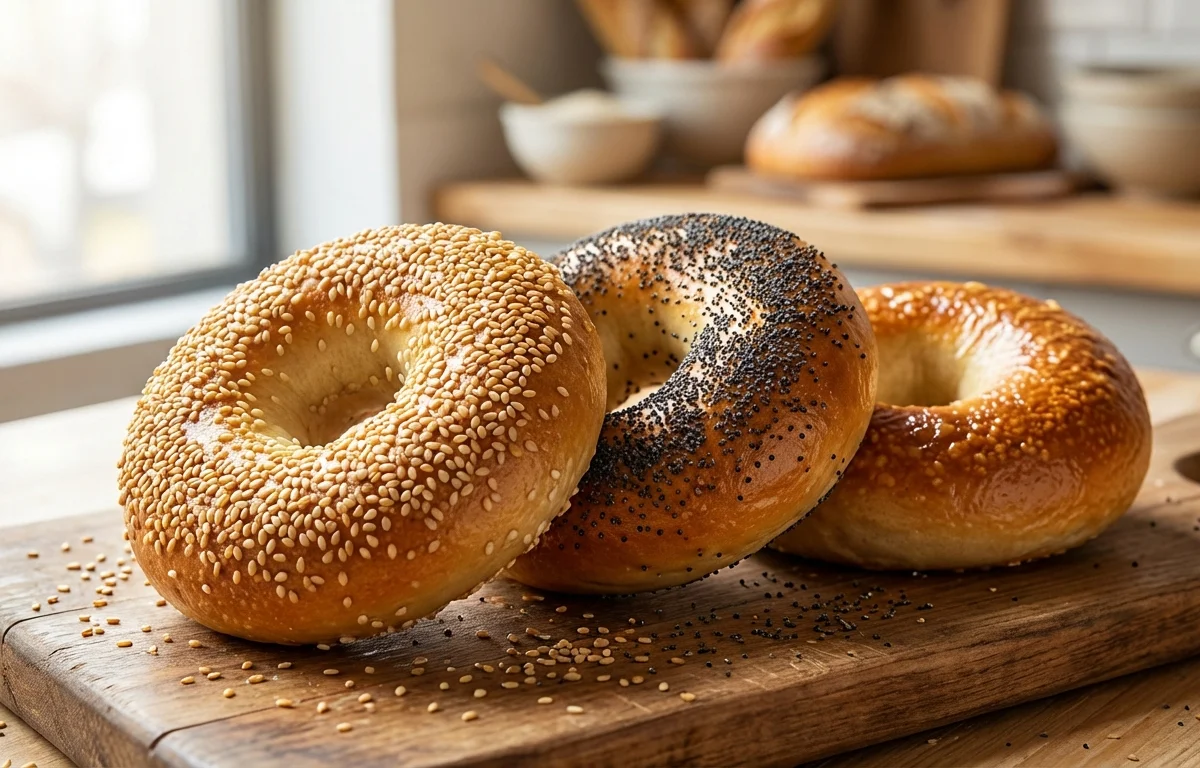
New York Bagels
Chewy, dense, and perfectly golden brown on the outside with a soft, tender crumb on the inside. These classic New York-style bagels get their signature shine and chew from a brief boil in malted water before baking. Slice, toast, and schmear with cream cheese for the ultimate breakfast experience.
For 4 servings
- prep · ~5 min
Activate the yeast.
In a small bowl, combine warm water (110°F), 1 tablespoon barley malt syrup, and yeast. Stir gently and let it sit for 5 minutes until foamy and bubbly. If it doesn't foam, the yeast is dead — start over with fresh yeast.
TIPWater hotter than 120°F will kill the yeast. Aim for baby-bottle warm. - knead · ~11 min
Knead the bagel dough.
In the bowl of a stand mixer fitted with a dough hook, combine bread flour and salt. Add the yeast mixture and mix on low speed until a stiff, coarse ball forms — about 4 minutes. Increase speed to medium-low and knead for another 6-7 minutes until the dough is smooth, firm, and elastic. Bagel dough should be stiff — it'll fight the mixer a little.
TIPA stiff, dry-ish dough makes a chewy bagel. Resist the urge to add more water. - rest · ~60 min
First rise.
Place the dough in a lightly oiled bowl, cover with a damp kitchen towel, and let it rise in a warm spot for 1 hour, or until slightly puffed but not doubled. Bagel dough is dense and rises less than bread dough.
- prep · ~10 min
Shape the bagels.
Punch down the dough and divide it into 8 equal pieces — about 125g each. Shape each piece into a smooth ball. Poke your thumb through the center and gently stretch the hole to about 1.5 inches wide. The hole should be larger than you think; it'll close up during boiling and baking. Place shaped bagels on a cornmeal-dusted baking sheet.
- rest · ~15 min
Proof the shaped bagels.
Cover the bagels loosely with a damp kitchen towel and let them rest for 10-15 minutes. They'll puff just slightly. Meanwhile, preheat your oven to 425°F (218°C) with the rack in the center position.
TIPDon't overproof — 15 minutes max. Overproofed bagels deflate in the water. - boil · ~6 min
Boil the bagels.
Bring the large pot of water to a rolling boil. Stir in the remaining 1 tablespoon of barley malt syrup. Gently drop 3-4 bagels into the water. Boil for 45 seconds per side — use a timer. Flip with a slotted spoon and boil 45 seconds more. Transfer back to the baking sheet, spaced apart.
TIPA shorter boil = thinner crust. A 90-sec-per-side boil = extra-chewy bagels. - garnish · ~2 min
Top with seeds while still wet.
Straight out of the boil, the bagels are sticky — sprinkle sesame seeds (or your favorite topping) over them immediately so they adhere. Work quickly before the surface dries.
TIPEverything bagel blend, poppy seeds, or flaky salt all work beautifully. - bake · ~20 min
Bake until deeply golden.
Place the baking sheet in the preheated oven and bake for 18-22 minutes, rotating halfway through, until the bagels are deeply golden brown and sound hollow when tapped on the bottom. Cool on a wire rack for at least 20 minutes before slicing.
TIPUnderbaking leaves bagels pale and soft. Wait for deep amber-gold — that's flavor.
What to keep in mind.
6 tips from the recipe — small details that make a real difference to the final dish.
- 1Weigh your flour for accuracy; bread flour's protein content is critical for chewy bagels.
- 2Boil bagels in batches to avoid crowding; the water should stay at a rolling boil.
- 3Use a timer for the boil — 45 seconds per side gives the perfect balance of chew and crust.
- 4Let bagels cool completely on a wire rack before slicing to prevent a gummy interior.
- 5Store cooled bagels in a paper bag at room temperature for up to 2 days, or freeze for up to 3 months.
- 6For extra shine, brush bagels with an egg wash (1 egg + 1 tbsp water) before baking.
Adapt it for your goals.
Everything bagel
Skip the sesame seeds and sprinkle with a homemade everything bagel blend (sesame seeds, poppy seeds, dried garlic, dried onion, and flaky salt) right after boiling for a classic New York deli-style topping.
whole wheat bagelWhole wheat bagel
Replace 1 cup of bread flour with whole wheat flour and add 2 extra tablespoons of water; the whole wheat adds nutty flavor and more fiber, though the bagels will be slightly less chewy.
vegan bagelVegan bagel
The recipe is already vegan if you skip any optional egg wash — barley malt syrup is plant-based, and no dairy is used. Perfect for those avoiding animal products.
mini bagelsMini bagels
Divide the dough into 12 to 16 pieces instead of 8, shaping smaller rings and boiling for only 30 seconds per side; bake for 15–18 minutes. Great for kids or appetizer platters.
cinnamon raisin bagelCinnamon raisin bagel
Add 1 teaspoon of ground cinnamon to the dry flour and knead in ⅔ cup of raisins after the dough comes together. Boil as directed — the raisins add bursts of sweetness.
Why this is on our healthy list.
Good Source of Energy
Bread flour is rich in carbohydrates, providing sustained energy for active mornings.
Low in Fat and Sugar
This bagel recipe contains no butter or oil, and only a small amount of barley malt syrup for flavor, making it a lower-fat baked good.
Customizable for Dietary Needs
The base recipe is dairy-free and egg-free, making it suitable for vegan and lactose-intolerant diets as written.
Contains Protein from Bread Flour
Bread flour has a higher protein content than all-purpose flour, contributing to both structure and a modest protein boost.
Frequently asked questions
The shine and crust come from boiling in water with barley malt syrup. If the water wasn't at a full rolling boil, or you skipped the syrup, the crust will be dull.


