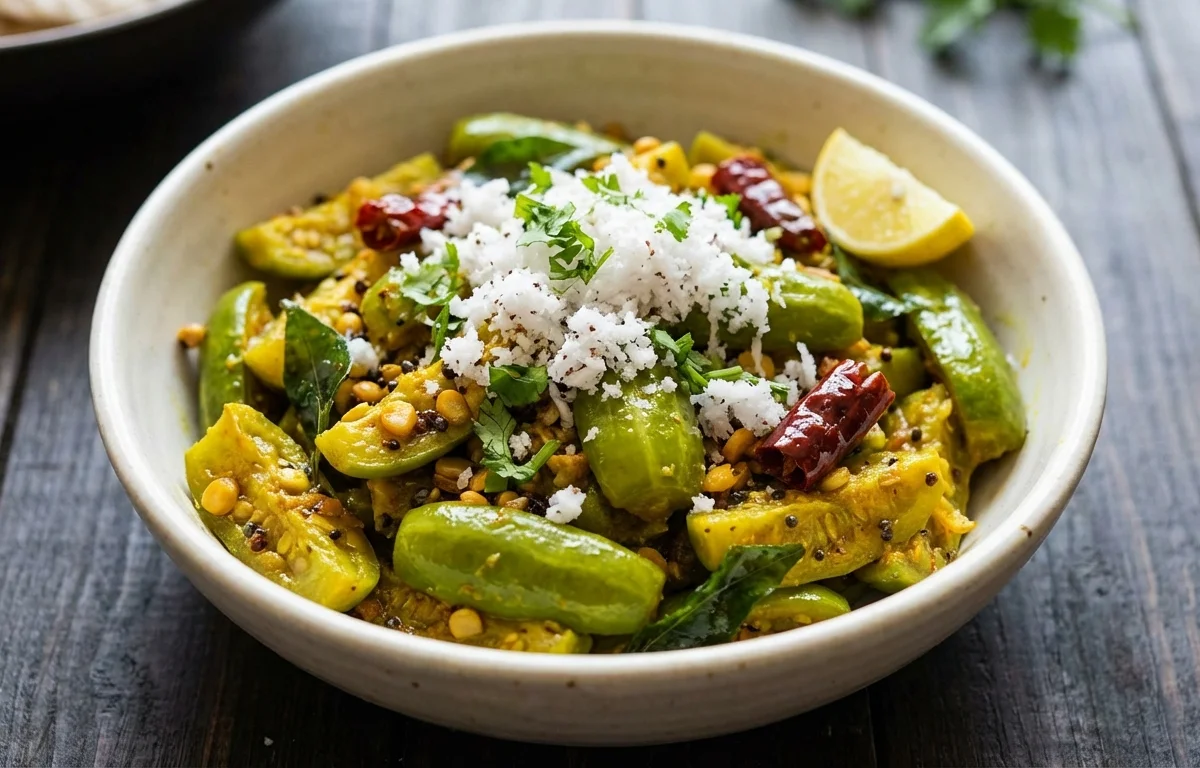
Thondekai Palya
A simple, everyday Kannadiga-style stir-fry made with tender ivy gourd. The vegetable is cooked with a fragrant tempering of mustard seeds, curry leaves, and dried red chili, then finished with fresh coconut for a mildly spiced, comforting side that pairs perfectly with rice and rasam or chapati.
For 4 servings
- prep
Prep the ivy gourd.
1.Wash 500g tender ivy gourd thoroughly and pat dry.2.Trim both ends and slice into thin, uniform rounds (about 3-4 mm thick). - temper · ~2 min
Make the tempering.
1.Heat 2 tsp oil in a heavy-bottomed pan over medium heat.2.Add 0.5 tsp mustard seeds and let them splutter (30 sec).3.Add 0.5 tsp cumin seeds, 2 broken dried red chilies, and 8 curry leaves. Sauté until fragrant (15 sec).4.Add 1 pinch asafoetida and stir once.TIPKeep the heat medium — asafoetida and curry leaves burn quickly. - saute · ~10 min
Cook the ivy gourd.
1.Add the sliced ivy gourd to the pan and stir well to coat with the tempering.2.Add 1 pinch turmeric powder and 0.5 tsp salt. Mix thoroughly.3.Cover the pan with a lid and cook on low heat for 8-10 minutes, stirring occasionally.4.Check doneness — the ivy gourd should be tender but still hold its shape.TIPNo water is needed — the vegetable releases its own moisture. If it sticks, sprinkle a teaspoon of water. - saute · ~3 min
Dry out and finish.
1.Remove the lid and increase heat to medium.2.Stir-fry for 2-3 minutes until any remaining moisture evaporates and the edges get slightly crisp. - garnish
Add fresh coconut and serve.
Turn off the heat. Sprinkle 3 tbsp grated fresh coconut over the top and mix gently. Transfer to a serving bowl and serve warm with rice and rasam or chapati.
TIPAdding the coconut off the heat keeps it fresh and fragrant — cooking it dulls the sweetness.
What to keep in mind.
6 tips from the recipe — small details that make a real difference to the final dish.
- 1Slice ivy gourd into thin, uniform rounds (3–4 mm) to ensure even cooking.
- 2Skip adding extra water — the ivy gourd releases enough moisture to steam itself tender.
- 3Cook covered on low heat; lifting the lid too early lets steam escape and can toughen the vegetable.
- 4For a slightly crisp texture, uncover the pan and stir-fry on medium for 2–3 minutes at the end.
- 5Add grated coconut only after turning off the heat to preserve its fresh sweetness and fluffy texture.
- 6If your ivy gourd is a bit tough or mature, sprinkle 1 tsp of water during cooking to help soften it.
Adapt it for your goals.
Dal tadka style
Add ½ cup of cooked toor dal (pigeon pea lentils) after cooking the ivy gourd and simmer for 2 minutes. This turns the dry palya into a moist, spoonable side that pairs beautifully with rice.
with peanutsWith peanuts
Stir in 2 tablespoons of roasted peanuts along with the grated coconut for added crunch and nutty protein — a favorite in coastal Karnataka households.
low oil versionLow-oil version
Dry-roast the mustard seeds and cumin in the pan first until fragrant, then add just ½ tsp oil for the tempering. The ivy gourd's own moisture handles the cooking.
spicy masalaSpicy masala
Add 1 teaspoon of red chili powder or sambar powder along with the turmeric for a bolder, heat-driven flavor profile.
Why this is on our healthy list.
Rich in Dietary Fiber
Ivy gourd provides both soluble and insoluble fiber, supporting healthy digestion and prolonging fullness.
Low in Calories and Fat
This stir-fry uses minimal oil and no cream or heavy sauces, making it a light, waistline-friendly side dish.
Source of Vitamins and Antioxidants
Ivy gourd contains vitamin A and C, along with bioactive compounds that help combat oxidative stress.
Contains Healthy Fats
Fresh grated coconut adds medium-chain triglycerides (MCTs) that provide quick energy and support brain function.
Frequently asked questions
Yes, but thaw and pat dry before slicing to avoid excess water. Cook a little longer on low heat to evaporate the extra moisture that frozen vegetables release.