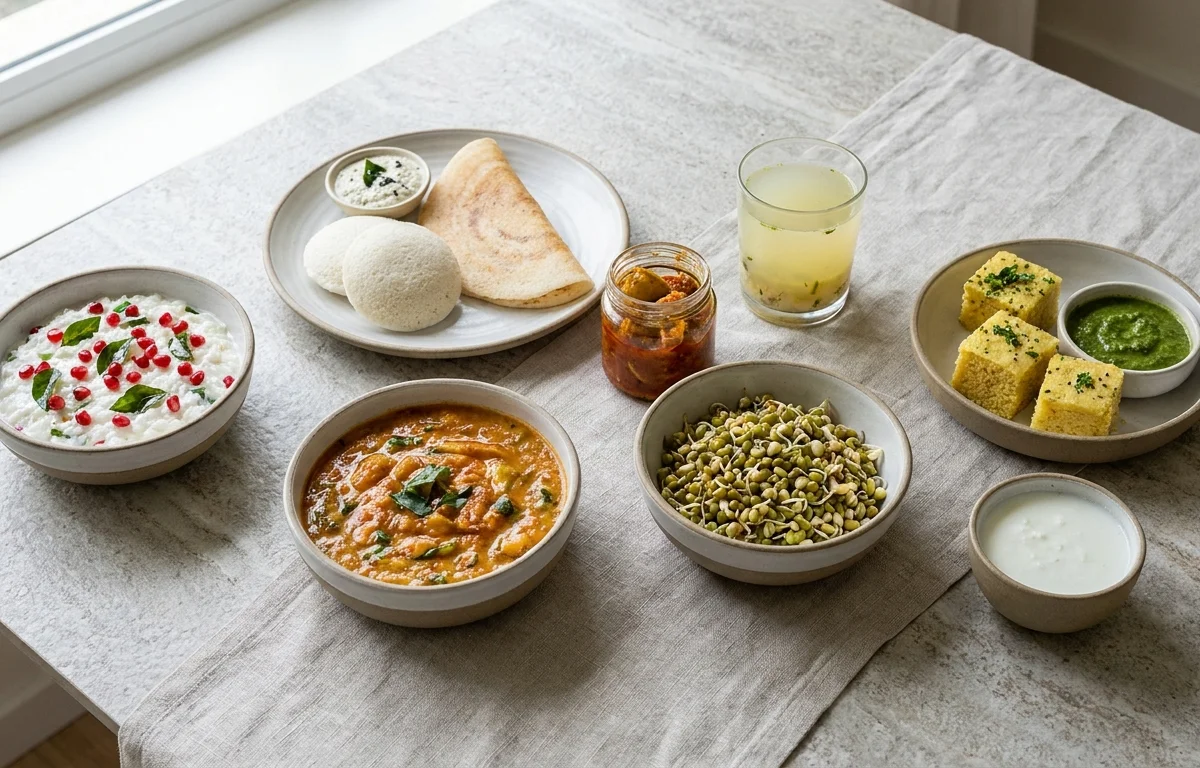
Kefir, Kimchi, Kanji: A Clear Guide to Live-Culture Fermented Foods
A clear, evidence-based tour of the 8 fermented foods most people encounter — kefir, yogurt, kanji, idli batter, kimchi, sauerkraut, miso, kombucha — with…
By Sourabh Garg, Content Creator
May 31, 2026 · Reviewed May 2026 · Updated Aug 2026
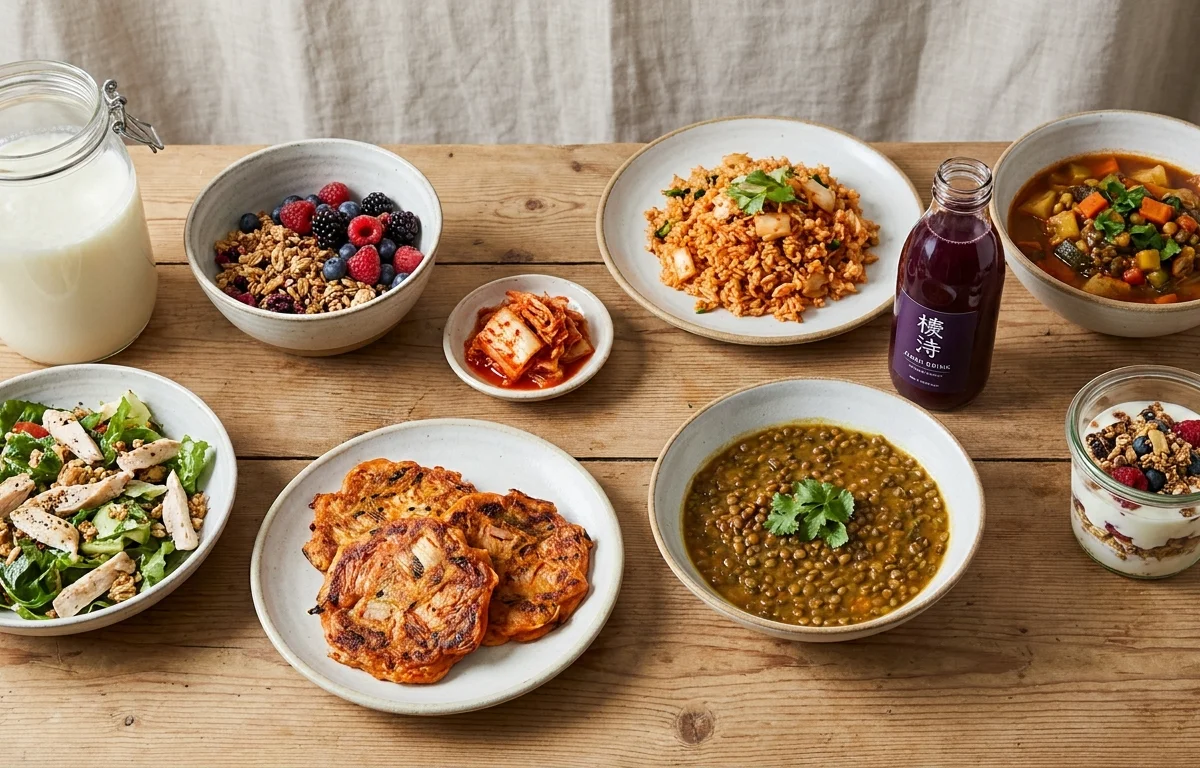
Fermented foods are having a long moment. Kefir is in supermarket dairy aisles, kimchi shows up on Buddha bowls, kombucha sponsors marathons, and kanji is back on Indian Holi tables. The marketing has run far ahead of the labels, though, and a lot of what is sold as 'probiotic' on a shelf is neither probiotic in the technical sense nor, in many cases, even alive.
This guide walks through the eight fermented foods most people actually encounter — kefir, yogurt, kanji, idli and dosa batter, kimchi, sauerkraut, miso, and kombucha — and answers the same four questions for each: what microbes are doing the work, how long the ferment runs, what it brings nutritionally, and whether the version on the supermarket shelf is still alive when you eat it. The Stanford Wastyk 2021 trial in Cell is the strongest evidence we have that regular fermented-food intake does something useful for the microbiome [1]. The ISAPP 2021 consensus statement is the cleanest definition of what counts and what does not [2]. The AGA 2020 guideline is the corrective for anyone hoping a daily kefir replaces a gastroenterologist [3]. All three sit behind this guide. If you want how to weave these into Indian meals day-to-day, that is the next article in this set; if you want symptoms and when to see a doctor, that is the one after. This one is the catalogue.
Fermented foods are not probiotics. Most of what supermarket shelves call 'probiotic' is neither alive nor a defined strain at a defined dose. The interesting thing about kefir, kimchi, kanji, and idli batter is what is actually happening microbiologically — and what survives the journey from ferment crock to your plate. This guide walks through the eight ferments most people encounter and tells you, for each one, what is alive, what is sodium, and what is marketing.
THE CATEGORY ERROR
Per the ISAPP 2021 consensus statement: a fermented food is any food made by desired microbial growth and enzymatic conversion of its components — no health benefit is required for the label, and the microbes may or may not still be alive in the finished food. A probiotic is a specific live microbial strain shown, at a defined dose, to confer a health benefit. Sourdough is fermented but not probiotic (baking kills the cultures). A specific Lactobacillus rhamnosus capsule is probiotic. A live-culture kefir sits in between: it is a fermented food that may contain probiotic strains, but the label 'probiotic' on the bottle is almost always marketing, not a regulated claim. [2]
What the strongest trial actually showed
6 servings/day
Fermented-food intake target in the intervention arm [1]
10 weeks
Trial duration
↑ diversity
Gut microbial diversity rose in the fermented arm; high-fibre arm did not [1]
19 markers ↓
Inflammatory cytokine signatures that decreased in the fermented arm [1]
Lower density than dairy ferments. Commercial regulation caps alcohol at <0.5%. [6]
10
Pasteurised / shelf-stable kimchi or sauerkraut~0 CFU/gPasteurised
Heat-killed at the factory. Some brands add spore-formers back so the label says 'live cultures' — a label trick. [7]
The eight ferments most people encounter
Kefir
Most diverse common ferment. Higher CFU than yogurt.
Bacteria + yeasts (10+ strains)
12–24 hr at room temp
Refrigerated, look for LAC seal
best
Yogurt / dahi
Homemade with a spoonful of starter is as good as premium brands. [4]
S. thermophilus + L. bulgaricus
6–12 hr at 40–45 C
LAC seal = ≥10^8 CFU/g
best
Kanji
Carrots/beet + mustard + salt + water. India's underrated kefir.
Wild Lactobacillus
3–5 days, warm spot
Homemade only — not commercially sold
best
Idli / dosa batter
Pre-digestion + lower phytate are real even after cooking. [8]
Leuconostoc + S. faecalis
~12 hr at 25 C+
Cooked dish has zero live cultures
good
Kimchi
Sodium 400–900 mg per half cup. Use as garnish. [5]
Leuconostoc → Lactobacillus succession
1–14 days (cold ferment slower)
Refrigerated 'raw' = live; shelf-stable = dead
good
Sauerkraut
Same sodium issue as kimchi. Refrigerated only for live cultures. [7]
Same LAB succession as kimchi
1–4 weeks at room temp
Most jars are pasteurised
ok
Miso
Add to warm broth OFF the heat. Boiling kills the cultures.
Aspergillus oryzae + LAB + yeasts
6 months–3 years
Long shelf life; unpasteurised is alive
good
Kombucha
Lower CFU than dairy ferments. Avoid home brew in pregnancy. [6]
SCOBY: yeasts + Acetobacter + LAB
7–14 days
Commercial: <0.5% ABV; home brew: 1–3%
ok
PASTEURISED ALERT
Pasteurisation is what makes a fermented food shelf-stable at room temperature. It also kills the cultures. If a jar of kimchi or sauerkraut sits in the canned-goods aisle (not the refrigerated case), it is almost certainly heat-treated. The live-culture versions live in the refrigerated section, list 'raw,' 'unpasteurised,' or 'naturally fermented' on the label, and have a shorter shelf life. Some brands add spore-forming Bacillus back to a pasteurised product after the fact so they can print 'live cultures' on the label — those microbes never fermented the cabbage and the species mix bears little resemblance to a wild ferment. [7]
Five principles for adding live-culture ferments to your week
01
Pick a dairy ferment and a non-dairy ferment
Dairy ferments (kefir, dahi, lassi, buttermilk/chaas) are dense in lactic-acid bacteria and the best-evidenced for general microbiome benefit. A non-dairy partner (kanji, raw kimchi, raw sauerkraut, kombucha, miso) adds different microbial families. The Wastyk Stanford trial used both. [1]
02
Aim for 1–2 servings a day, ramp slowly
Going from zero to six servings overnight produces gas and bloating for the first one to two weeks. Start with one serving daily for a week, then add a second. Most people land at 2–3 servings as a sustainable steady state — fewer than the 6 servings used in the trial, but still meaningful.
03
Refrigerated, not shelf-stable
For kimchi, sauerkraut, pickles, and kombucha, the live-culture version lives in the refrigerated case. The shelf-stable version is almost always pasteurised, regardless of what the front label says. The IDFA Live & Active Cultures seal on yogurt and kefir is the only positive certification widely used in the US. [4][7]
04
Pair cooked ferments with a raw fermented side
Idli is steamed, dosa is fried, sourdough is baked, kimchi pancakes are pan-fried — all delicious uses of fermented bases, but the cultures are dead in the finished food. Add a small spoonful of raw dahi, raw kimchi, or a sip of kanji to keep something alive on the plate.
05
Mind the sodium ledger
Commercial kimchi and sauerkraut commonly carry 400–900 mg of sodium per half cup [5]. On a 1,500 mg low-sodium target (AHA's optimal for hypertension, heart failure, CKD), a single half-cup serving is roughly a third of the day. Treat them as 2-tablespoon garnishes unless your sodium budget is generous.
A ferment-positive day (one practical example)
30%
Morning: 1 small bowl of homemade dahi
100–150 g of fresh dahi made with a spoonful of starter from yesterday's batch. ~10^8–10^9 CFU/g.
25%
Mid-morning or evening: 1 glass of chaas or kanji
200 mL of buttermilk in summer; the same volume of kanji in winter. Both are live-culture beverages.
25%
Lunch: 2 tbsp raw kimchi or fresh fermented pickle
Refrigerated, raw, 'naturally fermented' label. Two tablespoons keeps sodium around 100–200 mg.
20%
Dinner: cooked-ferment base + raw garnish
Idli or dosa for the pre-digestion benefits, served with a spoonful of fresh raw chutney on the side for live cultures.
SODIUM REALITY
Commercial kimchi and sauerkraut commonly carry 400–900 mg of sodium per half cup [5]. On the American Heart Association's 2,300 mg general ceiling, that is one-fifth of a day; on the 1,500 mg target advised for hypertension, heart failure, or chronic kidney disease, it is roughly a third. The practical move is to scale the portion down — 2 tablespoons (~100–200 mg) is a garnish, half a cup is a side dish. Homemade versions can be lower-salt, but going too low weakens the wild-LAB selection pressure and raises spoilage risk; aim for ~2% salt by vegetable weight if you make your own.
How to read a fermented-food label in 30 seconds
01
Is it in the refrigerated case?
Live-culture kimchi, sauerkraut, kefir, yogurt, miso, and kombucha all live cold. If it is in the centre aisles or on a non-refrigerated shelf, it is pasteurised (or shelf-stable for some other reason). Skip and find the refrigerated version.
02
Does the label say 'raw,' 'unpasteurised,' or 'naturally fermented'?
For kimchi and sauerkraut, this is the strongest positive signal. For yogurt and kefir, look for the IDFA Live & Active Cultures (LAC) seal instead — 100 million CFU/g at manufacture, ten times the FDA floor [4].
03
Are the listed cultures real strains, not just 'Bacillus' or 'probiotic blend'?
Genuine ferments list Lactobacillus, Leuconostoc, Streptococcus, Lactococcus, or named yeasts. A label that just says 'probiotic' with a generic Bacillus species after pasteurisation is the common label trick — it is technically alive but is not what fermented the food.
04
Check the sodium per serving against the serving size
Many packages list a 2-tbsp (28 g) serving so the numbers look small. Read across to half-cup (113 g) and the sodium quadruples. A 'low-sodium' kimchi at 200 mg per 2 tbsp is 800 mg per half cup.
05
Check the sell-by date and how the product looks
Live-culture ferments continue to ferment slowly in the jar. A vigorous fizz when you open it, a slightly bulging lid, and a sharper taste over time are all signs of a living product. A completely flat, sweet-tasting product after weeks in the fridge has likely been pasteurised regardless of the label.
“
Fermented foods are foods made through desired microbial growth and enzymatic conversions of food components. Fermented foods fall only under the foods category, and no health benefit is required, whereas the term probiotics should be reserved for those specific microbial strains which have been shown to improve our health.
— ISAPP consensus statement on fermented foods, Marco et al., Nature Reviews Gastroenterology & Hepatology, 2021
Plan a week of meals that include live-culture ferments by default
Our meal planner builds Indian meal plans that include a daily dairy ferment (dahi, chaas) and a rotating non-dairy ferment (kanji, raw kimchi, homemade pickle) without effort.
✓Anyone trying to add fermented foods to their diet who wants to know which products on a supermarket shelf still contain live cultures.
✓Home cooks curious about the microbiology behind everyday foods — idli batter, dahi, kanji — that already sit on Indian kitchen counters.
✓Readers who have heard 'probiotic' marketing claims and want to understand what the scientific definition (ISAPP 2021) actually covers, and what it does not.
✓People building a generally varied, plant-forward diet who want to include 1–2 servings of fermented food per day for microbiome diversity, with realistic expectations of what that delivers.
LIMIT OR AVOID IF
Skip this if
!You are immunocompromised — recent chemotherapy, post-transplant, advanced HIV — in which case live unpasteurised ferments (raw kimchi, unpasteurised kefir, home-brewed kanji or kombucha) carry a small but real infection risk and should be discussed with your clinician first.
!You have been put on a low-sodium target for hypertension, heart failure, or chronic kidney disease — commercial kimchi and sauerkraut commonly carry 400–900 mg of sodium per half cup [5], which can crowd out the rest of your day's budget quickly.
!You are pregnant — most fermented foods are fine, but unpasteurised soft cheeses (some artisan kefir cheeses, raw-milk yogurts) and home-brewed kombucha with non-trivial alcohol (up to ~3% ABV in home brews [6]) are usually advised against. Stick to commercial, pasteurised dairy ferments and skip the kombucha.
PRACTICAL TIPS
✓Buy refrigerated, not shelf-stable. Shelf-stable kimchi, sauerkraut, and pickle products in supermarket aisles are almost always pasteurised — pasteurisation is what makes them shelf-stable. Live-culture versions live in the refrigerated case and have 'raw,' 'unpasteurised,' or 'naturally fermented' on the label.
✓For yogurt and kefir, look for the IDFA Live & Active Cultures (LAC) seal, which guarantees at least 100 million CFU per gram at manufacture — ten times the FDA floor of 10 million per gram [4]. The seal is voluntary; absence is not proof of pasteurisation, but presence is a useful signal.
✓Make dahi at home with a spoonful of starter from your last batch. The strains are alive, the cost is roughly the price of milk, and a properly cultured batch reaches 10^8–10^9 CFU per gram — the same density as commercial premium yogurts, sometimes higher.
✓Treat raw sauerkraut and kimchi as a garnish (2 tablespoons), not a side dish (half a cup). A 2-tablespoon serving keeps sodium around 100–200 mg, while a half cup commonly lands at 400–900 mg [5] — enough to crowd a hypertension-target day.
✓If you cook the ferment, you have killed the cultures. Idli is steamed, dosa is fried, kimchi pancakes are pan-fried — all delicious, all functionally dead in microbial terms. The fermentation still pre-digests carbohydrates and changes flavour and texture, which is real value, but those preparations should not be counted in your 'live-culture' tally.
✓Add ferments gradually. Going from zero to six servings a day will produce gas and bloating for the first one to two weeks while the gut microbiota rebalances. Start with one serving a day, hold for a week, then add a second. Most people tolerate the ramp-up better than the leap.
Fermented foods are a real, evidenced category — the Wastyk 2021 Stanford trial showed that six servings a day for ten weeks raised microbial diversity and lowered inflammatory markers in healthy adults [1]. That is the strongest result the literature offers, and it is genuinely interesting. What it is not is a license to treat any jar with the word 'probiotic' on the front as medicine. The AGA 2020 guideline is direct: routine probiotic supplements are not recommended for IBS, ulcerative colitis, Crohn's, or C. difficile treatment — the evidence is not there [3].
The practical version is short. Buy refrigerated, not shelf-stable. Look for the IDFA Live & Active Cultures seal on yogurt and kefir [4]. Treat commercial kimchi and sauerkraut as garnish, not main course, because 400–900 mg of sodium can hide in a half cup [5]. Make your own dahi, kanji, and idli batter where you can — that is where you control the variables. And remember the ISAPP line that frames the whole field: fermented foods are foods, not therapies [2].
FREQUENTLY ASKED QUESTIONS
Frequently asked questions
What is the actual difference between a 'fermented food' and a 'probiotic'?
The ISAPP 2021 consensus is the authoritative line. Fermented foods are 'foods made through desired microbial growth and enzymatic conversions of food components' — no health benefit is required for the label, and the microbes that did the work may or may not still be alive when you eat the food. Probiotics are 'live microorganisms that, when administered in adequate amounts, confer a health benefit on the host' — a specific strain, a specific dose, demonstrated benefit. Most foods sold as 'probiotic' on supermarket shelves do not meet the second definition; they are fermented foods with live microbes, which is a different and looser category. [2]
Does the science actually back up eating fermented foods?
Yes, but more modestly than the wellness industry claims. The strongest single result is the Stanford Wastyk 2021 trial in Cell: 36 healthy adults randomised to either 6 servings/day of fermented foods or a high-fibre diet for 10 weeks. The fermented-food arm showed increased gut microbial diversity and decreases in 19 inflammatory cytokines; the high-fibre arm did not show the same diversity effect. [1] The trial was small (n=36), healthy adults only, and 10 weeks — useful evidence but not a basis for treating disease. The AGA 2020 guideline on probiotic supplements is explicit that routine supplements are NOT recommended for IBS, Crohn's, ulcerative colitis, or C. difficile treatment. [3]
Is kanji actually fermented, or is it just spiced water?
Kanji is genuinely fermented. Black or red carrots and/or beetroot are submerged in water with ground mustard seeds and rock salt, then left in a warm spot for 3–5 days. Wild lactic acid bacteria on the vegetable skins — predominantly Lactobacillus species — convert the natural sugars to lactic acid, dropping the pH and producing the tangy bite. Mustard seeds contribute glucosinolate-derived antimicrobial compounds that bias the ferment toward the desired LAB and away from spoilage organisms. A properly fermented kanji has live-culture densities comparable to a good commercial kefir, dairy-free, and made from cheap winter vegetables.
Why does my supermarket sauerkraut not seem to do anything?
Because it is almost certainly pasteurised. Shelf-stable jars in the canned-goods aisle are heat-treated to kill the cultures so the product is stable at room temperature. The cabbage was fermented at the factory, but the microbes are no longer alive by the time you open the jar. Live-culture versions live in the refrigerated case, list 'raw,' 'unpasteurised,' or 'naturally fermented' on the label, and have a shorter shelf life. Some brands add spore-forming bacteria back to a pasteurised product so they can print 'live cultures' on the label — that is a label trick, not the same thing as a wild ferment. [7]
How much sodium is in a typical serving of kimchi or sauerkraut?
More than most people expect. A half cup of commercial sauerkraut commonly contains 400–900 mg of sodium depending on the brand. [5] Commercial kimchi runs in a similar range. On the American Heart Association's 1,500 mg low-sodium target (advised for hypertension, heart failure, and CKD), a half-cup serving is roughly a quarter to two-thirds of the daily budget. Treat them as a 2-tablespoon garnish (~100–200 mg) instead of a side-dish portion. Homemade versions can be lower-salt, but reducing salt too far weakens the wild-LAB selection pressure and increases spoilage risk.
Is idli batter a live-culture food?
Yes — until you steam it. The overnight ferment of soaked urad dal and rice (~12 hours at 25 C or above) produces a vigorous wild ferment dominated by Leuconostoc mesenteroides and Streptococcus faecalis, each reaching more than 10^9 cells per gram by 11–13 hours. [8] That is on par with premium yogurts. But idli is steamed (~100 C) and dosa is pan-fried — both kill the cultures. You still get the benefits of the ferment (pre-digestion of carbohydrates, lower phytate, better mineral bioavailability, lighter texture), just not live microbes in the finished food. Eat a spoonful of dahi or a small portion of raw fermented chutney on the side if you want live cultures in the meal.
Does kombucha contain alcohol?
Yes. Commercial kombucha sold as non-alcoholic must contain less than 0.5% ABV in the US. Home-brewed kombucha is unregulated and commonly reaches 1–2.5% ABV; longer ferments, warmer rooms, and sweeter starting tea can push it to 3% or more. [6] That matters in pregnancy, for children, for people in recovery, and for anyone with liver disease. If you brew at home, taste a small batch first and consider testing with a brewer's hydrometer if you are sharing it with anyone in those groups; otherwise, stick to commercial brands in those contexts.
Should I take a probiotic supplement instead of eating fermented foods?
For most adults without a specific medical indication, no — the AGA 2020 guideline does not recommend routine probiotic supplements for IBS, Crohn's, ulcerative colitis, or C. difficile treatment, and the broader supplement evidence is weak. [3] The narrow indications where the AGA does support probiotics are specific (C. difficile prevention during antibiotic courses, NEC prevention in preterm infants, pouchitis post-IBD surgery) and depend on specific strains at specific doses. Outside those situations, fermented foods are a better-evidenced and cheaper route to the same general goal of microbial diversity — backed by the Wastyk Stanford trial [1] and broader observational microbiome work.
ABOUT THE AUTHOR
Sourabh Garg
CONTENT CREATOR
Sourabh writes about Indian cuisine, budget cooking, and the everyday nutrition questions that come up in Indian kitchens — chapati portions, dal protein, how to keep dishes balanced without losing the flavours families actually want. His pieces lean on credible sources (ICMR-NIN, peer-reviewed studies) and home-cook reality in equal measure.
Built using verified nutrition databases, culinary research, and traditional cooking knowledge — every claim is cross-referenced against the sources listed in the article. Last reviewed May 2026.
Articles are curated using trusted food databases (USDA FoodData Central, IFCT), culinary literature, and dietary guidelines, then structured by our editorial team for clarity, accuracy, and usefulness.
· Verified data sources· Culinary research· Quality reviewed
!You have a histamine intolerance — aged ferments (miso, kombucha, kimchi, kefir, aged sauerkraut) are high in histamine and biogenic amines and can provoke symptoms in sensitive people.
ⓘ This guidance is general. Talk to a healthcare professional or registered dietitian for personalised dietary advice.