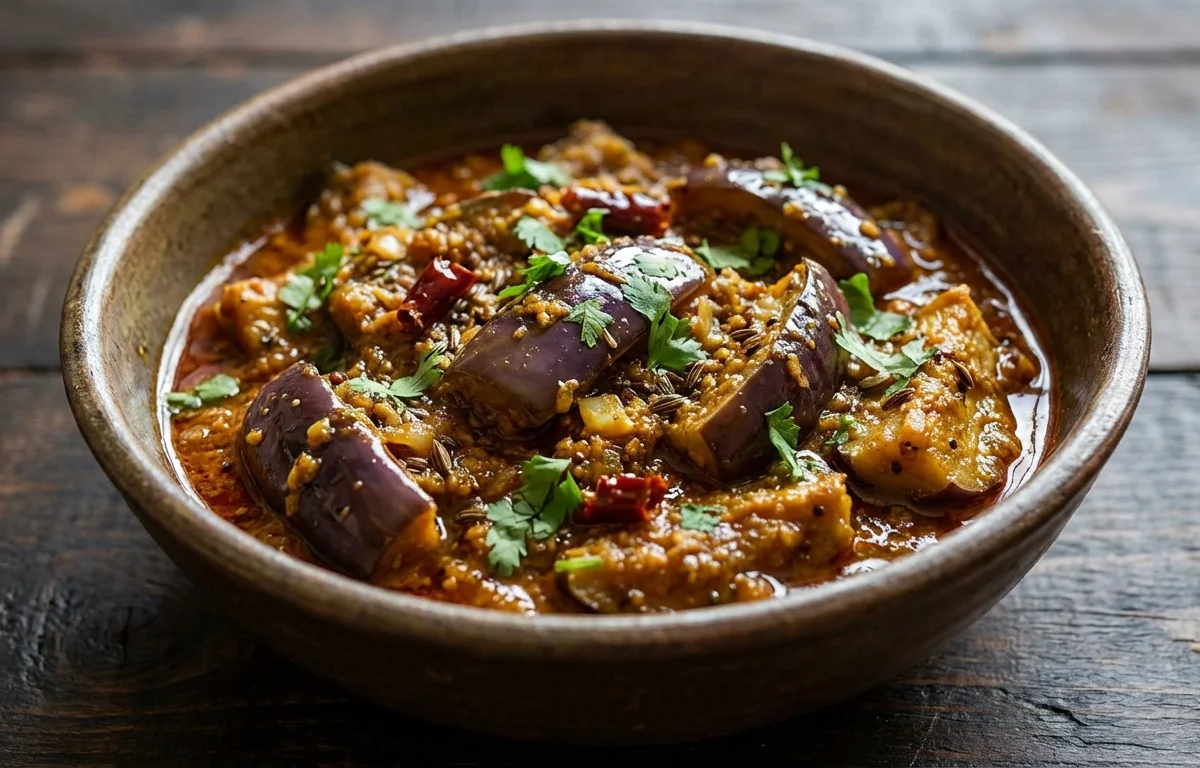
Baigana Besara
A homestyle Odia eggplant curry with the earthy punch of mustard paste, gentle heat, and a light tang. It cooks quickly, pairs beautifully with plain rice, and tastes even better after the flavors settle for a few minutes.
For 4 servings
- prep · ~15 min
Soak the mustard and cut the eggplant.
1.Soak the mustard seeds in a little water for 15 minutes.2.Wash the eggplant and cut into thick batons or long wedges.3.Keep the garlic cloves peeled and the green chilies ready.TIPThick pieces hold their shape better and stay silky after simmering. - mix · ~3 min
Grind the mustard paste.
Drain the soaked mustard seeds and grind with garlic, 1 green chili, turmeric powder, and a little water to a smooth paste. Keep the paste slightly loose so it mixes easily into the curry.
TIPUse cold water and grind just until smooth to keep the mustard from turning bitter. - saute · ~7 min
Cook the eggplant lightly.
1.Heat oil in a kadai over medium heat.2.Add the eggplant pieces and cook, turning gently, until lightly golden and half-cooked.3.Remove to a plate so the pieces do not overcook. - temper · ~1 min
Make the tempering.
In the same kadai, add panch phoran and let it crackle for a few seconds. Add the slit green chili and stir briefly until fragrant.
- simmer · ~6 min
Add the mustard paste and cook the curry.
1.Lower the heat and add the mustard paste to the kadai.2.Stir in the remaining water and salt, mixing well so the paste does not catch at the bottom.3.Add tamarind paste and bring the mixture to a gentle simmer.4.Return the eggplant to the pan and coat it well in the gravy.TIPKeep the heat low once the mustard paste goes in; hard boiling can make it split and taste sharp. - simmer · ~8 min
Simmer until the eggplant turns tender.
Cover and cook on low heat until the eggplant is fully tender and the gravy lightly thickens, about 6 to 8 minutes. Stir once or twice very gently so the pieces stay whole.
- rest · ~5 min
Rest the curry for 5 minutes.
- serve
Serve Baigana Besara warm with rice.
What to keep in mind.
7 tips from the recipe — small details that make a real difference to the final dish.
- 1Use thick eggplant wedges so they stay intact after the final simmer in the mustard gravy.
- 2Grind the soaked mustard with cold water and only until smooth; over-grinding can make the paste bitter.
- 3Half-fry the eggplant first, then finish it in the gravy so it turns silky without collapsing.
- 4Keep the flame low after adding mustard paste; a vigorous boil can make the sauce taste harsh and split.
- 5Stir very gently once or twice during the covered simmer to avoid breaking the softened eggplant pieces.
- 6Let the curry rest for 5 minutes before serving so the mustard, tamarind, and panch phoran settle into the eggplant.
- 7This tastes excellent with steamed rice and can be made a few hours ahead, as the besara flavor deepens on standing.
Adapt it for your goals.
No-garlic
Skip the garlic in the mustard paste for a simpler, more austere version that still highlights the classic besara mustard flavor.
low oilLow-oil
Shallow-cook the eggplant in less oil or pan-steam it before simmering to make the dish lighter while keeping the same gravy profile.
mixed vegetableMixed-vegetable
Add potato, pumpkin, or pointed gourd along with eggplant for a fuller Odia-style besara that pairs especially well with rice.
spicierSpicier
Use an extra green chili in the paste or tempering if you want a sharper heat against the earthy mustard and tamarind.
Why this is on our healthy list.
Vegetable-Forward Curry
Eggplant makes this dish rich in plant compounds and fiber, giving body and satisfaction without relying on heavy dairy or rich gravies.
Mustard and Garlic Depth
Mustard seeds and garlic add robust flavor, so the curry tastes full and punchy with a relatively simple ingredient list.
Light, Tangy Gravy
The sauce is built from mustard paste, water, and tamarind rather than cream, keeping the dish bright and lighter in style.
Frequently asked questions
Mustard can turn bitter if it is over-ground, ground with warm water, or boiled too hard. Use cold water and keep the simmer gentle.