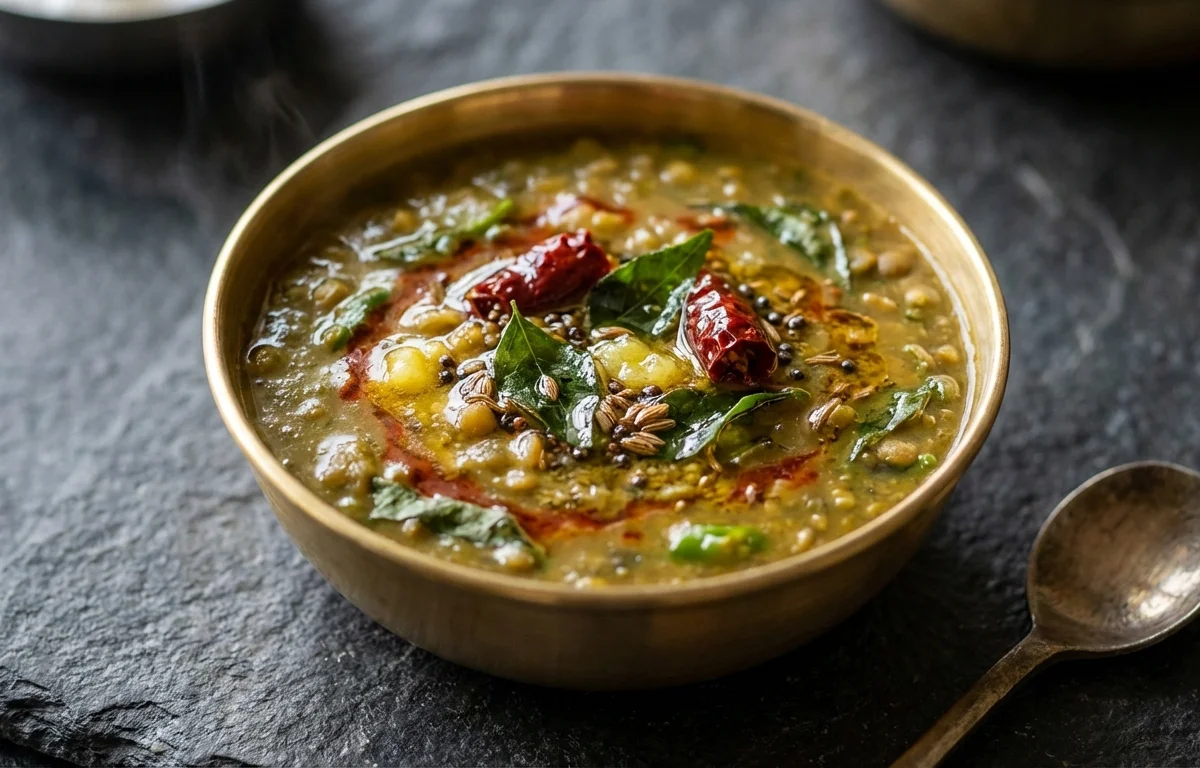
Gongura Pappu
Tangy gongura leaves cooked with toor dal make a comforting Andhra-style pappu that tastes bright, earthy, and deeply homely. It comes together with simple pantry spices and a fragrant tempering that rounds out the sour bite beautifully.
For 4 servings
- prep
Prep the dal and greens.
1.Rinse the toor dal until the water runs mostly clear.2.Pick and wash the gongura leaves well to remove any grit.3.Chop the onion and tomato, slit the green chili, and lightly crush the garlic. - pressure cook · ~20 min
Cook the dal until soft.
1.Add toor dal, tomato, green chili, turmeric powder, salt, and 3 cups water to a pressure cooker.2.Cook on medium heat for 4 whistles, then let the pressure release naturally.3.Open the cooker and mash the dal lightly until creamy but not completely smooth.TIPA soft dal base helps the sharp gongura blend in evenly. - saute · ~8 min
Cook the gongura base.
1.Heat oil in a pan over medium heat.2.Add the crushed garlic and chopped onion, and cook until the onion turns soft and light golden.3.Add gongura leaves and cook, stirring often, until the leaves wilt down completely and turn pulpy.4.Add red chili powder and mix well for a few seconds.TIPCook the gongura until the raw sour smell softens; this gives a rounder taste. - simmer · ~7 min
Combine the dal and gongura.
Add the mashed dal to the pan and mix well with the cooked gongura. Simmer for 5 to 7 minutes, stirring now and then, until the pappu thickens and the flavors come together. Add a splash of water only if it looks too thick.
- temper · ~1 min
Make the tempering.
1.Heat a small pan over medium heat.2.Add mustard seeds and let them splutter.3.Add cumin seeds, dried red chili, and curry leaves, and cook for a few seconds until fragrant.TIPKeep the heat moderate so the spices bloom without burning. - assemble · ~1 min
Pour the tempering over the pappu.
Pour the hot tempering over the simmering gongura pappu and mix gently. Let it bubble for 1 minute so the seasoning spreads through the dal.
- serve
Serve hot.
What to keep in mind.
7 tips from the recipe — small details that make a real difference to the final dish.
- 1Wash gongura very thoroughly and drain well; grit in the leaves will spoil the smooth dal texture.
- 2Mash the pressure-cooked toor dal only lightly so the pappu stays creamy with some body.
- 3Cook the gongura until its raw, sharp aroma mellows and the leaves turn pulpy before mixing in the dal.
- 4Add extra salt only after combining, because gongura's sourness can make the seasoning seem milder at first.
- 5If the pappu thickens as it rests, loosen it with a small splash of hot water, not cold.
- 6Pour the tempering while it is sizzling hot so the mustard, cumin, and curry leaf aroma blooms through the dal.
- 7This pappu tastes even better after 20 to 30 minutes of resting, when the sour gongura settles into the dal.
Adapt it for your goals.
Spicier
Add more green chilies or a little extra red chili powder if you want a sharper Andhra-style heat with the sour gongura.
low oilLow-oil
Use less oil and make a lighter tempering; the dish still stays flavorful because gongura and garlic are naturally bold.
no onionNo-onion
Skip the onion for a simpler, more leaf-forward pappu that lets the tang of gongura stand out more clearly.
garlic freeGarlic-free
Omit garlic in both the sauté and tempering for a cleaner, more austere flavor while keeping the classic sour dal profile.
Why this is on our healthy list.
Protein-Rich Dal Base
Toor dal adds plant protein and makes the dish filling and satisfying as part of a simple meal.
Leafy Green Goodness
Gongura leaves bring the benefits of leafy greens along with their distinctive tart flavor.
Fiber From Dal and Vegetables
The combination of dal, onion, tomato, and gongura contributes fiber that supports a hearty, balanced dish.
Moderate, Pantry-Based Cooking
This pappu uses a small amount of oil and relies on lentils, greens, and spices rather than heavy ingredients.
Frequently asked questions
It is best to use mostly the leaves. Tender stems are fine in small amounts, but thicker stems can stay stringy after cooking.



.webp)