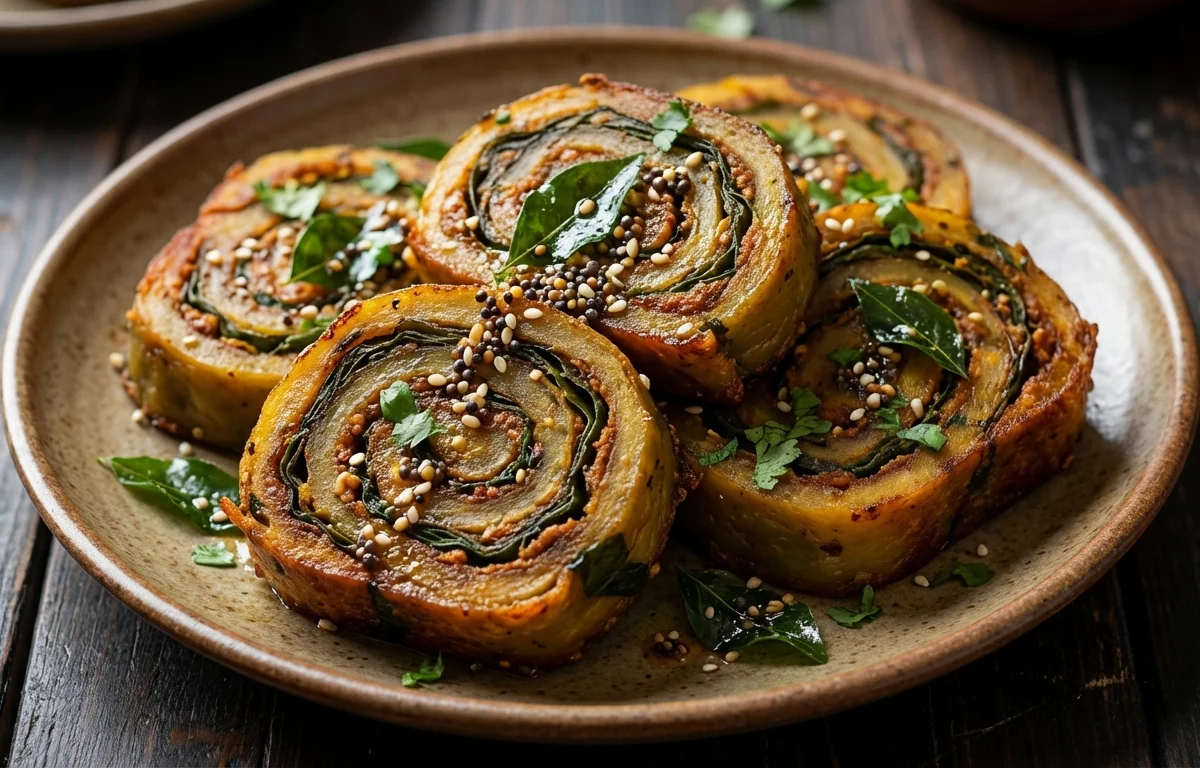
Pathrode
Pathrode is a coastal Karnataka classic made by spreading a spiced rice and lentil paste over colocasia leaves, rolling them up, steaming until firm, and slicing into soft, flavorful rounds with a gentle tang and warmth.
For 8 servings
- prep · ~240 min
Soak the rice and lentils.
Wash the rice, toor dal, and chana dal well. Soak them together in enough water for 4 hours, then drain completely.
- prep · ~10 min
Prepare the leaves.
1.Wash the colocasia leaves thoroughly and pat them dry.2.Trim the thick stalks and gently shave any very thick center veins so the leaves roll easily.3.Keep the leaves flat and ready for layering.TIPHandle the leaves gently so they do not tear while spreading the paste. - mix · ~8 min
Grind the spiced batter.
1.Add the soaked rice, toor dal, chana dal, dry red chili, tamarind, jaggery, coriander seeds, cumin seeds, turmeric powder, asafoetida, and salt to a grinder.2.Add a little water and grind to a thick, slightly coarse paste.3.The batter should be spreadable, not runny.TIPKeep the batter thick so it clings to the leaves and the rolls hold their shape after steaming. - assemble · ~10 min
Layer the leaves and spread the batter.
1.Place one large leaf shiny side down on the work surface.2.Spread a thin, even layer of batter over it.3.Place a second leaf on top, alternating direction if needed, and spread more batter.4.Repeat with 3 to 4 leaves to make one stack. - assemble · ~7 min
Fold and roll the pathrode.
1.Fold the sides of the leaf stack inward.2.Roll tightly from the base to the tip into a firm log.3.Repeat with the remaining leaves and batter to make a second log.TIPA tight roll gives neat slices after steaming. - steam · ~30 min
Steam the rolls until firm.
Place the rolls in a steamer in a single layer. Steam on medium heat until the leaves are fully cooked and the rolls feel firm, about 25 to 30 minutes.
- rest · ~10 min
Cool the rolls slightly.
Let the steamed rolls rest for 10 minutes so they firm up and slice cleanly.
- assemble
Slice the pathrode.
Cut each roll into 4 equal slices to make 8 pieces total.
- serve
Serve warm.
Serve Pathrode warm as a snack or side dish.
What to keep in mind.
7 tips from the recipe — small details that make a real difference to the final dish.
- 1If the colocasia leaves are very mature, shave the thick center rib well so the roll bends without cracking.
- 2Grind the batter slightly coarse, not silky smooth; that texture gives Pathrode its characteristic bite after steaming.
- 3Spread the batter all the way to the edges in a thin layer so the leaf stack sticks together evenly.
- 4Alternate the direction of each leaf in the stack to create a more even log and neater slices.
- 5Steam on medium heat rather than high, so the rolls cook through without water dripping onto them.
- 6Rest the rolls before slicing; hot Pathrode tends to crumble and the layers can separate.
- 7Leftover slices can be pan-fried the next day until crisp at the edges for a more robust, toasted flavor.
Adapt it for your goals.
Pan-fried
After steaming and slicing, shallow-fry the pieces for crisp edges and a deeper roasted flavor.
spicierSpicier
Increase the dry red chilies for a hotter coastal-style Pathrode with more punch against the jaggery.
no jaggeryNo-jaggery
Skip the jaggery for a sharper, more savory version if you prefer the tamarind and chili to dominate.
coconut addedCoconut-added
Add a little fresh grated coconut to the batter for a softer texture and a sweeter coastal Karnataka note.
Why this is on our healthy list.
Leafy Green Goodness
Colocasia leaves add plant compounds and leafy vegetable value, making the dish more nourishing than a plain rice snack.
Plant-Based Protein
Toor dal and chana dal contribute protein and make the steamed rolls more satisfying and balanced.
Steamed, Not Deep-Fried
Because Pathrode is steamed, it delivers rich flavor and texture without the heaviness of deep frying.
Fiber From Rice and Lentils
The combination of lentils, spices, and leaves offers fiber that helps make this dish filling.
Frequently asked questions
That usually means the colocasia leaves were not cooked enough or needed more souring from tamarind. Steam until fully firm and cooked through.