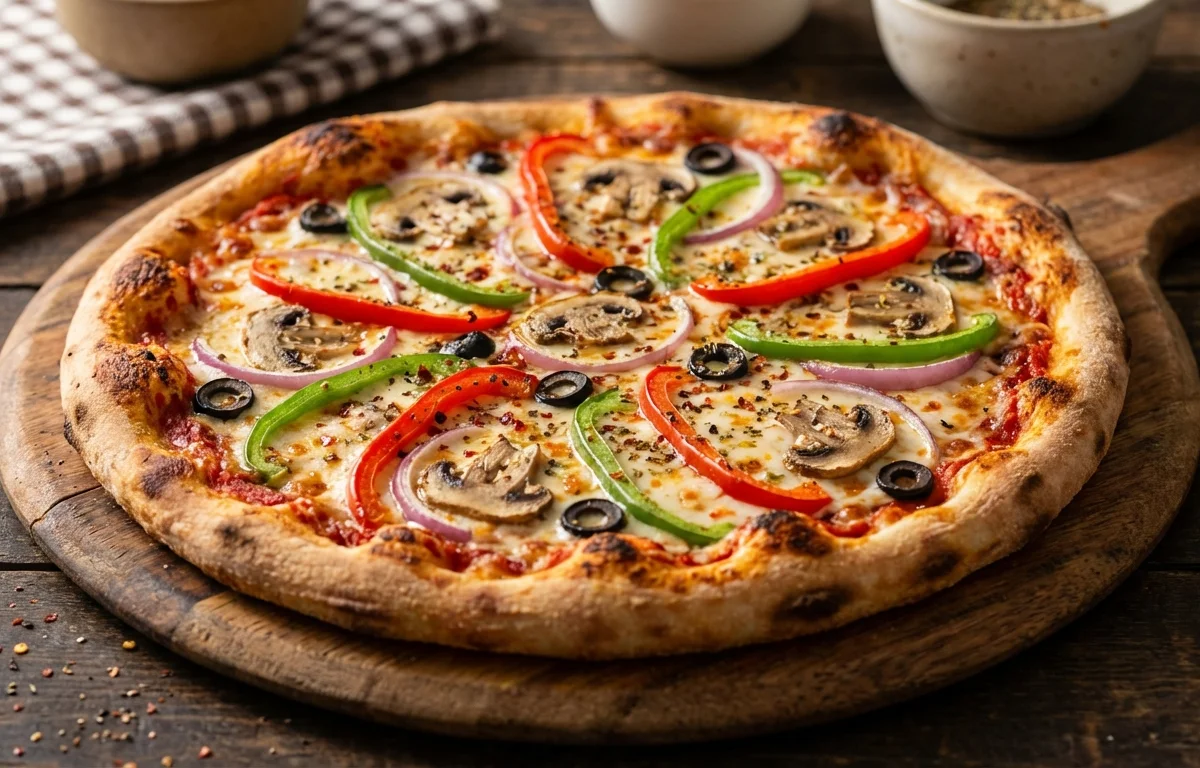
Veggie Pizza
A colorful, loaded pizza with a crispy homemade crust, tangy tomato sauce, and a mountain of fresh vegetables. Melty mozzarella ties together bell peppers, mushrooms, onions, and olives for a satisfying weeknight dinner that beats delivery every time.
For 4 servings
- prep · ~7 min
Activate the yeast.
In a small bowl, combine warm water, sugar, and yeast. Stir gently and let sit for 5-7 minutes until foamy and fragrant.
- knead · ~10 min
Make the pizza dough.
1.In a large bowl, combine flour, salt, and 2 tbsp olive oil.2.Pour in the activated yeast mixture.3.Mix with a wooden spoon until a shaggy dough forms.4.Turn onto a floured surface and knead 8 minutes until smooth and elastic.TIPThe dough should bounce back when poked — that's how you know it's ready. - rest · ~45 min
Let the dough rise.
Place dough in a lightly oiled bowl, cover with a damp towel, and let rise in a warm spot until doubled in size.
TIPIf your kitchen is cold, place the bowl in a turned-off oven with the light on. - prep · ~20 min
Make the pizza sauce.
1.Score an X on the bottom of each tomato, blanch in boiling water for 30 seconds, then transfer to ice water.2.Peel off the skins, crush tomatoes by hand or with a fork.3.Heat 1 tsp olive oil in a saucepan, sauté minced garlic until fragrant (1 min).4.Add crushed tomatoes, oregano, basil, and red chili powder.5.Simmer on low heat for 15 minutes until thickened, stirring occasionally.TIPCrushing by hand gives a rustic texture — don't over-blend the sauce. - saute · ~9 min
Pre-cook the vegetables.
1.Heat 1 tsp olive oil in a skillet over medium-high heat.2.Add sliced mushrooms and cook 3 minutes until they release water and start to brown.3.Add bell pepper and onion, sauté 3 minutes until just softened.4.Add corn and cook 1 minute. Remove from heat.TIPDon't skip this step — raw vegetables release water in the oven and make the crust soggy. - prep · ~15 min
Preheat the oven to 475°F.
Place a baking sheet or pizza stone in the oven while it preheats. A hot surface is key to a crispy crust.
- assemble · ~5 min
Shape the pizza.
1.Punch down the risen dough and divide in half.2.On a floured surface, roll each piece into a 12-inch round.3.Sprinkle cornmeal on a piece of parchment paper and transfer the dough.4.Spread half the sauce on each round, leaving a 1-inch border.5.Top with shredded mozzarella, sautéed vegetables, and sliced olives.TIPSlide the pizza (on parchment) directly onto the preheated baking sheet — the parchment handles the transfer easily. - bake · ~15 min
Bake the pizza until golden and bubbly.
Carefully transfer the pizza to the hot baking sheet. Bake for 12-15 minutes until the crust is golden brown and the cheese is bubbling with light brown spots.
- garnish · ~2 min
Garnish with fresh basil and serve.
Remove from oven, scatter fresh basil leaves on top. Let cool 2 minutes, then slice and serve hot.
TIPLetting the pizza rest briefly helps the cheese set so the toppings don't slide off.
What to keep in mind.
6 tips from the recipe — small details that make a real difference to the final dish.
- 1If your kitchen is cold, let the dough rise in a turned-off oven with the light on for consistent warmth.
- 2Crush the tomatoes by hand for a rustic, chunky sauce texture — avoid over-blending.
- 3Pre-cook mushrooms until they release water and brown to prevent a soggy pizza crust.
- 4Slide the pizza (on parchment) directly onto a preheated baking sheet for a crisp bottom crust.
- 5Let the baked pizza rest 2 minutes before slicing so the cheese sets and toppings stay put.
- 6For extra flavor, brush the crust edge with garlic-infused olive oil before baking.
Adapt it for your goals.
Gluten-free
Substitute a 1:1 gluten-free flour blend for the all-purpose flour; the dough will be stickier—add extra dusting flour as needed.
high proteinHigh-protein
Add 1 cup cooked chickpeas or shredded grilled chicken on top of the vegetables for extra protein without overpowering the veggie flavor.
veganVegan
Replace mozzarella with shredded vegan mozzarella or a cashew-based cheese; the pre-cooked vegetables and homemade sauce keep it flavorful.
Why this is on our healthy list.
High in Dietary Fiber
Bell peppers, mushrooms, onions, and corn provide natural fiber that supports healthy digestion.
Rich in Antioxidants
Tomatoes and bell peppers are loaded with vitamin C and lycopene, which help protect cells from damage.
Low in Saturated Fat
Using moderate mozzarella and olive oil keeps saturated fat lower than typical meat-heavy pizzas.
Good Source of B Vitamins
Mushrooms and corn supply B vitamins like niacin and folate, important for energy metabolism.
Frequently asked questions
Raw vegetables release water during baking, which can soak the crust and make it soggy — pre-cooking removes that moisture.