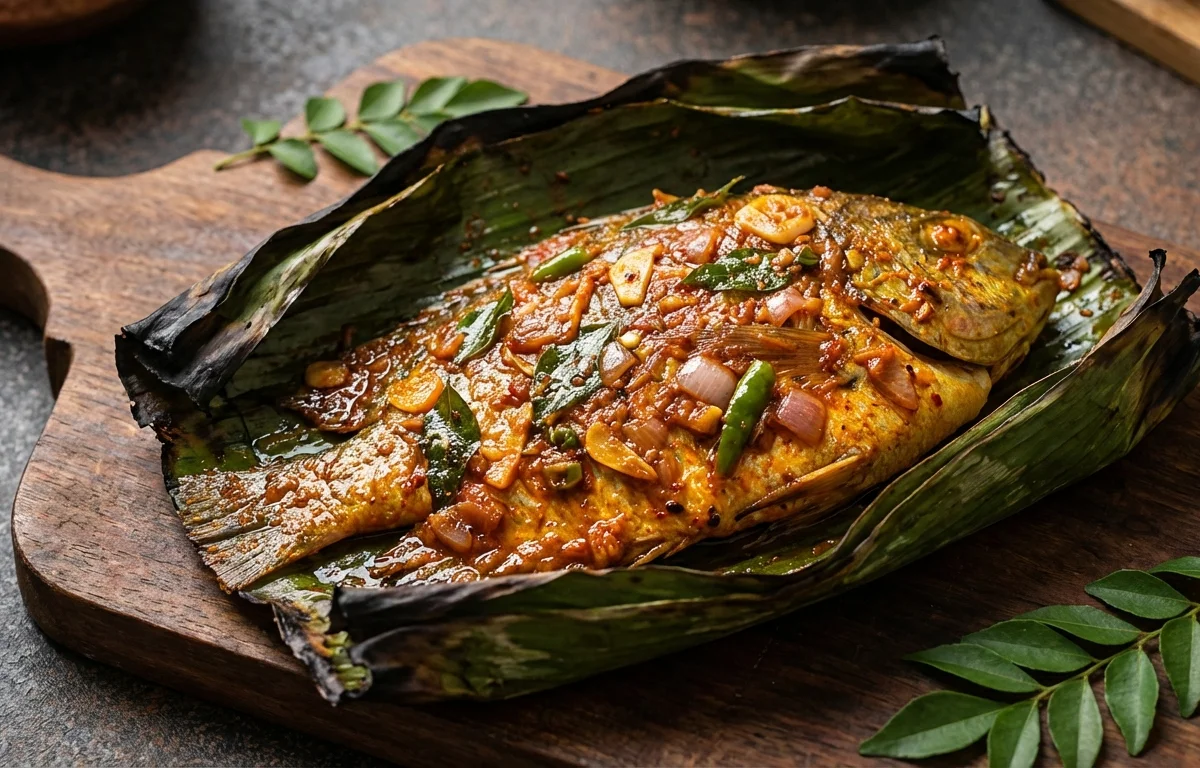
Meen Pollichathu
A show-stopping Kerala delicacy where whole fish is marinated in a tangy, spicy masala, wrapped in banana leaves, and pan-cooked until smoky and fragrant. The banana leaf locks in moisture, infusing the fish with a subtle earthy aroma while keeping it incredibly tender. Best enjoyed straight from the leaf with steamed rice.
For 4 servings
- prep · ~15 min
Prepare the marinated fish.
1.Clean the fish, pat dry completely, and score deep cuts on both sides.2.Mix together 0.25 tsp salt, lemon juice, and 1 pinch of turmeric powder.3.Rub this mixture all over the fish, pushing into the scored cuts.4.Set aside to marinate for 15 minutes while preparing the masala.TIPPat the fish bone-dry before marinating. Excess moisture dilutes the flavor and steams instead of sears. - prep · ~20 min
Make the spicy masala paste.
1.Heat 2 tbsp coconut oil in a pan over medium heat until shimmering.2.Add sliced garlic and julienned ginger. Sauté until fragrant and lightly golden (1-2 min).3.Add green chilies and curry leaves, letting them crackle for 30 seconds.4.Add sliced shallots. Cook, stirring frequently, until deep golden brown (8-10 min).5.Reduce heat to low. Add turmeric powder, red chili powder, coriander powder, and black pepper.6.Stir for 30 seconds until spices are fragrant but not burnt.7.Add chopped tomatoes and salt. Cook until tomatoes break down completely and the mixture is thick (5-6 min).8.Stir in tamarind pulp. Cook for 1 more minute until well blended.9.Turn off the heat and let the masala cool slightly.TIPTake your time caramelizing the shallots. Deep golden brown, not just translucent, is what gives the signature sweet-savory depth to Kerala pollichathu. - prep · ~3 min
Prepare the banana leaves.
1.Gently pass each banana leaf piece over an open gas flame for 10-15 seconds per side.2.The leaf will soften and turn a brighter green. This prevents cracking during wrapping.3.Wipe the leaves clean with a damp kitchen towel.4.Lay two leaves overlapping on the counter to create a wide wrapping surface.TIPWilting the leaves over flame makes them pliable and releases a subtle smoky aroma that infuses the fish as it cooks. - assemble · ~5 min
Assemble the fish parcels.
1.Place half of the masala paste in the center of the prepared banana leaf.2.Place the marinated fish directly on top of the masala.3.Cover the fish entirely with the remaining masala paste, packing it gently into the scored cuts.4.Fold the banana leaf over the fish like a parcel, tucking in the ends.5.Secure with kitchen twine or toothpicks if needed.TIPFold the leaf tight enough to hold shape but not so tight it tears. You want the fish to steam inside a snug cocoon. - fry · ~18 min
Pan-cook the fish parcel.
1.Place a large flat skillet or tawa over low-medium heat.2.Place the wrapped banana leaf parcel directly on the skillet.3.Cook for 8-10 minutes on the first side, pressing down gently with a spatula.4.The leaf will char slightly and release an incredible aroma.5.Carefully flip the parcel and cook the other side for another 7-8 minutes.6.You will hear gentle sizzling and the leaf will be charred in spots — that signals it is done.TIPKeep the heat moderate. High heat burns the leaf before the fish cooks through. You want a slow, steady char that steams the fish perfectly inside. - serve · ~1 min
Serve the Meen Pollichathu hot from the leaf.
1.Transfer each parcel to a plate.2.Open the parcel at the table so everyone gets that burst of smoky banana-leaf aroma.3.Serve immediately with steamed rice.
What to keep in mind.
7 tips from the recipe — small details that make a real difference to the final dish.
- 1Choose a firm, oil-rich fish like pomfret or sea bass so it holds up during cooking.
- 2Deep caramelize the shallots until golden brown for the signature sweet-savory depth.
- 3Wilt banana leaves over an open flame until they turn bright green and pliable to prevent tearing.
- 4Pack the masala into the scored cuts on the fish for maximum flavor penetration.
- 5Cook the parcel over low-medium heat; high heat burns the leaf before the fish cooks through.
- 6Let the parcel rest for 2 minutes after cooking to allow juices to redistribute before opening.
- 7Make the masala a day ahead and refrigerate to deepen flavors.
Adapt it for your goals.
Low-oil
Reduce coconut oil to 1 tbsp and use a non-stick pan; the banana leaf already traps steam, so less oil still yields moist fish.
high proteinHigh-protein
Swap the whole fish for 600g of skinless salmon fillets; adjust cooking time to 6 minutes per side as fillets cook faster.
jainJain
Omit garlic and onion (shallots), and replace with asafoetida (hing) and extra ginger-garlic paste made from ginger and asafetida; use a pinch of sugar to balance acidity.
veganVegan
Replace fish with 600g firm tofu or banana blossom (pre-boiled and shredded); marinate and cook the same way for a plant-based version.
spicy variantSpicy variant
Add 3-4 dried red chilies (soaked) to the masala paste for extra heat, and finish with a teaspoon of crushed black pepper.
Why this is on our healthy list.
Rich in Omega-3s
Fish like pomfret or sea bass provide heart-healthy omega-3 fatty acids, which support brain function and reduce inflammation.
Antioxidant-Rich Spices
Turmeric, curry leaves, and black pepper contain potent antioxidants that help combat oxidative stress and boost immunity.
Good Source of Lean Protein
This dish delivers high-quality, easily digestible protein from fish, essential for muscle repair and overall health.
Digestive Aid from Tamarind
Tamarind pulp is a natural digestive aid, helping to soothe the stomach and promote smooth digestion.
Low in Saturated Fat
Cooked in minimal coconut oil and steamed in banana leaf, this dish keeps saturated fat low compared to deep-fried fish preparations.
Frequently asked questions
Yes, thaw them completely, then wipe dry and wilt over an open flame or in a dry skillet until pliable before wrapping.