
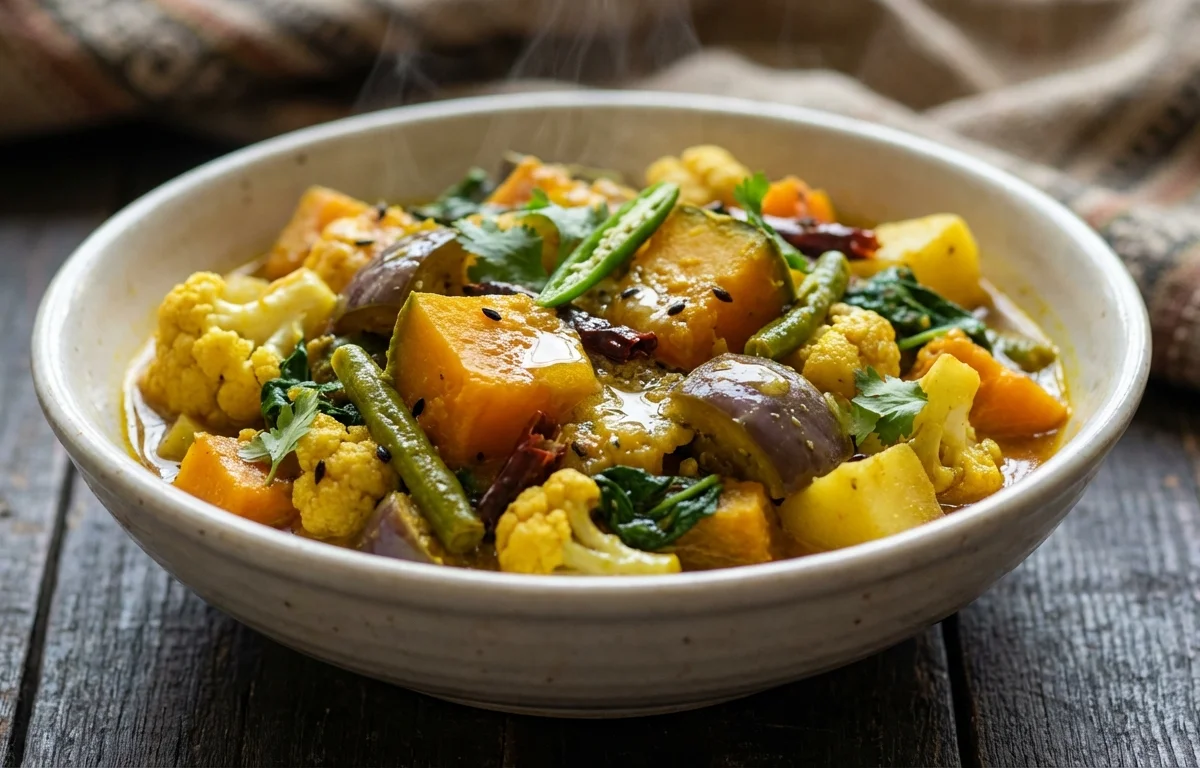
Vegetable Ghonto
A soulful Bengali mishmash of seasonal vegetables, gently cooked with minimal spices and a hint of panch phoron. The vegetables are pressure-cooked to tenderness, then mashed and stir-fried until they meld into a semi-dry, comforting medley. A staple in everyday Bengali meals, this ghonto brings together the mild sweetness of pumpkin, potatoes, and brinjal with the earthy notes of green bananas and lentils.
For 4 servings
- prep · ~15 min
Prep the vegetables and roast the lentils.
1.Peel and cube potato, sweet potato, green banana, and pumpkin into 1-inch chunks.2.Cube the brinjal into similar sized chunks and soak in salted water to prevent browning.3.Dry roast the moong dal in a small pan over low heat until lightly golden and fragrant (2-3 min).4.Grind the roasted dal to a coarse powder using a mortar pestle or grinder. Set aside.TIPKeep the vegetable chunks uniform in size so they cook evenly in the pressure cooker. - pressure cook · ~10 min
Pressure cook the vegetables.
1.Place all the cubed vegetables in the pressure cooker.2.Add turmeric powder, salt, and 0.25 cup water. Mix gently.3.Close the lid and pressure cook on medium heat for 2 whistles.4.Turn off heat and allow pressure to release naturally. - prep · ~1 min
Mash the cooked vegetables lightly.
Open the cooker once pressure is released. Using the back of a ladle or a potato masher, gently mash the vegetables until roughly broken down. Keep the texture chunky with some pieces intact — not a puree. Drain any excess water if too watery and reserve.
- temper · ~3 min
Temper the mustard oil and whole spices.
1.Heat mustard oil in a kadhai over medium-high heat until it reaches its smoking point (pale smoke appears).2.Lower heat to medium and let it cool for 15 seconds.3.Add bay leaf and dried red chilies. Sauté until fragrant (20 sec).4.Add panch phoron and let it crackle and pop completely (30-40 sec).TIPHeating mustard oil past its smoke point removes its raw pungency and makes it nuttier. - saute · ~3 min
Sauté the aromatics and spice powders.
1.Add the ginger paste to the tempered oil and sauté until the raw aroma disappears (1 min).2.Add red chili powder and cumin powder. Stir continuously for 20 seconds.3.Add the mashed vegetables to the pan and mix well with the spices.4.Add sugar and mix thoroughly. - saute · ~7 min
Stir-fry the mashed vegetables with roasted dal.
1.Add the roasted moong dal powder to the pan.2.Stir continuously on medium-low heat, scraping the bottom of the pan to prevent sticking.3.Cook until the mixture comes together, dries out slightly, and the oil begins to separate at the edges (5-7 min).4.Check salt and adjust if needed.TIPScraping the slightly caramelised bits from the bottom of the pan builds deep, savoury flavour. - garnish · ~1 min
Finish with ghee and coriander.
Drizzle ghee over the hot ghonto and sprinkle freshly chopped coriander leaves. Give it one final gentle mix and serve immediately.
What to keep in mind.
6 tips from the recipe — small details that make a real difference to the final dish.
- 1Soak the cubed brinjal in salted water immediately after cutting to prevent discoloration and reduce bitterness.
- 2Keep vegetable chunks uniform (1-inch) so they cook evenly and mash to a consistent texture.
- 3Let the pressure release naturally for a softer, more uniform mash — don't force it open.
- 4Drain excess cooking liquid before mashing for a dry, cohesive final texture.
- 5Scrape the caramelised bits from the kadhai while stir-frying for deep, savoury flavour.
- 6Adjust the sugar based on the natural sweetness of your pumpkin and sweet potato.
Adapt it for your goals.
Vegan
Replace ghee with an extra teaspoon of mustard oil or any neutral oil. The dish remains authentic and fully plant-based.
low oilLow-oil
Dry-roast the spices in a non-stick pan and skip the tempering oil; the cooked vegetables already release moisture for stir-frying.
high proteinHigh-protein
Add 1/4 cup of cooked chana dal or brown chickpeas after mashing the vegetables to boost protein and add textural contrast.
jainJain
Omit the onion-garlic-like ginger paste (or use a tiny pinch of asafoetida) and use rock salt instead of regular salt to suit Jain dietary restrictions.
Why this is on our healthy list.
High in Dietary Fiber
The mix of pumpkin, sweet potato, brinjal, green banana, and moong dal provides a generous amount of fiber that supports digestion and satiety.
Rich in Beta-Carotene
Pumpkin and sweet potato are excellent sources of beta-carotene, which the body converts to vitamin A for healthy vision and immunity.
Good Source of Plant Protein
Moong dal (split mung beans) adds a complete amino acid profile when paired with the grains or rice typically served alongside ghonto.
Low in Saturated Fat
Made primarily with vegetables and a modest amount of mustard oil, this dish is naturally low in unhealthy saturated fats.
Frequently asked questions
Yes, you can substitute with seasonal choices like raw papaya, beans, carrots, or even cauliflower — just keep the total volume similar and cube them uniformly.



-curry.webp)
.webp)