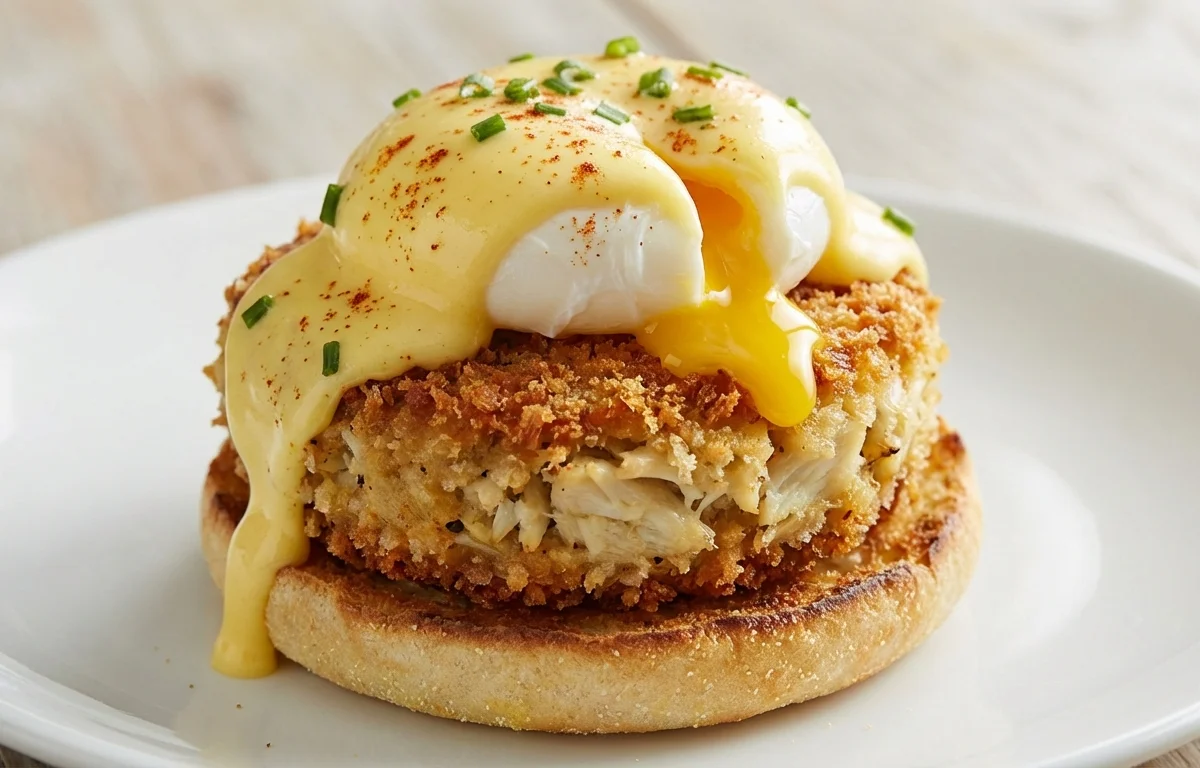
Crab Benedict
Buttery toasted English muffins topped with sweet, lump crab cakes, perfectly poached eggs, and a velvety blanket of homemade hollandaise. This coastal twist on the classic brunch dish brings a taste of the seaside to your weekend table in under an hour.
For 4 servings
- mix · ~15 min
Make the crab cake mixture.
1.In a large bowl, gently pick through the crab meat to remove any remaining shell fragments.2.Add mayonnaise, Dijon mustard, Worcestershire sauce, Old Bay seasoning, cayenne pepper, breadcrumbs, and parsley.3.Fold together gently until just combined, keeping the crab lumps intact. Avoid overmixing.4.Divide the mixture into 4 equal portions and shape into patties about 1-inch thick.5.Cover with plastic wrap and refrigerate for 15 minutes to firm up.TIPHandle the crab gently — you want visible, sweet lumps in the final crab cake, not a paste. - prep · ~5 min
Set up the double boiler for hollandaise.
Fill the bottom of a double boiler with about 2 inches of water and bring to a gentle simmer over medium heat. Make sure the water does not touch the bottom of the top bowl.
- mix · ~4 min
Prepare the hollandaise base.
1.In the top of the double boiler, off the heat, whisk the 4 egg yolks with the lemon juice until the mixture is pale and slightly thickened (about 1 minute).2.Place the bowl over the barely simmering water and whisk constantly for 2 to 3 minutes, until the yolks are thick and ribbon-like.3.Remove the bowl from the heat if you see any sign of scrambling around the edges — the residual steam is often enough to finish.TIPThe water should be at a gentle simmer, not a boil. Too much heat turns your sauce into scrambled eggs. - mix · ~3 min
Finish the hollandaise.
1.Slowly drizzle in the melted butter in a thin, steady stream while whisking constantly.2.Once all the butter is incorporated, add a pinch of salt and whisk one final time.3.Remove the double boiler from the heat but keep the sauce in the warm bowl over the warm water, covered loosely with foil, until ready to serve. Whisk occasionally. - prep · ~10 min
Cook the crab cakes.
1.Heat 2 tablespoons of oil in a large nonstick skillet over medium heat until shimmering.2.Gently place the chilled crab cakes into the pan without crowding.3.Cook for 4 to 5 minutes per side until golden brown and heated through. Transfer to a paper towel-lined plate.TIPAvoid moving the crab cakes once they hit the pan for the first 3 minutes — this ensures a good crust forms. - boil · ~12 min
Poach the eggs.
1.Fill a medium saucepan with about 3 inches of water. Add 1 teaspoon of salt and 2 tablespoons of white vinegar.2.Bring to a gentle simmer (small bubbles on the bottom, no rolling boil).3.Crack each egg into a small ramekin or cup.4.Stir the water to create a gentle vortex and slide one egg into the center. Repeat with up to two eggs at a time.5.Cook for 3 to 4 minutes for a runny yolk. Remove with a slotted spoon and drain on a paper towel.TIPFresh eggs hold together best. If your egg white spreads, use a spoon to gently nudge the whites back toward the yolk during the first 30 seconds. - prep · ~3 min
Toast the English muffins.
Split the English muffins in half and toast them until golden and crisp. Place 2 halves on each of the 4 serving plates.
- assemble · ~3 min
Build the Crab Benedict.
1.Place one warm crab cake on top of each toasted English muffin half.2.Carefully set a poached egg on top of each crab cake.3.Spoon a generous 2 to 3 tablespoons of warm hollandaise over each egg.4.Garnish with a sprinkle of chopped fresh parsley and a light dusting of cayenne or paprika.TIPWarm your plates slightly before assembling — hollandaise breaks if it hits a cold plate. - serve
Serve immediately.
Bring the plates to the table right away while the hollandaise is still warm and the eggs are runny. Serve with a knife and fork.
What to keep in mind.
7 tips from the recipe — small details that make a real difference to the final dish.
- 1Pick through crab meat meticulously – even small shell bits ruin the silky texture.
- 2Chill the crab cakes for at least 15 minutes so they hold together during frying.
- 3Don't crowd the pan – fry in batches if needed to get a deep golden crust.
- 4Keep the hollandaise water at a gentle simmer, not a boil, to avoid scrambled yolks.
- 5Use the freshest eggs possible for poaching – they form tight, compact whites.
- 6Slide poached eggs onto a paper towel to drain excess vinegar water before plating.
- 7Warm serving plates slightly – cold plates cause hollandaise to seize and break.
Adapt it for your goals.
Low-oil
Pan-fry the crab cakes in a nonstick skillet with just 1 teaspoon of oil, or bake them at 400°F for 12 minutes, flipping halfway, for a lighter finish.
gluten freeGluten-free
Swap plain breadcrumbs for gluten-free panko or almond flour to keep the cakes bound without gluten.
dairy freeDairy-free
Use a plant-based butter or vegan margarine in the hollandaise (melt and emulsify slowly) and skip the butter on the English muffins.
high proteinHigh-protein
Add 2 tablespoons of plain Greek yogurt to the crab mixture and replace half the breadcrumbs with crushed pork rinds for a protein boost without sacrificing texture.
Why this is on our healthy list.
Lean Protein from Crab
Lump crab meat is naturally low in fat and provides high-quality protein, supporting muscle repair and satiety.
Rich in Selenium
Crab is an excellent source of selenium, an antioxidant mineral that supports thyroid health and immune function.
Omega-3s from Egg Yolks
The egg yolks in both the poached eggs and hollandaise supply omega-3 fatty acids, which promote heart and brain health.
Vitamin B12 Boost
Crab meat is naturally abundant in vitamin B12, essential for energy production and nervous system health.
Frequently asked questions
Most likely the mixture was too wet or not chilled long enough. Refrigerate the patties for at least 15 minutes and use a thin spatula to flip gently.