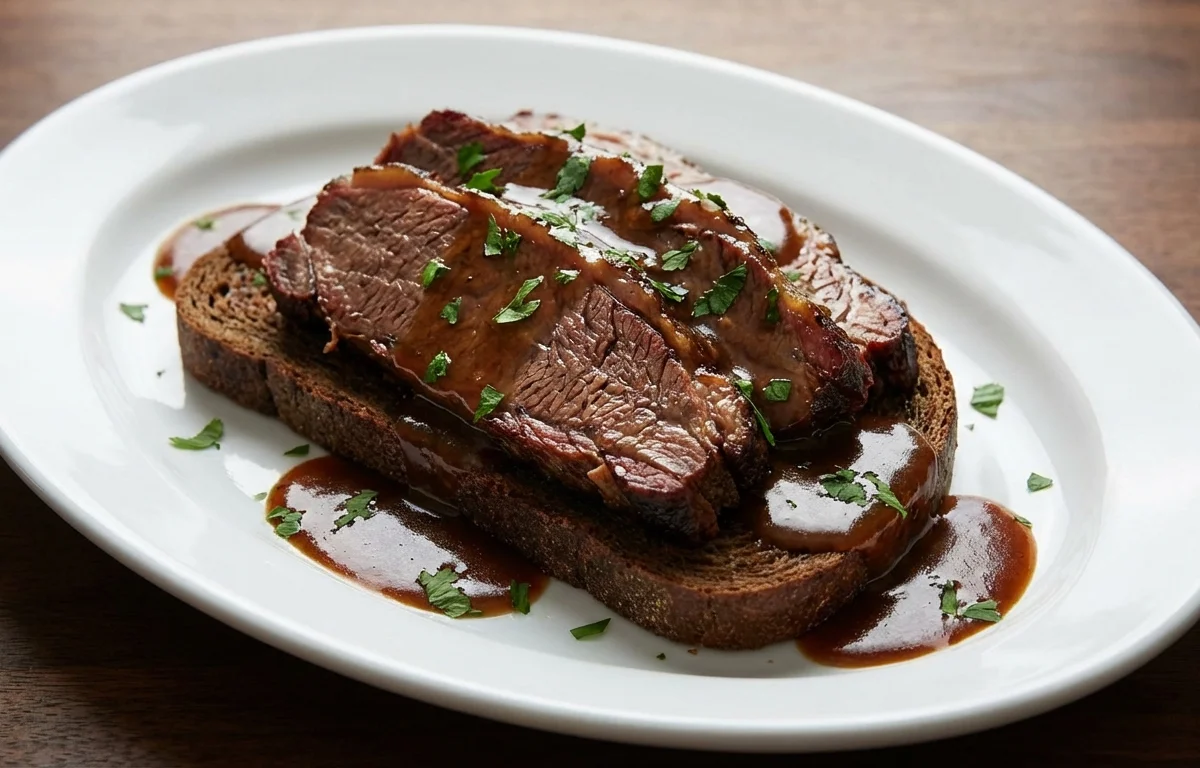
Hot Brisket on Rye with Gravy
Tender, slow-braised beef brisket piled high on hearty rye bread and smothered in a rich, savory pan gravy. This classic deli-style sandwich is messy, deeply satisfying, and brings the warmth of a Jewish-American kitchen to your table.
For 4 servings
- prep
Preheat the oven and season the brisket.
1.Preheat the oven to 325°F (160°C).2.Pat the 1 kg beef brisket completely dry with paper towels.3.Season both sides with 1 pinch salt and 1 pinch black pepper, pressing the seasoning in.TIPDrying the meat is essential—it allows a deep brown sear. Don't skip this. - fry · ~10 min
Sear the brisket.
1.Heat 2 tbsp vegetable oil in a dutch oven over medium-high heat until shimmering.2.Sear the brisket pieces for 4-5 minutes on each side until a dark brown crust forms.3.Transfer the browned meat to a plate and set aside.TIPDon't crowd the pot. Sear in two batches if the pieces don't fit with space around them. - saute · ~7 min
Build the aromatic base.
1.Lower the heat to medium and add the 2 sliced onions to the pot.2.Sauté until soft and translucent, about 5 minutes.3.Add 4 minced garlic cloves and cook until fragrant, about 1 minute.4.Stir in 2 tbsp tomato paste and cook for 1 more minute to remove the raw taste. - simmer · ~5 min
Braise the brisket.
1.Pour in 750 ml water and 1 tbsp soy sauce. Scrape the browned bits from the bottom of the pot with a wooden spoon.2.Add the chopped carrots, 2 bay leaves, and the seared brisket back into the pot.3.Bring the liquid to a gentle simmer on the stovetop.TIPThe liquid should come about halfway up the meat. It doesn't need to cover it completely. - bake · ~200 min
Braise the brisket until fork-tender.
1.Cover the dutch oven tightly with a lid and transfer to the preheated oven.2.Cook for 3 to 3.5 hours, turning the meat once halfway through.3.The brisket is done when a fork slides in with very little resistance.TIPIf the meat is still tight, put it back in for another 20 minutes. Brisket relaxes only when it's fully done. - rest · ~15 min
Rest the meat.
1.Carefully lift the brisket from the pot and set it on a cutting board.2.Tent with foil and let it rest for 15 minutes while you make the gravy.3.Strain the braising liquid into a saucepan, pressing on the solids. Discard solids. - simmer · ~7 min
Make the pan gravy.
1.Skim any excess fat from the surface of the strained liquid.2.Place the saucepan with the liquid over medium heat and bring to a low simmer.3.Take a ladleful of the hot liquid into a small bowl and whisk in 2 tbsp flour until a smooth slurry forms.4.Whisk the slurry back into the saucepan and simmer until the gravy coats the back of a spoon, about 5-7 minutes.TIPIf the gravy gets too thick, thin it with a splash of water. Too thin? Simmer a few minutes longer. - prep
Slice the brisket.
1.Find the direction of the grain on the rested brisket.2.Using a sharp knife, slice the meat thinly, against the grain.TIPSlicing against the grain shortens the muscle fibers, making each bite tender rather than chewy. - assemble
Assemble the sandwiches.
1.Lightly toast the 8 slices of rye bread.2.Pile a generous amount of sliced brisket on half the bread slices.3.Spoon warm gravy over the meat, then top with the remaining bread slices.4.Serve extra gravy on the side for dipping. - garnish
Garnish with chopped parsley and serve immediately.
Sprinkle the sandwiches with the chopped parsley. Serve piping hot with a side of pickles and a small bowl of the extra gravy.
What to keep in mind.
7 tips from the recipe — small details that make a real difference to the final dish.
- 1Score the fat cap in a crosshatch pattern before searing to render fat more evenly.
- 2Let the brisket come to room temp for 30 minutes before searing for more even cooking.
- 3If the braising liquid doesn't cover the meat halfway, add a splash more water or broth.
- 4For extra flavor, deglaze the pot with a splash of dry red wine before adding water.
- 5Rest the brisket at least 15 minutes before slicing so juices redistribute.
- 6Slice the brisket against the grain at a slight angle for wider, tender slices.
- 7Make the gravy a day ahead and reheat gently—it thickens and deepens in flavor.
Adapt it for your goals.
Lower-fat
Trim all visible fat from the brisket before cooking and skip the oil sear by using a nonstick pan or oven-browning. This reduces overall fat while still delivering tender beef.
gluten freeGluten-free
Replace the rye bread with gluten-free rye-style bread and use a gluten-free flour blend or cornstarch slurry instead of all-purpose flour for the gravy. Still delivers the same deli comfort.
extra herbyExtra-herby
Add 2 sprigs of fresh thyme and 1 star anise to the braising liquid for a subtle aromatic lift. This brightens the rich beef without overwhelming the classic flavor.
Why this is on our healthy list.
High in Protein
Beef brisket is an excellent source of high-quality protein, which supports muscle maintenance and satiety.
Rich in Iron
Red meat like brisket provides heme iron, a form of iron that is easily absorbed to help prevent anemia.
Vegetable-Based Antioxidants
Carrots and onions in the braise contribute beta-carotene and quercetin, which have antioxidant properties.
Frequently asked questions
Yes. After searing, transfer everything to a slow cooker and cook on low for 8–10 hours or high for 5–6 hours until fork-tender. Then make the gravy on the stovetop.