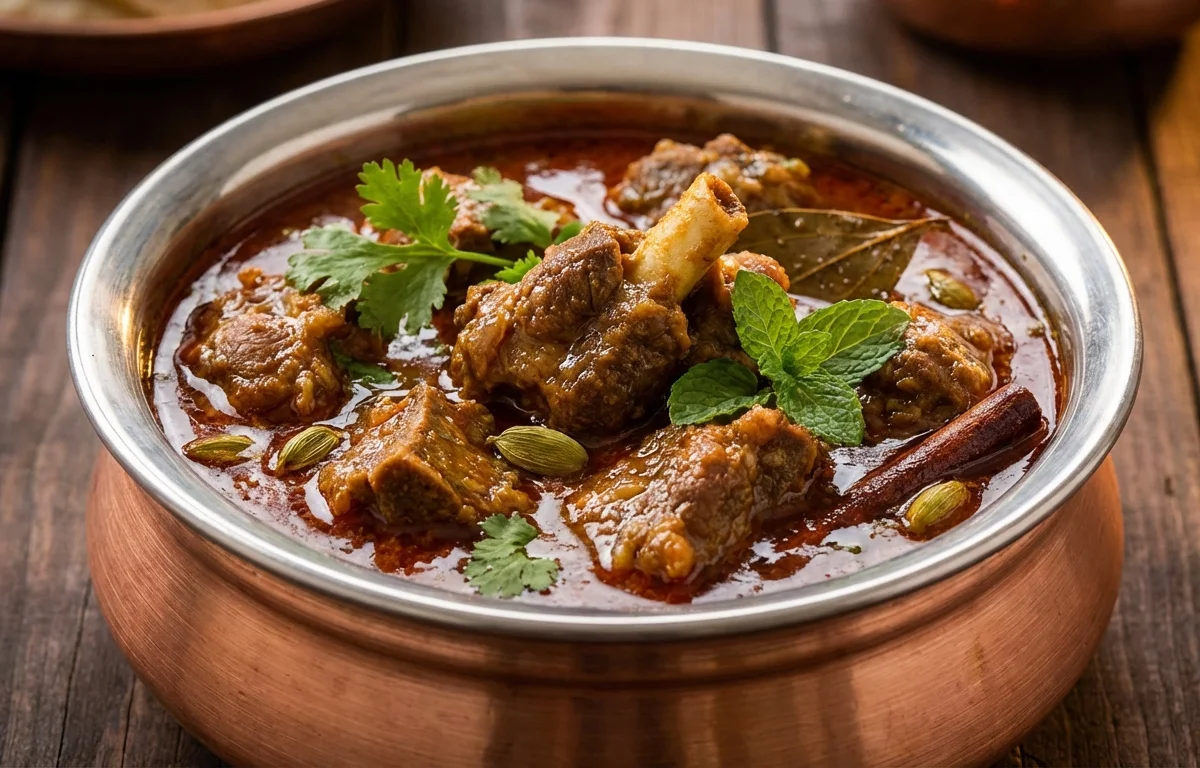
Hyderabadi Mutton Curry
A rich, home-style Hyderabadi curry where mutton cooks slowly with browned onions, yogurt, warm spices, and herbs until the gravy turns deep, fragrant, and full of flavor. It pairs especially well with rice, naan, or simple roti.
For 4 servings
- prep · ~15 min
Prepare the mutton and base ingredients.
1.Wash the mutton pieces and drain well.2.Slice the onions thinly and chop the tomatoes.3.Whisk the yogurt until smooth.4.Slit the green chilies and keep the mint and coriander ready. - saute · ~10 min
Brown the whole spices and onions.
1.Heat oil and ghee in a pressure cooker over medium heat.2.Add bay leaf, cinnamon, green cardamom, cloves, and cumin seeds.3.Let the spices sizzle for 20 to 30 seconds until fragrant.4.Add the sliced onions and cook until deep golden brown.TIPKeep the heat medium while browning onions so they color evenly without turning bitter. - saute · ~8 min
Cook the aromatics and tomatoes.
1.Add ginger-garlic paste and sauté until the raw smell disappears.2.Add chopped tomatoes and green chilies.3.Cook until the tomatoes soften and the mixture looks jammy.4.Stir in turmeric powder, red chili powder, coriander powder, and cumin powder. - mix · ~6 min
Coat the mutton with the masala.
Add the mutton and salt, then mix well so every piece is coated in the onion-tomato masala. Cook for 5 to 6 minutes, stirring often, until the meat changes color.
- mix · ~4 min
Add yogurt, mint, and water.
Lower the heat and stir in the yogurt a little at a time so it blends smoothly. Add mint leaves and hot water, then mix well and scrape the bottom of the cooker.
TIPAdding yogurt on low heat helps keep the gravy smooth and prevents curdling. - pressure cook · ~30 min
Pressure cook until the mutton is tender.
Cover and cook on medium heat until the mutton turns tender, about 20 to 25 minutes after full pressure is reached. Let the pressure drop naturally before opening the cooker.
- simmer · ~10 min
Simmer the curry to finish the gravy.
Open the cooker and simmer the curry uncovered for 8 to 10 minutes until the gravy thickens slightly and the oil rises to the top. Stir in garam masala and lemon juice in the last minute.
- garnish
Garnish with coriander leaves.
- serve
Serve hot with rice, naan, or roti.
What to keep in mind.
7 tips from the recipe — small details that make a real difference to the final dish.
- 1Drain the washed mutton well so the masala fries properly instead of steaming.
- 2Take the onions to a deep golden brown; they give this curry its signature color and sweetness.
- 3Cook the tomatoes until jammy before adding mutton, or the gravy can taste sharp and underdeveloped.
- 4Add the whisked yogurt little by little on low heat to keep the gravy smooth.
- 5After pressure cooking, check one piece near the bone; it should yield easily but not fall apart completely.
- 6Simmer uncovered until oil rises on top, which signals the masala has cooked out well.
- 7This curry tastes even better after a few hours of resting, when the mutton absorbs the spice base.
Adapt it for your goals.
Spicier
Add extra slit green chilies or a bit more red chili powder for a hotter, more robust Hyderabadi-style heat.
bonelessBoneless
Use boneless mutton for easier serving, but reduce cooking time slightly since it can dry out faster than bone-in pieces.
slow cookedSlow-cooked
Make it in a heavy pot instead of a pressure cooker for a slower, deeper reduction and a more traditional bhuna-style finish.
low oilLow-oil
Cut back the oil and rely on careful onion browning plus a longer final simmer for a lighter but still flavorful curry.
Why this is on our healthy list.
Protein-Rich Main Dish
Mutton and yogurt make this curry filling and satisfying, with substantial protein in every serving.
Herb-Forward Finish
Fresh mint, coriander leaves, and lemon juice add freshness and aromatic lift to balance the richness of the meat.
Spice-Based Flavor
Whole and ground spices like cumin, coriander, cloves, and cinnamon bring depth without needing heavy cream.
Frequently asked questions
Yes. Cook it covered in a heavy pot on low heat until the mutton is tender, adding hot water as needed and allowing extra time.