
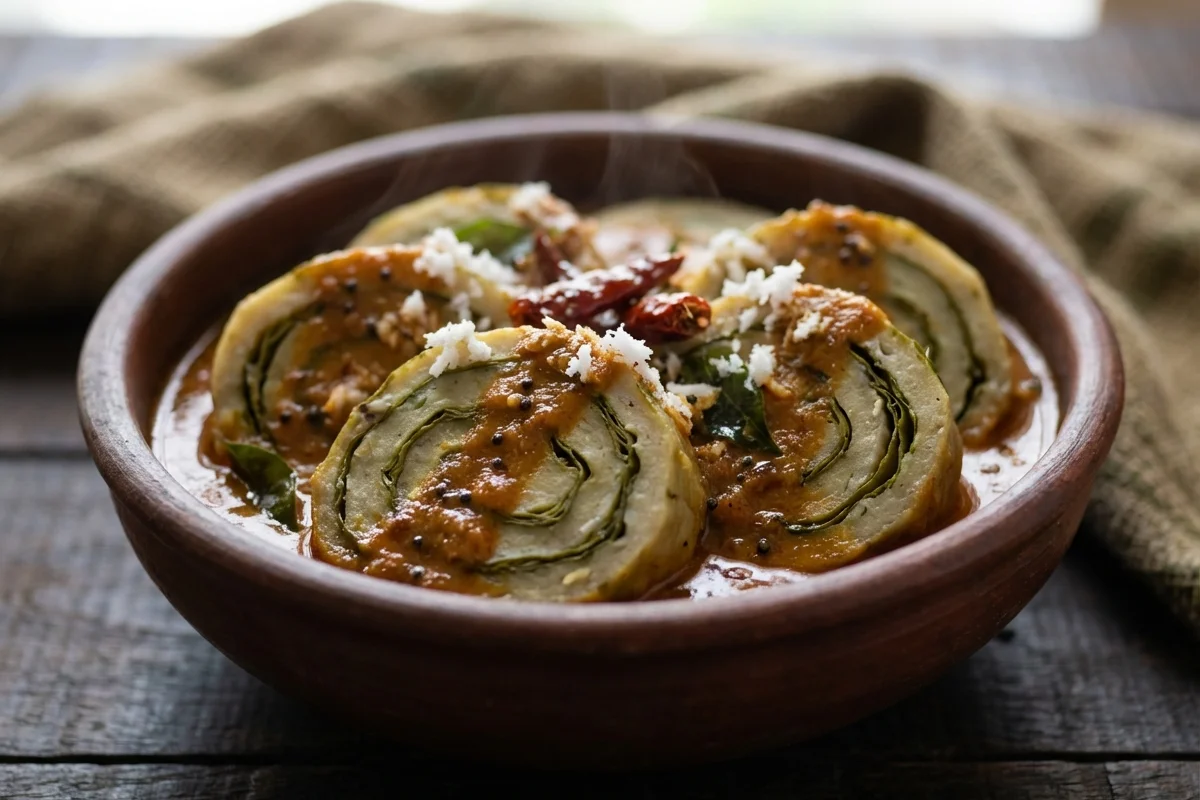
Pathrode Gasi
Tender spiced colocasia leaf rolls simmered in a creamy coconut and tamarind gravy. This coastal Karnataka classic balances earthy greens with tangy, mildly spiced flavors, creating a comforting dish that pairs beautifully with steamed rice.
For 4 servings
- prep
Soak the rice and dal.
1.Wash and soak rice and toor dal together in water for 2 hours.2.Drain and set aside.TIPSoaking softens the grains and ensures a smooth paste. - prep
Prepare the colocasia leaves.
1.Wash each leaf gently and pat dry.2.Remove the thick center vein and stem with a sharp knife.3.Set leaves aside on a flat surface, glossy side down.TIPChoose young, tender leaves to avoid any itchiness. Rubbing a little tamarind on the leaves also helps neutralize oxalate crystals. - mix
Make the spice paste for stuffing.
1.Grind soaked rice, toor dal, jaggery, tamarind paste, dried red chilies, cumin seeds, and salt into a thick, smooth paste.2.Use very little water — just enough to help the blades move.TIPThe paste should be spreadable but not runny. A thick paste gives the rolls a good bite. - assemble
Layer and roll the leaves.
1.Place the largest leaf on the work surface, glossy side down.2.Spread a thin, even layer of paste over the entire leaf.3.Place a second leaf on top, slightly smaller, and spread more paste.4.Repeat with 3-4 leaves per roll, finishing with paste on top.5.Fold the sides inward and roll tightly from the stem end to the tip to form a log.TIPRoll firmly but gently — too tight and the paste will ooze out. Too loose and the rolls will fall apart when cutting. - steam · ~20 min
Steam the pathrode rolls.
1.Arrange the rolls in a steamer basket or greased pressure cooker vessel.2.Steam for 15-20 minutes until the leaves darken and the paste is cooked.3.Cool completely, then slice each roll into 1-inch thick rounds.TIPIf using a pressure cooker, remove the whistle and use a tight lid. Do not cook under pressure — gentle steam only. - saute · ~3 min
Roast the gravy masala.
1.Heat 1 teaspoon coconut oil in a small pan over medium heat.2.Add urad dal and fenugreek seeds; sauté until golden (45 seconds).3.Add coriander seeds and dried red chilies; roast until fragrant (30 seconds).4.Cool the mixture, then grind with grated coconut and a little water to a smooth paste.TIPRoast the spices on low heat to avoid burning. The fenugreek should only turn light brown — any darker and it turns bitter. - simmer · ~10 min
Simmer the gasi gravy.
1.Transfer the ground coconut masala to a pan. Add tamarind paste, salt, and 2 cups water.2.Bring to a gentle boil over medium heat, stirring occasionally.3.Lower the heat and simmer for 8-10 minutes until the raw smell disappears and the gravy thickens slightly.TIPThe gravy should coat the back of a spoon but still be pourable. Add a splash of water if it gets too thick. - temper · ~1 min
Make the tempering.
1.Heat 1 teaspoon coconut oil in a small tadka pan over medium heat.2.Add mustard seeds and let them splutter (30 seconds).3.Add curry leaves and fry until crisp (10 seconds).4.Pour the tempering over the simmering gravy and stir once.TIPPour the tempering just before serving for maximum aroma. The crackle of mustard seeds is your cue that it's ready. - assemble · ~5 min
Add sliced pathrode to the gravy.
1.Gently place the sliced pathrode rounds into the simmering gravy.2.Let them heat through for 2-3 minutes — do not stir too much or the rolls may break.3.Turn off the heat and let it rest for 5 minutes.TIPPathrode slices are delicate after steaming. Use a flat spatula to move them gently in the gravy. - serve
Serve Pathrode Gasi hot with steamed rice.
Ladle the curry into bowls, ensuring each serving gets a few pathrode rounds and plenty of tangy coconut gravy. A drizzle of raw coconut oil on top adds a final aromatic touch.
What to keep in mind.
7 tips from the recipe — small details that make a real difference to the final dish.
- 1Choose young, tender colocasia leaves to avoid any scratchy throat sensation from oxalate crystals.
- 2Spread the rice-dal paste thinly and evenly on each leaf to ensure even cooking and a balanced bite.
- 3Steam the rolls in an open pot or pressure cooker without the whistle for gentle, even heat.
- 4Cool the steamed rolls completely before slicing to get clean, neat rounds that hold their shape.
- 5Roast fenugreek seeds only until light golden to prevent bitterness from seeping into the gravy.
- 6Add the pathrode slices gently into the gravy and avoid vigorous stirring to keep them intact.
- 7Rest the dish for 5 minutes after turning off the heat so the rolls absorb the gravy's flavor.
Adapt it for your goals.
Vegan
This recipe is already vegan — no changes needed. It uses coconut oil and no dairy, making it naturally plant-based.
Gluten FreeGluten-Free
Pathrode Gasi is naturally gluten-free as it uses rice and lentils instead of wheat. Just ensure your tamarind paste and jaggery are certified gluten-free.
Low OilLow-Oil
Reduce coconut oil in the tempering to 1 teaspoon and skip the oil drizzle at serving. The gravy is already low-fat from coconut milk paste.
Why this is on our healthy list.
Rich in Fiber
Colocasia leaves and rice provide dietary fiber, supporting healthy digestion and prolonged satiety.
Good Source of Plant Protein
Toor dal and urad dal contribute plant-based protein, making this dish a wholesome meal option.
Contains Antioxidants
Coconut, curry leaves, and spices like cumin and coriander offer natural antioxidants and anti-inflammatory compounds.
Iron from Greens
Colocasia leaves are naturally rich in iron, which supports oxygen transport and energy metabolism.
Frequently asked questions
Yes, but thaw and pat them completely dry before using. Fresh leaves yield a better texture and are easier to roll.



.webp)
.webp)