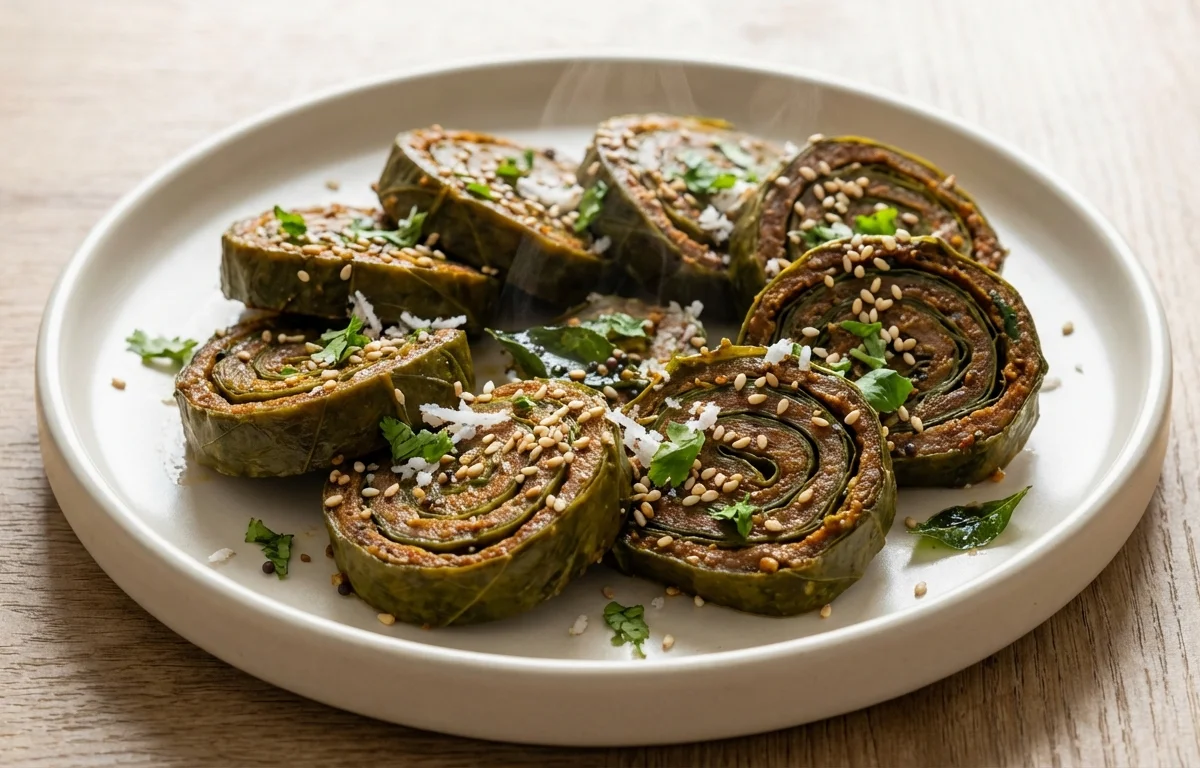
Patrado
Patrado is a coastal Indian steamed colocasia leaf roll layered with a sweet, spicy and tangy chickpea flour paste. Sliced and lightly tempered, it has earthy flavor, soft texture, and lovely little swirls in every bite.
For 8 servings
- prep · ~10 min
Prepare the colocasia leaves.
1.Wash the colocasia leaves well and pat them dry.2.Trim the thick stems close to the base.3.Lightly flatten the thick center vein with a knife so the leaves roll easily.TIPHandle the leaves gently so they do not tear while spreading and rolling. - mix · ~5 min
Make the spiced chickpea paste.
1.Add chickpea flour, tamarind paste, jaggery, red chili powder, turmeric powder, coriander powder, cumin powder, asafoetida, and salt to a bowl.2.Pour in the water little by little.3.Mix into a thick, smooth, spreadable paste with no lumps. - assemble · ~10 min
Layer and roll the patrado.
1.Place one leaf shiny side down and spread a thin layer of paste over it.2.Place a second leaf on top in the opposite direction and spread more paste.3.Repeat to make 2 stacks using 4 leaves in each stack.4.Fold in the sides tightly and roll each stack from base to tip into a firm log.TIPKeep the paste layer thin and even so the rolls steam through without becoming dense. - steam · ~20 min
Steam the rolls until firm.
Place the rolls in a steamer and steam over medium heat until the chickpea paste is cooked through and the rolls feel firm to the touch.
- rest · ~5 min
Cool the rolls slightly before slicing.
TIPWarm rolls can break while slicing, so let them settle for neat pinwheel pieces. - prep
Slice the steamed rolls.
Cut each roll into 4 equal slices to make 8 pieces total.
- temper · ~2 min
Make the tempering.
1.Heat oil in a wide pan over medium heat.2.Add mustard seeds and let them splutter.3.Add sesame seeds and curry leaves and cook for a few seconds. - saute · ~2 min
Coat the slices in the tempering.
Add the sliced patrado to the pan and turn gently for 1 to 2 minutes so the tempering coats the pieces well without breaking them.
- serve
Serve the patrado warm.
What to keep in mind.
8 tips from the recipe — small details that make a real difference to the final dish.
- 1Dry the taro leaves well before spreading the batter so the paste clings instead of sliding off.
- 2Flatten only the thick center vein lightly; cutting too deep can make the leaves tear while rolling.
- 3Keep the besan paste thick and spreadable, not runny, or the layers will seep and the rolls may open.
- 4Roll each stack firmly and tuck in the sides well to get neat pinwheel slices after steaming.
- 5Steam on medium heat until the log feels set and a knife inserted into the center comes out without raw batter.
- 6Let the steamed rolls cool for a few minutes before slicing; this helps the swirls stay intact.
- 7Use a wide pan and turn the slices gently during tempering so the patrado gets coated without crumbling.
- 8Patrado keeps well after steaming; slice and temper just before serving for the best texture.
Adapt it for your goals.
Pan-crisped
After steaming and slicing, shallow-fry the pieces a little longer for crisp edges and a more snack-like texture.
extra spicyExtra-spicy
Increase the red chili powder slightly for a sharper heat that stands up well to the sweet-tangy jaggery and tamarind.
no onion no garlicNo-onion-no-garlic
This version already fits easily; just ensure the asafoetida used is a pure no-onion-no-garlic variety.
jainJain
Omit asafoetida if needed and keep the same sweet-sour-spiced paste for a Jain-friendly adaptation.
Why this is on our healthy list.
Plant-Based Protein
Chickpea flour adds plant protein and makes the dish more filling than a plain steamed leaf preparation.
Fiber-Rich Ingredients
Taro leaves, chickpea flour, tamarind, and sesame contribute fiber, which supports satiety and digestive health.
Steamed, Not Deep-Fried
Most of the cooking is done by steaming, so the dish stays relatively light while still tasting rich and satisfying.
Mineral-Dense Additions
Sesame seeds and leafy colocasia bring useful minerals and variety to the dish beyond just carbohydrates.
Frequently asked questions
Flattening the thick center vein helps the leaves bend and roll neatly without cracking, so the logs stay tight while steaming.