
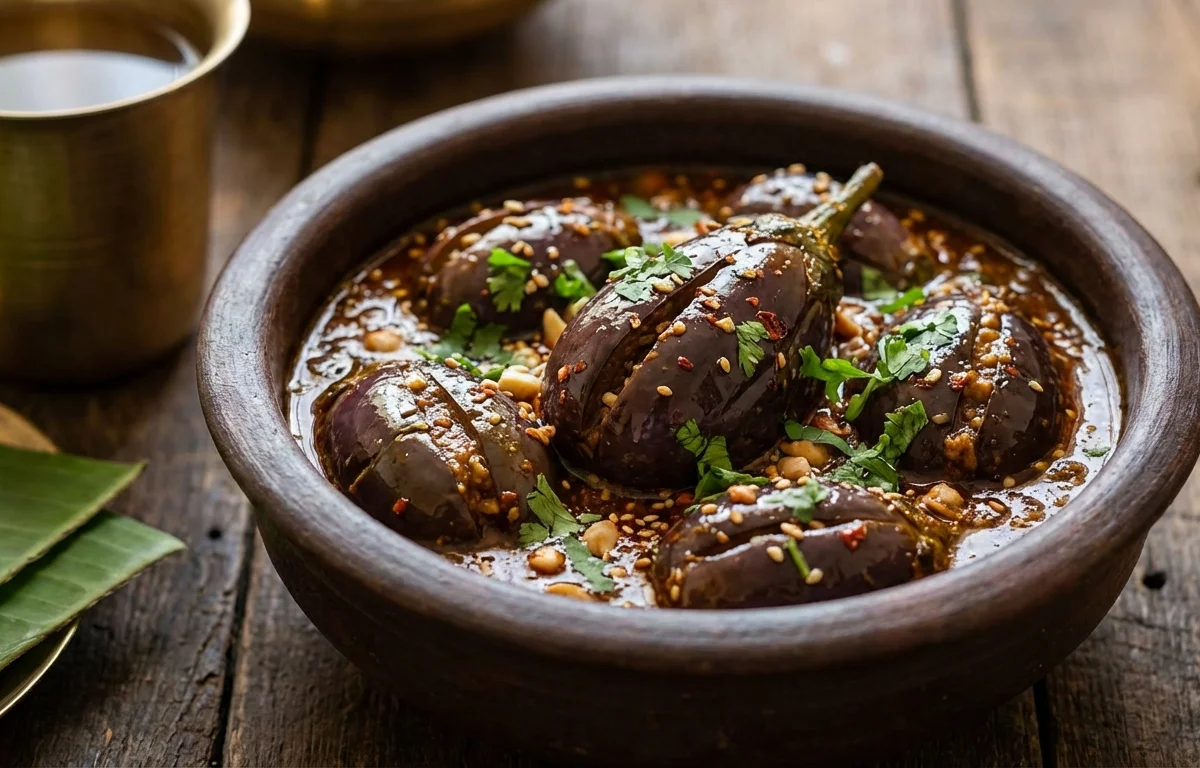
Badanekayi Yennegai
Tender baby eggplants stuffed with a rich, slow-roasted spice and peanut masala, then simmered in a tangy tamarind gravy. This iconic Karnataka dish is packed with deep, nutty, and spicy flavors that pair perfectly with jowar roti or steamed rice.
For 4 servings
- prep
Prepare the brinjals.
Wash the baby brinjals and pat them dry. Slit each brinjal into quarters lengthwise from the bottom, keeping the stem intact. Soak them in a bowl of salted water to prevent discoloration.
- roast · ~10 min
Dry roast the masala spices.
1.Heat a heavy-bottomed pan over medium-low heat. Add peanuts and roast until spotty and fragrant (2-3 min). Remove and set aside.2.In the same pan, add sesame seeds and dry roast until they pop and turn golden (1 min). Remove.3.Add dried coconut and roast until light golden brown (1 min). Remove.4.Add coriander seeds, cumin seeds, fenugreek seeds, cinnamon stick, and cloves. Roast until fragrant (2-3 min).5.Finally, add dried red chilies and roast for 30 seconds until crisp. Transfer everything to a plate to cool completely.TIPRoast each ingredient on low heat to avoid burning—especially the coconut, which can turn bitter if over-roasted. - saute · ~5 min
Sauté the onions and garlic.
In the same pan, heat 2 tsp oil over medium heat. Add chopped onion and garlic cloves. Sauté until the onions turn soft and translucent (4-5 min). Add turmeric powder and red chili powder, stir for 30 seconds, and turn off the heat. Allow to cool.
- mix · ~2 min
Grind the stuffing masala.
Transfer the cooled roasted spices, peanuts, coconut, sesame seeds, and the sautéed onion-garlic mixture to a blender. Add 2-3 tbsp water and grind to a thick, coarse paste. The texture should be spreadable, not too smooth.
TIPAdd water sparingly; the masala needs to be thick enough to stuff inside the brinjals without oozing out. - prep · ~5 min
Stuff the brinjals.
Drain the brinjals from the water. Gently open the slits and stuff each brinjal generously with the ground masala paste. Reserve any leftover masala for the gravy.
- fry · ~5 min
Sear the stuffed brinjals.
Heat the remaining oil in a wide, heavy-bottomed pan over medium heat. Add mustard seeds and let them splutter. Add curry leaves and asafoetida. Gently place the stuffed brinjals in the pan, stir lightly to coat them in the tempered oil, and sear for 3-4 minutes, turning them carefully.
TIPDo not overcrowd the pan; the brinjals should sear and not steam. Use a large enough pan to fit them in a single layer. - simmer · ~20 min
Simmer with tamarind gravy.
1.Pour the tamarind water (1 cup) into the pan. Add salt, jaggery, and any leftover masala paste.2.Stir gently to mix without breaking the brinjals. Bring to a gentle boil.3.Lower the heat, cover the pan, and let it simmer for 15-20 minutes until the brinjals are cooked through and the gravy thickens to a semi-dry consistency.4.Stir once or twice in between, very gently, to prevent sticking.TIPCook covered on low heat to allow the flavors to penetrate the brinjals. The gravy should coat the brinjals and not be watery. - garnish
Garnish with fresh coriander leaves.
Turn off the heat. Garnish with chopped fresh coriander leaves and let the curry rest covered for 10 minutes before serving to allow the flavors to meld.
TIPThis curry tastes even better the next day as the spices continue to infuse.
What to keep in mind.
7 tips from the recipe — small details that make a real difference to the final dish.
- 1Choose small, firm, and evenly sized baby brinjals so they cook uniformly and hold their shape during simmering.
- 2Slit the brinjals only from the bottom to about 1cm below the stem so the four quarters stay attached.
- 3Roast peanuts, sesame, and coconut separately on low heat—coconut burns quickly and turns bitter.
- 4Grind the stuffing masala to a coarse, thick paste; too much water will make the filling runny and leak out.
- 5Sear the stuffed brinjals in a single layer without crowding; this develops a light crust and prevents steaming.
- 6Simmer the curry covered on low heat so the brinjals absorb the tamarind-spice gravy without turning mushy.
- 7Let the finished curry rest for 10 minutes off heat before serving to let the flavors meld and deepen.
Adapt it for your goals.
Low-oil
Skip the final searing step and instead simmer the stuffed brinjals directly in the tamarind gravy after tempering. This method uses only 1 tablespoon of oil while still delivering the full depth of roasted flavors.
high proteinHigh-protein
Add 1/4 cup of cooked, crumbled tofu or boiled chana dal (Bengal gram) to the ground masala before stuffing. This boosts protein content without altering the traditional Karnataka flavor profile.
veganVegan
The recipe is already vegan as written—just ensure the jaggery is vegan-friendly (some commercial jaggery uses animal-based clarifiers). No changes needed.
coconut freeCoconut-free
Omit the dried coconut from the roasting step and replace it with 1 tablespoon of poppy seeds (khus khus) for a similar creamy texture and a subtle, mild nuttiness.
Why this is on our healthy list.
Rich in Dietary Fiber
Baby brinjals (eggplants) are an excellent source of soluble fiber, which supports healthy digestion and helps maintain stable blood sugar levels.
Heart-Healthy Fats
Peanuts and sesame seeds provide monounsaturated and polyunsaturated fats that contribute to cardiovascular health when consumed as part of a balanced diet.
Packed with Antioxidants
Coriander seeds, cumin, fenugreek, and cinnamon are rich in polyphenols and flavonoids that help combat oxidative stress in the body.
Good Source of Plant Iron
Sesame seeds and curry leaves contribute dietary iron, which is essential for oxygen transport and energy production.
Frequently asked questions
Yes, but cut them into 2-inch chunks with slits, then stuff and proceed. Baby brinjals hold their shape better; larger ones may become mushy. Adjust simmering time to 10-12 minutes.


