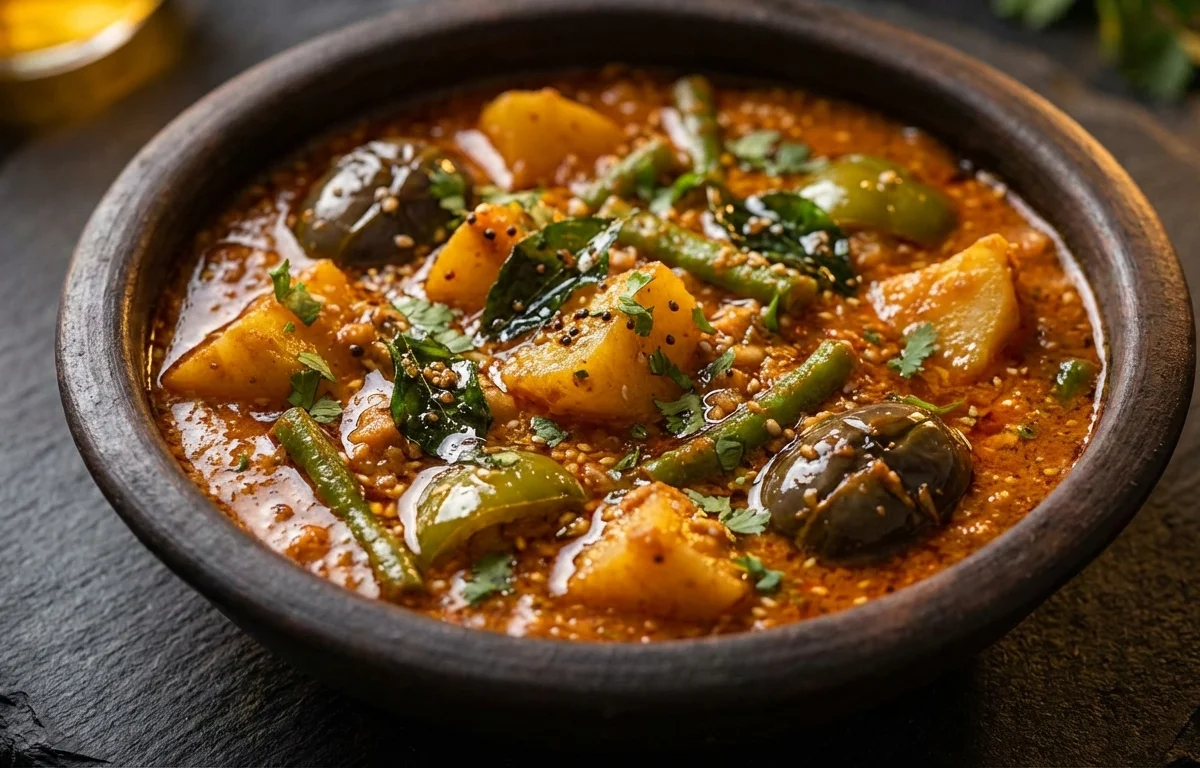
Vegetable Salan
A mellow, nutty Hyderabadi-style curry with mixed vegetables simmered in a lightly spiced peanut, sesame, and coconut gravy. It is rich without being too heavy and tastes especially good with biryani, pulao, or roti.
For 4 servings
- prep · ~10 min
Prep the vegetables and aromatics.
1.Cut the eggplant into medium wedges.2.Cut the carrot into thick batons and the green beans into 2 inch pieces.3.Cube the bell pepper, slice the onion, and chop the tomato.4.Roughly chop the ginger and keep the garlic and green chilies ready. - roast · ~4 min
Roast the nuts and seeds.
1.Heat a dry pan over low heat.2.Add peanuts and roast until lightly golden and fragrant.3.Add white sesame seeds and desiccated coconut.4.Roast for 1 to 2 minutes more, stirring often, then cool slightly.TIPKeep the heat low so the sesame and coconut do not burn and turn bitter. - mix · ~3 min
Grind the salan masala.
Blend the roasted peanuts, sesame seeds, desiccated coconut, ginger, garlic, and tomato with 0.5 cup water to a smooth paste.
- saute · ~6 min
Cook the vegetables.
1.Heat 1 tbsp oil in a wide pan over medium heat.2.Add eggplant, carrot, green beans, and bell pepper.3.Cook for 5 to 6 minutes until the vegetables are lightly browned but still hold their shape.4.Remove them to a plate.TIPDo not fully soften the vegetables here; they will finish cooking in the gravy. - temper · ~1 min
Make the tempering.
1.Heat the remaining 1 tbsp oil in the same pan.2.Add mustard seeds and let them splutter.3.Add cumin seeds, fenugreek seeds, and curry leaves.4.Stir for a few seconds until fragrant. - saute · ~7 min
Build the curry base.
1.Add sliced onion and green chilies to the pan.2.Cook until the onion turns soft and light golden, 5 to 6 minutes.3.Add turmeric powder, red chili powder, and coriander powder.4.Stir for 20 seconds on low heat.TIPLower the heat before adding the powders so they bloom without scorching. - simmer · ~7 min
Simmer the salan gravy.
Add the ground masala paste and cook for 3 to 4 minutes, stirring often. Mix in tamarind paste, salt, and the remaining 1.5 cups water, then bring to a gentle simmer.
- simmer · ~12 min
Finish cooking the vegetables in the gravy.
Return the sautéed vegetables to the pan, cover, and simmer for 10 to 12 minutes until the vegetables are tender and the gravy thickens slightly.
- garnish
Garnish with cilantro.
- serve
Serve hot.
Serve Vegetable Salan warm with biryani, pulao, roti, or plain rice.
What to keep in mind.
7 tips from the recipe — small details that make a real difference to the final dish.
- 1Roast the peanuts, sesame, and coconut only until fragrant and pale golden; darker roasting can make the salan bitter.
- 2Blend the masala paste very smooth so the gravy turns silky instead of grainy.
- 3Brown the vegetables in a wide pan without crowding so they keep shape and pick up light color.
- 4Add the tamarind after the masala has cooked a few minutes; this keeps the raw sourness from standing out.
- 5Simmer gently once the vegetables go back in, or the eggplant can collapse before the carrots finish cooking.
- 6If the gravy thickens too much on standing, loosen it with a splash of hot water before serving.
- 7This salan tastes even better after 30 minutes of resting, when the nutty gravy and tamarind meld.
Adapt it for your goals.
Biryani-style
Keep the gravy slightly looser and a touch tangier so it pairs especially well with Hyderabadi biryani and rice dishes.
low oilLow-oil
Dry-roast the vegetables longer and reduce the pan oil slightly; the salan will be lighter but still nutty from the masala.
spicierSpicier
Increase green chilies and red chili powder for a sharper, hotter salan that stands up well to plain rice or roti.
root veg heavyRoot-veg-heavy
Use more carrot and beans, and add potato if desired, for a heartier everyday curry with a thicker, more filling finish.
Why this is on our healthy list.
Fiber From Mixed Vegetables
Eggplant, carrots, beans, bell pepper, onion, and tomato make the dish vegetable-rich and naturally high in fiber.
Plant-Based Healthy Fats
Peanuts, sesame, and coconut add satisfying fats that help carry the spices and make the curry more filling.
Phytonutrient-Rich Ingredients
Colorful vegetables, curry leaves, ginger, garlic, and cilantro contribute a range of protective plant compounds.
Frequently asked questions
Yes. It reheats very well and often tastes better after a few hours because the nutty masala and tamarind have more time to blend.