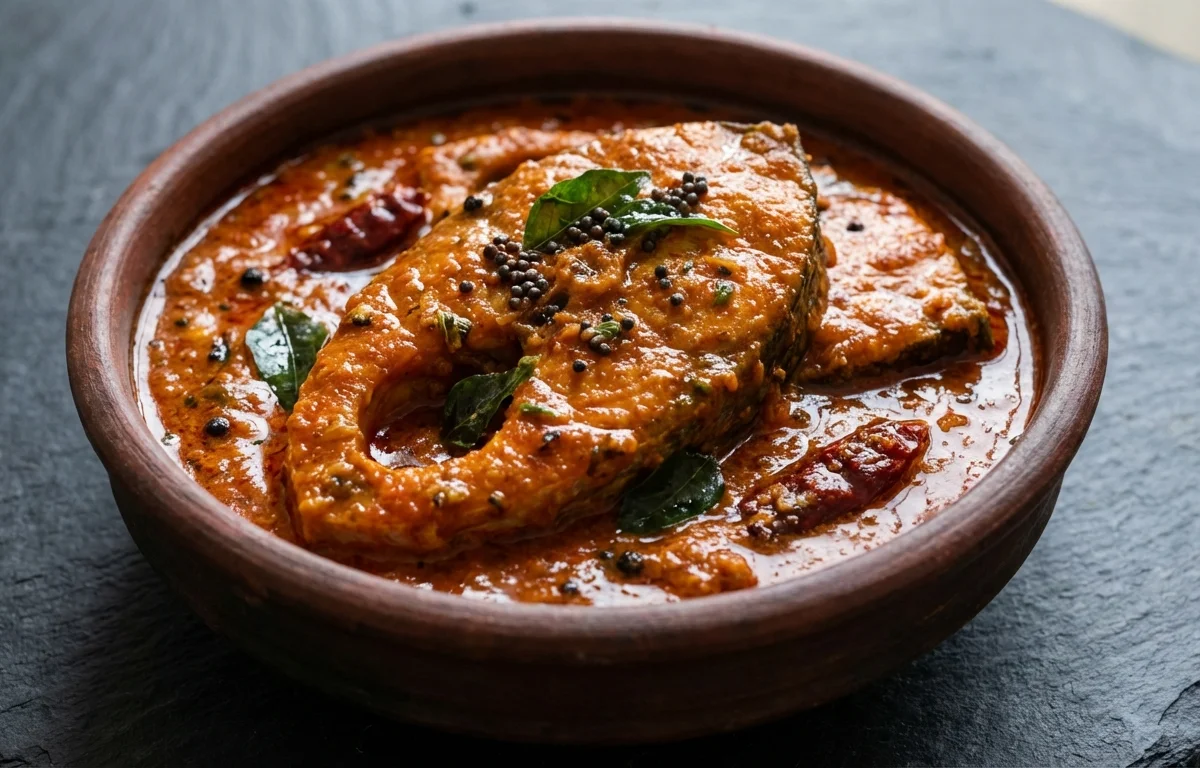
Anjal Pulimunchi
A fiery, tangy Mangalorean delicacy featuring firm king fish steaks simmered in a luscious, deep-red gravy. Freshly roasted spices, garlic, and copious amounts of tamarind create a bold, lip-smacking curry that clings beautifully to every piece of fish. Best enjoyed with a bowl of steaming rice.
For 4 servings
- prep
Marinate the fish steaks.
Pat the fish steaks dry with a paper towel. Rub them gently with a pinch of salt and a pinch of turmeric powder. Set aside for 10-15 minutes.
- roast · ~3 min
Roast the whole spices.
1.Heat 1 teaspoon of coconut oil in a small pan over medium-low heat.2.Add dried red chilies, coriander seeds, cumin seeds, fenugreek seeds, and black peppercorns.3.Roast, stirring constantly, until the spices turn fragrant and slightly darker (2-3 minutes). Transfer to a plate.4.In the same pan, add the garlic cloves and roast until they get light brown spots. Transfer to the plate with the spices.TIPDon't burn the fenugreek seeds — they turn bitter fast. Remove from heat the moment they darken slightly. - roast · ~4 min
Roast the grated coconut.
1.In the same pan, add the fresh grated coconut.2.Roast on medium-low heat, stirring continuously, until the coconut turns golden brown and releases a toasty aroma (3-4 minutes).3.Remove from heat and let the coconut cool completely along with the other roasted ingredients.TIPThe color of the roasted coconut is key to the final gravy — a deep golden brown without any black bits. - mix · ~2 min
Grind the masala paste.
1.In a mixer jar, combine the roasted spices, roasted garlic, roasted coconut, and the extracted tamarind pulp.2.Add 1/2 cup of water to help blending.3.Grind to a fine, smooth paste. Scrape down the sides and add a splash more water if needed. - saute · ~8 min
Sauté the onion base.
1.Heat the remaining 2 tablespoons of coconut oil in a heavy-bottomed pan over medium heat.2.Add the finely chopped onion and sauté until it turns deep golden brown (7-8 minutes).3.Toss in the fresh curry leaves and fry for another 20 seconds until they crackle. - simmer · ~12 min
Cook the masala paste.
1.Lower the heat to medium-low and carefully pour the ground masala paste into the pan with the onions.2.Rinse the mixer jar with a little water and add that water to the pan.3.Add the remaining salt (about 1/4 tsp or to preference).4.Bring the gravy to a gentle simmer and cook uncovered, stirring occasionally, until the raw smell goes away and the oil starts to separate from the sides (10-12 minutes).TIPUse a splatter screen if the gravy starts bubbling out of the pan. - simmer · ~8 min
Gently poach the fish.
1.Adjust the consistency of the gravy. It should be thick enough to coat a spoon. Add water if it's too thick.2.Slide the marinated fish steaks into the simmering gravy one by one, spooning some gravy over them.3.Cover the pan and let the fish cook on a low heat for 6-8 minutes, or until just cooked through and flaky.4.Do not stir forcefully; just tilt the pan gently to swirl the gravy.TIPFish cooks fast — as soon as the flesh flakes easily with a spoon, remove from heat to avoid overcooking. - rest · ~10 min
Rest the curry off the heat.
Turn off the heat and let the Anjal Pulimunchi sit covered for 10 minutes. This allows the fish to soak in all the robust, tangy flavors.
- garnish
Garnish with fresh curry leaves and serve hot.
Drizzle a few drops of raw coconut oil on top for extra aroma. Serve in a bowl with steamed rice or neer dosa.
What to keep in mind.
7 tips from the recipe — small details that make a real difference to the final dish.
- 1Use Byadgi or Kashmiri dried chilies for a deep red color without excessive heat.
- 2Roast the fenugreek seeds only until they darken slightly to avoid bitterness.
- 3Roast the coconut to a deep golden brown for maximum flavor and color in the gravy.
- 4Let the fish marinate for exactly 10–15 minutes to lightly season without drawing out moisture.
- 5Slide fish steaks gently into the gravy and avoid stirring to keep them intact.
- 6Rest the curry covered for 10 minutes after cooking to let the fish absorb the tangy masala.
- 7Sauté the onion until deep golden brown for a sweet, complex base in the gravy.
Adapt it for your goals.
Low-oil
Reduce coconut oil to 1 tablespoon for the onion sauté, and omit the final drizzle. The masala paste and roasting already provide enough richness for a lighter version.
high proteinHigh-protein
Swap king fish for firm chunks of swordfish or tuna, or use thick fillets of seabass for a slightly different protein profile while keeping the Mangalorean character.
jainJain
Replace king fish with firm chunks of raw banana or paneer, and substitute tamarind with dried mango powder (amchur) for the sour component. Skip garlic and onion by using asafoetida (hing) in the sauté.
veganVegan
Substitute the fish with large cubes of king oyster mushrooms or extra-firm tofu, and use a splash of coconut vinegar if a sharper tang is desired. Ensure the coconut is fresh and no ghee is used.
Why this is on our healthy list.
Rich in Omega-3 Fatty Acids
King fish is a fatty fish naturally high in anti-inflammatory omega-3s, which support heart and brain health.
Antioxidant-Rich Spice Blend
The roasted spices — turmeric, cumin, coriander, and fenugreek — are packed with antioxidants that help combat oxidative stress.
Digestive Aid from Tamarind
Tamarind contains natural acids and dietary fiber that can stimulate digestion and promote gut health.
Healthy Fats from Coconut
Fresh grated coconut provides medium-chain triglycerides (MCTs), a type of fat that is easily utilized for energy.
Frequently asked questions
Use thick king fish steaks, marinate only briefly, slide them gently into the simmering gravy, and never stir — just tilt the pan to coat.