
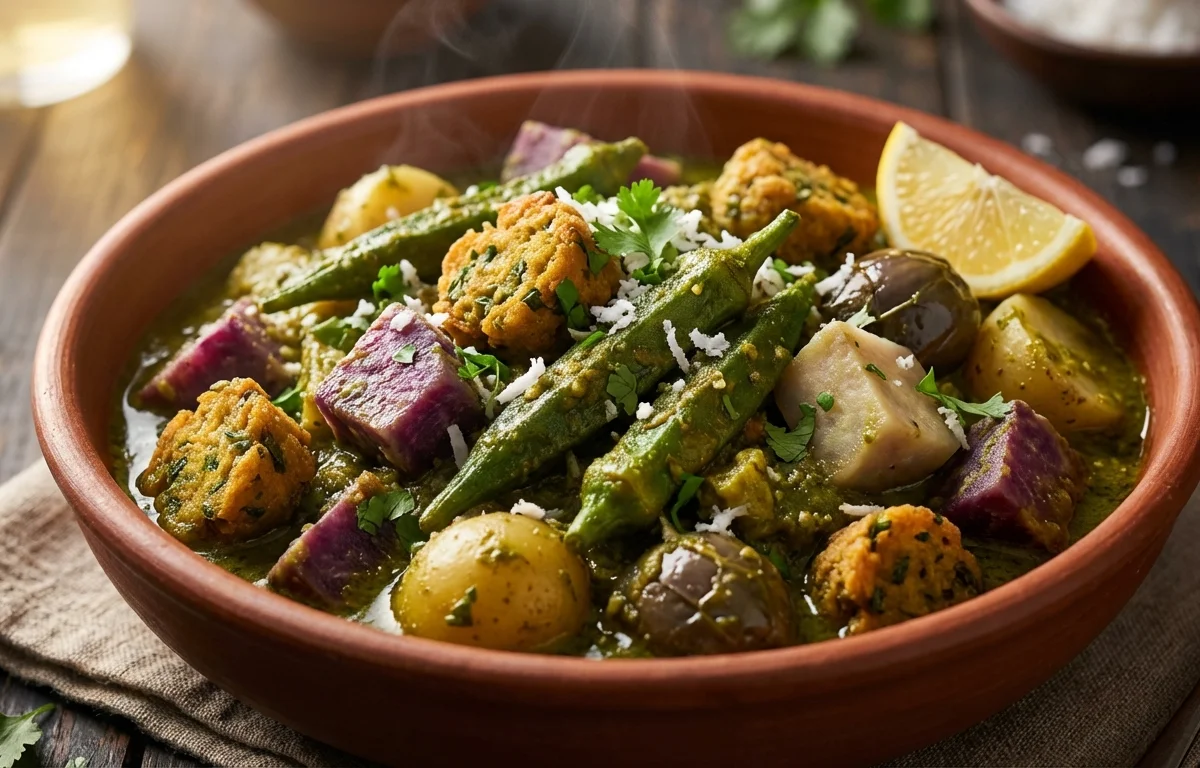
Gujarati Undhiyu
A much-loved Gujarati mixed vegetable dish made with winter vegetables, stuffed baby eggplants, fresh beans, and soft methi muthia. It cooks slowly so the spices, coconut, and herbs soak into every bite.
For 4 servings
- prep · ~15 min
Prepare the vegetables.
1.Wash and trim the surti papdi and remove any strings.2.Peel the potatoes, yam, sweet potato, and raw banana as needed and cut into large pieces.3.Slit each baby eggplant in a cross from the base, keeping the stem end intact for stuffing. - mix · ~8 min
Make the green masala stuffing.
1.Grind coriander leaves, green chili, ginger, and garlic to a coarse mixture without adding extra water.2.Transfer it to a bowl and mix in desiccated coconut, peanuts, sesame seeds, coriander powder, cumin powder, red chili powder, garam masala, jaggery, lemon juice, and part of the salt.3.Mix well to make a moist stuffing. - assemble · ~7 min
Stuff the eggplants and potatoes.
Fill the slits in the baby eggplants with some of the stuffing. Rub a little stuffing over the potatoes, sweet potato, yam, and raw banana, and keep the remaining stuffing aside for the pot.
- mix · ~10 min
Make the muthia mixture.
1.In a bowl, combine fresh methi leaves, whole wheat flour, chickpea flour, semolina, carom seeds, turmeric powder, asafoetida, a little jaggery, a little lemon juice, a little salt, and 1 tbsp oil.2.Add just enough water from the measured water if needed and bring the mixture together into a soft dough.3.Shape it into small oval dumplings.TIPKeep the dough just firm enough to hold shape so the muthia do not break while cooking. - fry · ~8 min
Shallow-fry the muthia.
Heat 1 tbsp oil in a wide pan and shallow-fry the muthia on medium heat until lightly golden on all sides. Remove and keep aside.
TIPTurn them gently so they brown evenly without cracking. - temper · ~3 min
Make the base in a heavy pot.
1.Heat the remaining oil in a heavy pot or kadai over medium heat.2.Add mustard seeds and let them splutter.3.Add cumin seeds and the remaining asafoetida and stir for a few seconds.4.Spread a little of the leftover stuffing over the bottom of the pot. - assemble · ~5 min
Layer the vegetables.
1.Add the surti papdi and tuvar lilva first.2.Arrange the potatoes, yam, sweet potato, and raw banana over them.3.Place the stuffed eggplants on top and scatter the rest of the stuffing between the layers.4.Pour in the measured water around the sides and sprinkle the remaining salt. - simmer · ~25 min
Cook the undhiyu slowly.
Cover and cook on low heat until the vegetables are almost tender, shaking the pot once or twice instead of stirring too much. This takes about 25 minutes.
TIPAvoid frequent stirring or the stuffed eggplants and soft vegetables may break. - assemble · ~10 min
Add the muthia and finish cooking.
Nestle the fried muthia into the pot, cover again, and cook for 8 to 10 minutes more until everything is tender and the masala clings to the vegetables.
- garnish
Garnish with coriander leaves and a little lemon juice.
- serve
Serve hot.
Serve Gujarati Undhiyu warm as part of a meal, traditionally with puri or rotla.
What to keep in mind.
7 tips from the recipe — small details that make a real difference to the final dish.
- 1Keep the green masala coarse and fairly dry so it stays inside the eggplants instead of leaking into the pot.
- 2Cut yam, sweet potato, and raw banana into thick, similar pieces so they finish cooking at about the same time.
- 3Do not make the muthia dough too wet; a soft but shape-holding dough prevents them from disintegrating later.
- 4Shallow-fry the muthia only until lightly golden, not deeply browned, so they can still absorb some masala in the final simmer.
- 5Pour water around the edges of the pot rather than over the top to avoid washing the stuffing off the vegetables.
- 6Shake the pot gently during cooking instead of stirring with a spoon, especially after adding the stuffed eggplants.
- 7Undhiyu tastes even better after a short rest off the heat, when the jaggery, lemon, coconut, and spices settle into the vegetables.
Adapt it for your goals.
Jain
Skip garlic and ginger in the stuffing, omit potatoes, and increase sweet potato, raw banana, and yam for a Jain-friendly version with similar body.
veganVegan
This recipe is already vegan as written, making it a good festive main for plant-based meals without major changes.
low oilLow-oil
Steam or air-fry the muthia instead of shallow-frying and reduce the tempering oil slightly for a lighter everyday undhiyu.
no garlicNo-garlic
Leave out the garlic and boost ginger, green chili, coriander, and asafoetida for a satvik-style flavor profile.
Why this is on our healthy list.
Fiber-Rich Mixed Vegetables
Surti papdi, pigeon peas, eggplant, yam, sweet potato, and raw banana make this dish filling and naturally rich in dietary fiber.
Plant-Based Protein Support
Fresh pigeon peas, chickpea flour, peanuts, and sesame seeds add plant protein that makes the meal more satisfying.
Good Source of Greens and Herbs
Fresh methi leaves and coriander contribute phytonutrients and deepen flavor without relying only on heavy fat.
Balanced Energy Ingredients
The combination of root vegetables, beans, and muthia gives steady, hearty energy, which suits this traditional winter dish.
Frequently asked questions
Yes. Use whatever fresh broad beans, flat beans, or shelled peas are available, though the flavor and texture will be less traditional.


