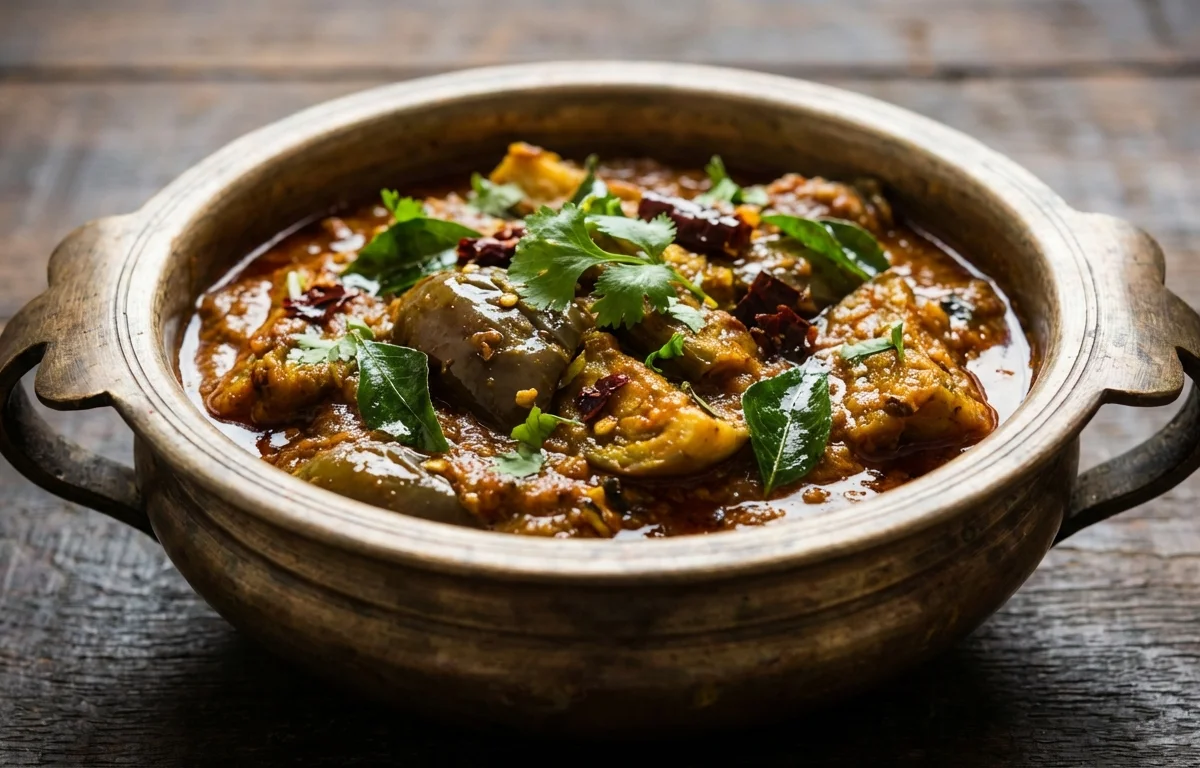
Andhra Vankaya Kura
This homestyle Andhra brinjal curry is full of bold flavor from peanuts, sesame, coconut, and tamarind. The eggplant turns silky as it cooks, while the masala coats every piece in a rich, spicy layer that goes beautifully with rice or roti.
For 4 servings
- prep · ~10 min
Prep the eggplant and aromatics.
1.Wash the eggplant and cut into small wedges, keeping the stem end intact on larger pieces if possible.2.Chop the onion and tomato finely.3.Roughly chop the ginger and garlic.4.Slit the green chilies and keep the curry leaves ready.TIPKeep the cut eggplant in a bowl of water until needed so it does not darken. - roast · ~5 min
Roast the masala ingredients.
1.Heat a dry pan on low heat.2.Add peanuts, sesame seeds, desiccated coconut, coriander seeds, and dried red chilies.3.Roast gently, stirring often, until fragrant and lightly colored.4.Take them off the heat and cool completely.TIPUse low heat here so the sesame and coconut toast evenly without burning. - mix · ~3 min
Grind the masala.
Transfer the roasted ingredients to a grinder jar with ginger, garlic, tamarind paste, red chili powder, turmeric powder, and 2 to 3 tbsp water. Grind to a thick, slightly coarse paste.
- temper · ~2 min
Make the tempering.
1.Heat oil in a wide pan over medium heat.2.Add mustard seeds and let them splutter.3.Add cumin seeds, urad dal, and chana dal.4.Stir in the curry leaves and green chilies for a few seconds. - saute · ~8 min
Cook the onion and tomato base.
1.Add the chopped onion and cook until soft and light golden.2.Add the tomato and cook until it breaks down and turns pulpy.3.Stir well so the base looks glossy and lightly cooked down. - saute · ~5 min
Cook the eggplant with the masala.
1.Add the eggplant and mix gently to coat it in the onion mixture.2.Add the ground masala paste, salt, and jaggery.3.Cook for 2 to 3 minutes, stirring gently so the paste coats every piece.TIPUse a wide pan and turn the eggplant carefully so it stays in shape. - simmer · ~12 min
Cover and cook until tender.
Pour in the water, mix gently, cover, and cook on low heat until the eggplant is soft and the masala turns thick and clings to it. Stir once or twice in between to prevent sticking.
- garnish · ~1 min
Finish with coriander leaves.
Open the pan, cook off any extra moisture if needed, then sprinkle in the coriander leaves and give the curry one gentle mix.
- serve
Serve hot.
Serve Andhra Vankaya Kura hot with plain rice, ghee rice, roti, or chapati.
What to keep in mind.
7 tips from the recipe — small details that make a real difference to the final dish.
- 1Keep the cut brinjal in water until cooking so the wedges stay pale and don’t oxidize.
- 2Roast the peanut-sesame-coconut mixture only until lightly golden; burnt sesame will make the curry bitter.
- 3Grind the masala slightly coarse rather than fully smooth for a more traditional, clingy texture.
- 4Use a wide, heavy pan so the eggplant cooks in one layer and holds its shape better.
- 5Stir gently only once or twice during simmering; overmixing can turn the brinjal mushy.
- 6The curry is done when the wedges are silky but not collapsing and the masala coats them thickly.
- 7This tastes even better after 30 minutes of rest, when the tamarind and roasted masala settle into the brinjal.
Adapt it for your goals.
Stuffed-brinjal
Use slit baby brinjals and stuff the ground masala inside for a richer, more festive Andhra-style curry.
low oilLow-oil
Reduce the oil slightly and cook in a nonstick pan; the curry will be lighter but still flavorful from the roasted masala.
no onion no garlicNo-onion-no-garlic
Skip onion and garlic for a satvik-style version; add a little extra tomato and curry leaves for balance.
extra spicyExtra-spicy
Increase dried red chilies or chili powder if you want a hotter curry that matches stronger Andhra heat.
Why this is on our healthy list.
Fiber-Rich Vegetable Base
Eggplant, onion, and tomato add fiber and bulk, making the curry satisfying alongside rice or roti.
Healthy Fats From Seeds and Nuts
Peanuts and sesame seeds contribute nourishing fats that also help carry the curry’s roasted spice flavors.
Phytonutrient-Packed Aromatics
Ginger, garlic, curry leaves, and coriander bring plant compounds along with bold fragrance and depth.
Frequently asked questions
It usually happens from overcooking or stirring too often. Use small firm brinjals, simmer on low, and turn the pieces gently.



.webp)