
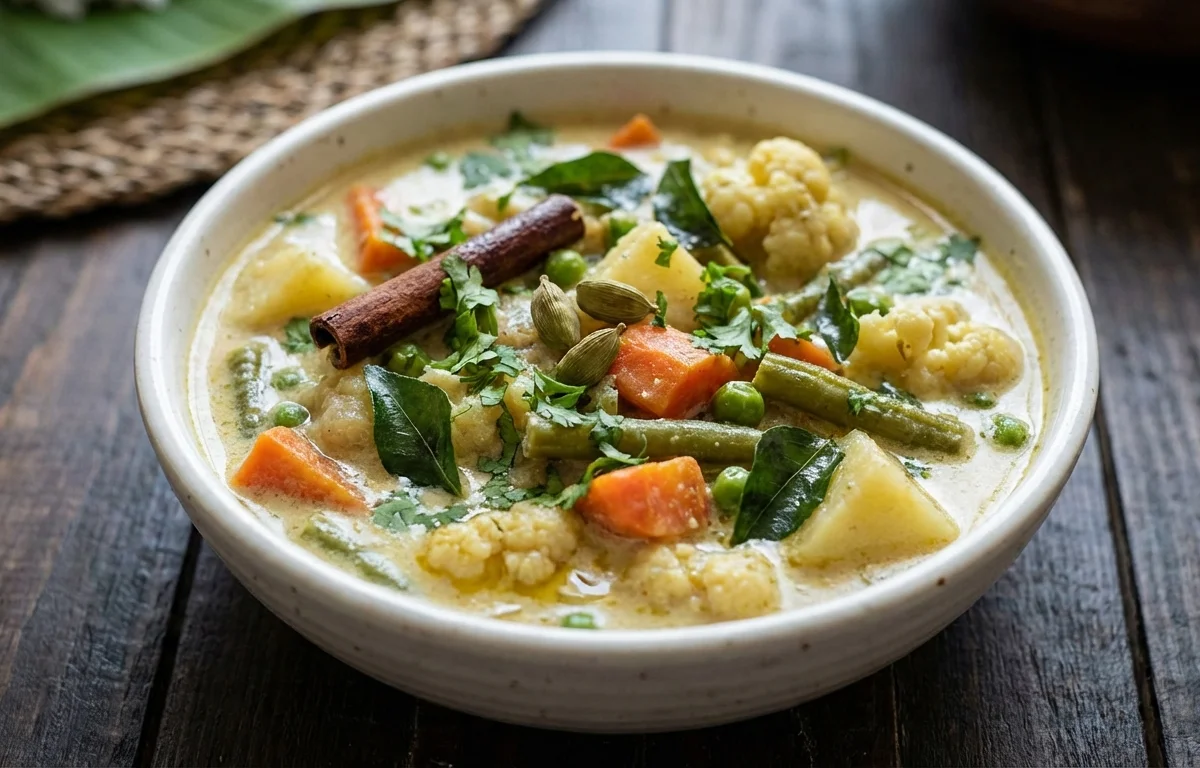
Malabar Vegetable Kurma
A fragrant, mildly spiced mixed vegetable curry from Kerala's Malabar coast, simmered in creamy coconut milk with a gentle warmth from whole spices. This vegetable kurma is rich, comforting, and pairs beautifully with soft appams, parottas, or ghee rice for a truly satisfying meal.
For 4 servings
- prep
Prep the vegetables.
1.Wash and dice 1 medium carrot into small cubes.2.Cut 100g green beans into 1-inch pieces.3.Peel and cube 1 medium potato.4.Cut 100g cauliflower into medium florets. - boil · ~5 min
Parboil the vegetables.
1.Bring a pot of water to a rolling boil.2.Add diced carrot, green beans, potato, cauliflower, and 0.5 cup green peas.3.Boil for 5 minutes until just tender but still firm.4.Drain the vegetables and set aside. - temper · ~1 min
Bloom the whole spices.
1.Heat 2 tbsp coconut oil in a deep pan over medium heat.2.Add 1 tsp fennel seeds and let sizzle for 10 seconds.3.Add 2-inch cinnamon stick, 3 green cardamom pods, 4 cloves, and 1 star anise.4.Fry until fragrant, about 30 seconds. - saute · ~12 min
Sauté the aromatics.
1.Add 2 thinly sliced onions and sauté until golden brown, about 7-8 minutes.2.Add 3 slit green chilies and 8 curry leaves, stir briefly.3.Add 2 tbsp ginger garlic paste and cook until the raw smell disappears, about 1 minute.4.Add 2 finely chopped tomatoes and cook until soft and mushy, about 4-5 minutes. - saute · ~1 min
Cook the spice powders.
1.Lower the heat to prevent burning.2.Add 1 pinch turmeric powder, 2 tsp coriander powder, 1 tsp red chili powder, and 1 pinch garam masala.3.Add 1 pinch salt.4.Stir continuously for 30-40 seconds until the spices release their aroma.TIPLow heat is key here — high heat burns the spice powders and turns them bitter. - simmer · ~5 min
Simmer the curry base with water.
1.Pour 1 cup of water into the pan.2.Stir well to deglaze, scraping up any browned bits from the bottom.3.Bring to a gentle simmer and let it bubble for 5 minutes until slightly reduced. - simmer · ~7 min
Add coconut milk and vegetables.
1.Pour in 1 cup thick coconut milk and stir gently to combine.2.Add the parboiled vegetables to the curry.3.Simmer on low heat for 5-7 minutes, letting the vegetables absorb the flavors.4.Do not let it boil vigorously after adding coconut milk.TIPAvoid a rolling boil after adding coconut milk — it can split and turn grainy. - mix
Finish with lemon juice.
1.Turn off the heat.2.Stir in 1 tbsp lemon juice.3.Check for seasoning and adjust if needed. - garnish
Garnish with coriander and serve hot.
1.Sprinkle 2 tbsp chopped coriander leaves on top.2.Serve immediately with appam, parotta, or ghee rice.
What to keep in mind.
8 tips from the recipe — small details that make a real difference to the final dish.
- 1Parboil the vegetables just until tender-crisp to avoid mushiness in the final curry.
- 2Sauté the onions until deep golden brown for a rich, sweet base that balances the spices.
- 3Bloom the whole spices in coconut oil to release their essential oils before adding liquids.
- 4Cook the spice powders on low heat for 30-40 seconds only to prevent bitterness.
- 5After adding coconut milk, keep the heat low and never let it boil to avoid curdling.
- 6Let the curry rest for 5 minutes after cooking so the flavors meld beautifully.
- 7Use thick first-extract coconut milk for a creamy, luxurious texture.
- 8Leftover kurma thickens on cooling; add a splash of warm water while reheating.
Adapt it for your goals.
Vegan
This recipe is already entirely plant-based, but for extra creaminess, swap half the water for store-bought light coconut milk or add 2 tablespoons of raw cashew paste in the simmer step.
low oilLow-oil
Reduce coconut oil to 1 tablespoon and dry-roast the whole spices for 20 seconds before adding a splash of water to sauté the onions — perfect for lighter cooking without losing flavor.
high proteinHigh-protein
Add 1 cup of cubed paneer or boiled chickpeas along with the parboiled vegetables for a heartier, protein-rich version that still absorbs the coconut-spice gravy beautifully.
kerala style with meatKerala-style with meat
Add 250g of boneless chicken (cut into cubes) after sautéing the onions. Brown the chicken for 5 minutes, then continue with tomatoes and spices — no need to change the coconut milk quantity.
Why this is on our healthy list.
Rich in Dietary Fiber
The combination of carrots, green beans, peas, and cauliflower provides a solid dose of soluble and insoluble fiber, supporting digestion and gut health.
Packed with Antioxidants
Curry leaves, turmeric, and coriander powder supply curcumin and flavonoids that help fight oxidative stress and reduce inflammation.
Healthy Fats from Coconut
Coconut milk and coconut oil offer medium-chain triglycerides (MCTs), a source of quick energy that may support metabolism and heart health.
Loaded with Vitamin A
Carrots and green peas contribute beta-carotene, which the body converts into vitamin A for healthy vision and immune function.
Frequently asked questions
Yes, add frozen peas, carrots, and beans directly to the boiling water — just reduce parboiling time to 3 minutes since frozen veggies are already blanched.



.webp)
.webp)