
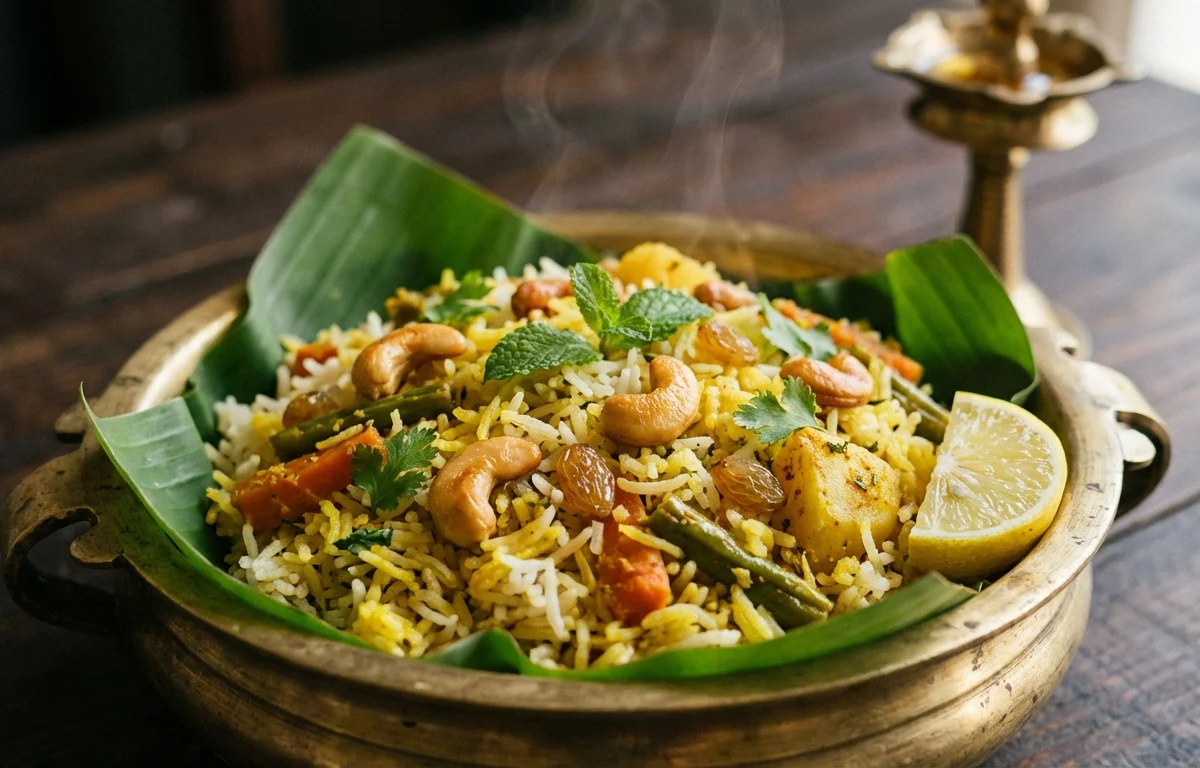
Malabar Vegetable Biryani
A fragrant rice dish from Kerala's Malabar coast, layered with spiced vegetables and aromatic ghee. Short-grain jeerakasala rice absorbs the richness of coconut milk, while the vegetable curry brings together carrots, beans, and green peas. Dum cooking seals in the flavors, making every katori a celebration of coastal spices and fresh herbs.
For 4 servings
- prep · ~30 min
Soak the rice and prep the vegetables.
1.Wash jeerakasala rice thoroughly and soak in water for 30 minutes. Drain well.2.Slice onions thinly. Chop tomatoes finely. Dice carrots, beans, and potato into even cubes.3.Whisk yogurt until smooth. Chop coriander and mint leaves.4.Soak saffron strands in warm milk and set aside.TIPSoaking the rice helps the grains stay separate during cooking. - fry · ~15 min
Fry onions, cashews, and raisins for garnish.
1.Heat 2 tbsp oil in a frying pan over medium heat.2.Add sliced onions and fry until deep golden brown and crisp (12–15 min). Remove and drain on paper towels.3.In the same pan, fry cashew nuts until golden, then add raisins until they puff up. Set aside.TIPFry onions on medium heat — patience gives the sweetest, crispiest result. - boil · ~6 min
Partially cook the rice.
1.Bring 2 cups water and 1 cup coconut milk to a boil in a saucepan.2.Add drained rice, 1 tsp ghee, and 1 pinch salt.3.Cook until rice is 70% done — grains should still have a bite (5–6 min).4.Drain immediately and spread on a plate to stop cooking.TIPThe rice should be only three-fourths cooked; it will finish under dum. - saute · ~16 min
Make the vegetable curry.
1.Heat 2 tbsp ghee in a heavy-bottomed pot over medium heat.2.Add cinnamon stick, cardamom, cloves, bay leaf, star anise, mace, and fennel seeds. Sauté until fragrant (30 sec).3.Add ginger-garlic paste and green chilies. Cook until raw smell disappears (1 min).4.Add chopped tomatoes and cook until soft, mushy, and oil separates (5 min).5.Add turmeric powder, red chili powder, and garam masala. Mix well.6.Add carrot, beans, green peas, and potato. Stir to coat with spices.7.Add whisked yogurt, half the fried onions, and salt. Mix well and cook for 5 minutes.8.Sprinkle half of the chopped coriander and mint leaves. Remove from heat.TIPThe vegetable base should be thick, not watery — any extra liquid will make the biryani soggy. - assemble · ~5 min
Layer the biryani for dum.
1.Spread the vegetable curry evenly at the bottom of the pot.2.Top with the partially cooked rice, spreading it in an even layer.3.Sprinkle remaining fried onions, cashew nuts, raisins, coriander, and mint on top.4.Drizzle rose water, lemon juice, and saffron-infused milk over the rice.5.Dot the remaining 1 tsp ghee on top for richness.TIPDon't stir the layers — dum cooking relies on undisturbed strata of rice and curry. - steam · ~25 min
Seal the pot and cook on dum.
1.Make a dough with wheat flour and water to seal the lid of the pot tightly.2.Place a tava (griddle) under the pot to diffuse the heat.3.Cook on high heat for 5 minutes, then reduce to the lowest possible heat.4.Continue dum cooking for 20–25 minutes. Keep the pot sealed — no opening.5.Turn off heat and let it rest for 10 minutes before opening.TIPPutting a heavy weight on the lid traps the steam — this slow steam is the soul of biryani. - serve · ~1 min
Open the seal and serve hot.
1.Break the dough seal and open the lid away from your face — steam is hot.2.Gently fluff the biryani with a fork, mixing the layers from the bottom.3.Transfer to a serving platter and garnish with any reserved fried onions.4.Serve hot with raita and pickle.TIPUse a flat spatula to lift from the bottom — this brings the vegetable gravy up through the rice.
What to keep in mind.
7 tips from the recipe — small details that make a real difference to the final dish.
- 1Using short-grain jeerakasala or khaima rice is key — it absorbs coconut milk without turning mushy.
- 2Soak the rice for exactly 30 minutes; under-soaking leads to hard grains, over-soaking makes them break.
- 3Cook the vegetable curry until the gravy thickens and oil separates — a watery curry ruins the dum texture.
- 4Resist stirring the layers after assembling; dum cooking relies on undisturbed strata for even steam infusion.
- 5Seal the pot lid tightly with wheat flour dough to trap all steam — this is essential for authentic dum.
- 6Place a tava or griddle under the pot to diffuse heat and prevent the bottom from burning during slow cooking.
- 7Let the biryani rest for 10 minutes after dum before opening — this allows the grains to firm up and flavors to meld.
Adapt it for your goals.
Protein-packed
Add 1 cup of paneer cubes (fried until golden) or 1 cup of boiled chickpeas to the vegetable curry for a heartier, protein-rich meal without compromising the coastal flavor profile.
veganVegan
Replace ghee with coconut oil, yogurt with thick coconut cream, and skip saffron milk — use turmeric-soaked almond milk instead for color. The biryani remains fragrant and creamy.
low oilLow-oil
Roast the cashews and raisins in a dry pan, skip the fried onion garnish (use fresh onion slices instead), and reduce ghee to 1 tbsp — the coconut milk and spices still deliver enough richness.
mixed seafood biryaniMixed-seafood biryani
Swap vegetables for 300g of mixed shrimp and firm fish chunks (like kingfish). Marinate seafood in turmeric, chili, and lemon juice before layering — cook seafood separately for 3 minutes before adding to the dum.
Why this is on our healthy list.
Rich in Healthy Fats
Coconut milk and ghee provide medium-chain triglycerides (MCTs) and butyrate, which support gut health and sustained energy.
High in Fiber from Vegetables
Carrots, beans, green peas, and potatoes contribute soluble and insoluble fiber, aiding digestion and promoting fullness.
Loaded with Antioxidant Spices
Turmeric, cinnamon, cardamom, cloves, and star anise offer anti-inflammatory and antimicrobial compounds that support immunity.
Source of Plant-Based Calcium
Coconut milk, yogurt, and cashew nuts provide calcium for bone health — especially beneficial in a plant-forward dish.
Frequently asked questions
Yes, but reduce the cooking time during the partial boil and skip the soaking if using basmati — jeerakasala is plumper and more absorbent.



.webp)
.webp)