
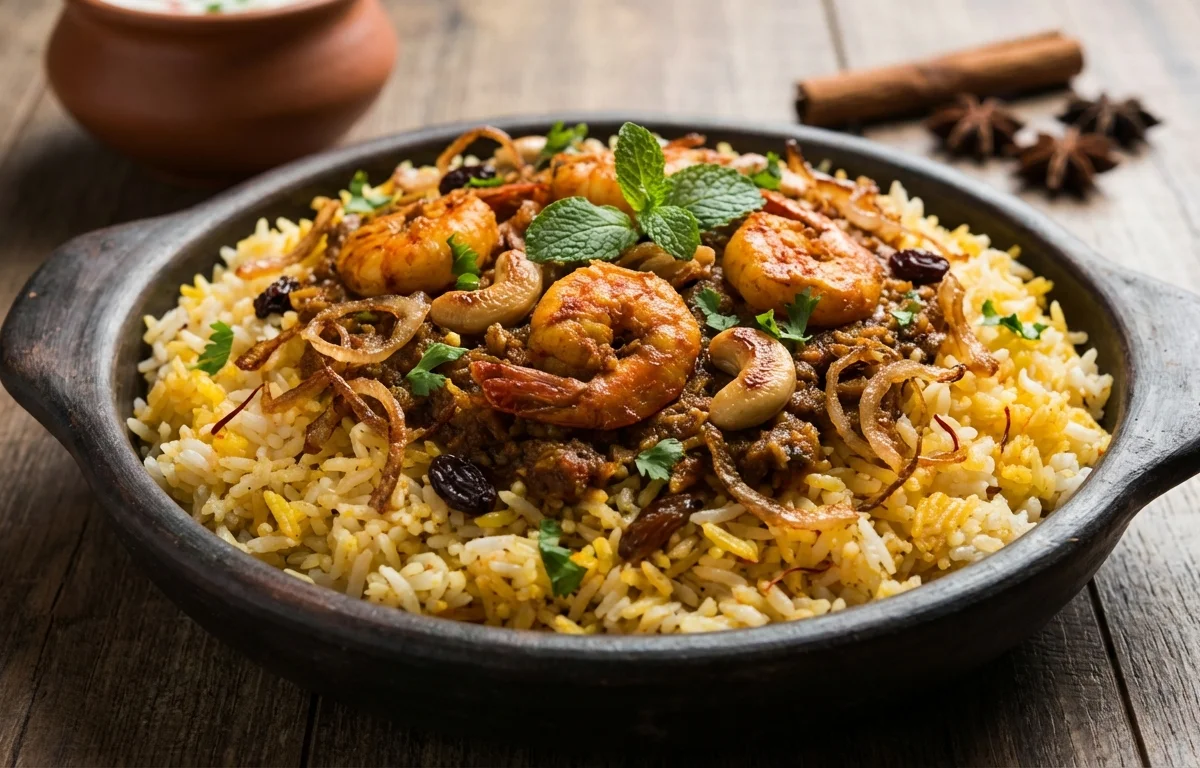
Malabar Prawn Biryani
Fragrant, lightly spiced biryani from Kerala's Malabar coast featuring succulent prawns layered with ghee-laced jeerakasala rice. Slow-cooked on dum with caramelized onions, fresh herbs, and a gentle touch of coconut milk that makes each grain of rice glisten with coastal flavor.
For 4 servings
- prep · ~15 min
Marinate the prawns.
1.In a bowl, combine cleaned prawns with 0.25 tsp salt, a pinch of turmeric, and 1 tsp lemon juice.2.Mix well and let sit for 15 minutes while you prepare the other components. - fry · ~12 min
Fry the onions golden for garnish and layering.
1.Heat 2 tbsp oil in a pan over medium heat.2.Add all the sliced onions and fry until deep golden and crisp (10-12 min).3.Remove half the onions and set aside for layering and garnish. Keep the remaining half in the pan.TIPStir continuously in the last 3 minutes — onions go from golden to burnt quickly. - fry · ~3 min
Sear the prawns lightly.
1.Push the remaining onions to one side of the pan.2.Add the marinated prawns and sear for 1 minute per side until they just turn pink and curl.3.Remove prawns immediately and set aside. Don't overcook — they'll cook further in the dum.TIPPrawns get rubbery if overcooked. A quick sear is all they need right now. - saute · ~10 min
Build the prawn masala.
1.In the same pan with the remaining fried onions, add 1 tbsp ghee over medium heat.2.Add cinnamon stick, cardamom, cloves, bay leaves, star anise, and fennel seeds. Sauté until fragrant (30 sec).3.Add slit green chilies, ginger paste, and garlic paste. Sauté 1 minute.4.Add chopped tomatoes and cook until soft and mushy (4-5 min).5.Reduce heat to low. Add turmeric, red chili powder, and coriander powder. Stir 30 seconds.6.Add whisked yogurt slowly, stirring continuously to prevent curdling. Cook 2 minutes.7.Add 0.25 cup water and bring to a gentle simmer. Add remaining 0.25 tsp salt.8.Return the seared prawns to the masala, stir gently, and cook 1 minute. Turn off the heat.TIPStir the yogurt in on low heat — high heat will split it instantly. - boil · ~6 min
Parboil the rice.
1.Bring 3 cups of water to a rolling boil in a large pot.2.Add the soaked and drained rice along with 0.5 tsp salt.3.Cook until the rice is 70% done — the grains should still have a slight bite (5-6 min).4.Drain immediately and spread on a plate to stop further cooking. - prep · ~5 min
Prepare the layering ingredients.
1.In a small pan, fry cashew nuts in 1 tsp ghee until golden. Add raisins, let them puff up, then remove.2.Soak saffron strands in 2 tbsp warm milk for 10 minutes.3.Have ready: torn mint leaves, chopped coriander, coconut milk, fried onions, garam masala, and lemon juice. - assemble · ~5 min
Layer the biryani for dum.
1.Grease a heavy-bottomed pot with 1 tsp ghee.2.Spread half the parboiled rice as the first layer.3.Spoon the prawn masala evenly over the rice.4.Sprinkle half the mint, coriander, fried onions, fried cashews, and raisins.5.Cover with the remaining rice.6.Drizzle coconut milk and saffron milk evenly over the top.7.Sprinkle remaining mint, coriander, fried onions, cashews, raisins, garam masala, and lemon juice.8.Dot the top with remaining ghee.TIPDon't mix the layers — the beauty of biryani is discovering each layer as you serve. - steam · ~25 min
Seal and dum cook the biryani.
1.Cover the pot with a tight-fitting lid. If the lid is loose, seal the edges with a strip of wheat dough.2.Place a flat tawa under the pot to diffuse direct heat.3.Cook on high heat for 2 minutes, then reduce to the lowest possible flame.4.Let it steam undisturbed for 20 minutes. Do not open the lid during this time.5.Turn off the heat and let it rest covered for another 5 minutes.TIPThe tawa underneath prevents the bottom from burning — a non-negotiable step for perfect biryani. - serve · ~1 min
Open gently and serve.
1.Remove the lid carefully so steam escapes away from you.2.Gently fluff the rice with a fork, scooping from the side to lift layers without breaking the grains.3.Serve hot with raita and lemon wedges on the side.TIPUse a flat spatula and go deep to the bottom when serving — you want prawn masala in every portion.
What to keep in mind.
7 tips from the recipe — small details that make a real difference to the final dish.
- 1Use jeerakasala or kaima rice for the authentic Malabar texture; it stays separate and fragrant.
- 2Parboil the rice to 70% doneness—it will finish cooking perfectly during the dum without turning mushy.
- 3Sear prawns just until they turn pink; they will cook further in the dum and stay tender.
- 4Stir yogurt into the masala on low heat only to prevent curdling and keep the gravy smooth.
- 5Place a tawa under the pot during dum to diffuse heat and prevent the bottom layer from burning.
- 6Let the biryani rest covered for 5 minutes after dum to allow steam to settle and grains to firm up.
- 7Use a flat spatula to scoop from the bottom when serving so every portion gets prawn masala.
Adapt it for your goals.
Low-oil
Substitute oil with water or broth for sautéing, reduce ghee to 1 tbsp, and skip fried onions (use raw thinly sliced shallots instead). This cuts fat while keeping the aromatic base.
high proteinHigh-protein
Replace half the rice with cauliflower rice or add boiled chickpeas and paneer cubes in the layering. Boosts protein content without overwhelming the prawn flavour.
jainJain
Omit garlic, onion, and ginger entirely; use asafoetida (hing) for the savoury note, and replace onions with sliced raw banana or bottle gourd. This keeps the dish Jain-friendly while retaining the layered dum style.
veganVegan
Swap ghee with coconut oil, yogurt with thick coconut cream (or cashew cream), and fried onions with store-bought vegan crispy onions. All other spices and coconut milk remain, so the coastal essence stays intact.
Why this is on our healthy list.
Rich in Lean Protein
Prawns provide high-quality, low-fat protein essential for muscle repair and satiety.
Contains Anti-Inflammatory Spices
Turmeric, ginger, cinnamon, and cloves in this biryani are known for their natural anti-inflammatory properties.
Good Source of Healthy Fats
Ghee and coconut milk supply medium-chain triglycerides (MCTs) that support energy metabolism and add richness.
Provides Iron and Zinc
Prawns and cashews contribute iron and zinc, important for immune function and oxygen transport.
Frequently asked questions
Yes, but the texture will be less sticky and aromatic. If using basmati, reduce cooking time slightly and rinse well to remove excess starch.



.webp)
.webp)