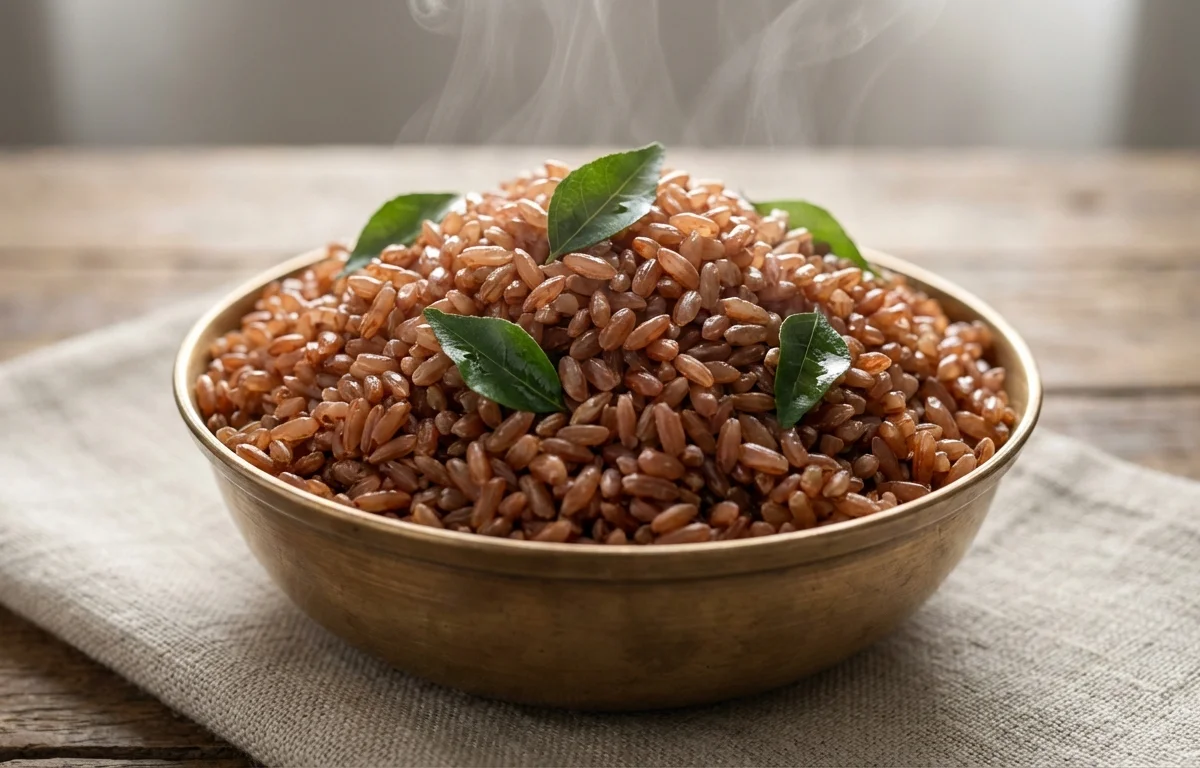
Most of us have a bag of white or brown rice in the pantry. They're reliable standbys. But red rice? It’s the one you might walk past, and you'd be missing out. It's got a wonderfully nutty, firm texture that holds its own in a way softer grains don't. And that beautiful reddish-brown color isn't just for looks — it's a sign that this whole grain is packed with anthocyanins, the same type of powerful antioxidants you find in berries. It's not a 'superfood,' it's just a really good, interesting grain that deserves a spot in your rotation.
↑ Red rice has a firm, chewy texture and a distinct nutty flavor.
Brown rice's more interesting cousin
Red rice is a variety of whole-grain rice that gets its color from a class of antioxidants called anthocyanins. Unlike white rice, where the bran and germ are milled away, red rice keeps them intact. This is where most of the fiber, nutrients, and that satisfyingly nutty flavor live.
Think of it as a step up from brown rice. It has a similar whole-grain profile but brings a firmer, chewier bite and a more complex, earthy taste. It doesn't get mushy easily, which makes it fantastic for salads, grain bowls, and as a sturdy base for curries and stews.
IN ONE LINE
The red hue isn't just pretty — it's a marker for anthocyanins, the same powerful antioxidants found in foods like blueberries and red cabbage.
Red rice nutrition facts
Here's the nutritional profile for a 100-gram serving of uncooked red rice, which cooks up to about 2.5-3 cups. Remember that this is a calorie-dense grain, so a typical cooked serving would be about one-third of this.
The main story here is that it's a source of slow-release energy from complex carbohydrates and fiber. The protein content is decent for a grain, and it's a significant source of minerals like manganese and magnesium, which are crucial for bone health and energy metabolism. The fat is minimal and comes from the healthy oils in the rice bran.
Red rice's glycemic index
Glycemic index (GI) tells you how quickly a food raises your blood sugar. Anything under 55 is low, 56-69 is medium, and 70+ is high.
Red rice doesn't have one single, universally agreed-upon GI value, as it varies by specific type and processing. However, most studies place it firmly in the medium-GI category, typically around 55-60. This is significantly better than white rice (which is often 70+) but a little higher than very low-GI grains like barley or quinoa. The fiber in the bran is what slows down digestion and prevents the sharp blood sugar spike you'd get from a refined grain.
GLYCEMIC INDEX · RED RICE vs COMMON FOODS
Red rice sits in the medium-GI band
Apple
whole fruit
LOW
Red Rice (est.)
whole grain
MEDIUM
Pineapple
whole fruit
MEDIUM
White Bread
refined
HIGH
Cornflakes
refined
HIGH
SCALE 0–90
04590
How to cook and eat it right
Red rice takes a little longer to cook than white rice, but it's worth the wait. The key is to let its natural flavor shine.
01
Rinse it well.
Rinse the rice under cold water until the water runs mostly clear. This removes excess surface starch.
02
Use the right water ratio.
A good starting point is 1 part rice to 2.5 parts water or broth. It needs more water and time than white rice.
03
Simmer, don't boil.
Bring to a boil, then reduce the heat to low, cover, and simmer for about 35-45 minutes, or until the water is absorbed and the grains are tender but still firm.
04
Let it rest.
Once cooked, turn off the heat and let it stand, covered, for 10 minutes. This lets the grains steam and firm up. Fluff with a fork before serving.
05
Watch your portion.
A sensible cooked portion is about ½ to 1 cup. It's satisfying, so you often need less than you think.
What red rice is good for
01
Antioxidant-Rich Color
The red bran is loaded with anthocyanins, which help protect your cells from oxidative stress and inflammation.
Red
pigment
02
Sustained, Whole-Grain Energy
As a medium-GI whole grain, it provides steady energy without the sharp peaks and crashes of refined carbs.
72 g
carbs
03
Good for Digestion and Fullness
With 3.5 grams of fiber per 100g, it supports gut health and helps you feel fuller for longer, which can aid in weight management.
3.5 g
fiber
04
A Source of Key Minerals
Red rice is a great natural source of manganese and magnesium, minerals essential for bone structure, nerve function, and blood sugar control.
Mg
magnesium
What to pair red rice with
Its robust, nutty flavor pairs beautifully with both rich and fresh ingredients. The goal is to complement it, not overwhelm it.
Is red rice right for you?
Three ways to use it
Go beyond just a side dish. Red rice's texture makes it a great base for vibrant, satisfying meals.
Tired of the same old grains? Let's mix it up.
Our meal planner can introduce you to new ingredients like red rice, perfectly portioned and paired in delicious recipes, taking the guesswork out of healthy eating.
Explore meal plans →SOURCES & REFERENCES · 3
One more thing
Eating well is rarely about willpower. It’s about having a short list of dinners you actually want to eat. Pick two from this list. Make them next week. The rest will follow.
If you want these on autopilot, our weekly meal planner can drop the picks above into your calendar with one click and build a single grocery list from the merged ingredients.
FREQUENTLY ASKED QUESTIONS
Frequently asked questions
Is red rice better than brown rice?
They are nutritionally very similar as both are whole grains. Red rice's main advantage is its higher concentration of anthocyanins, a type of antioxidant. Many people also prefer its nuttier flavor and firmer texture. Both are excellent choices over white rice.
Can people with diabetes eat red rice?
In moderation, yes. Red rice has a medium glycemic index, which is better than high-GI white rice. However, it is still a carbohydrate-rich food. Portion control is crucial — a small serving (e.g., 1/2 cup cooked) paired with protein and vegetables is the best approach. Always consult your doctor or dietitian.
Does red rice help with weight loss?
It can be part of a weight-loss diet. Its fiber content helps with satiety, making you feel full on a smaller portion. However, it is calorie-dense, so it's easy to overeat. Sticking to recommended serving sizes is key.
Why does red rice take so long to cook?
Like other whole grains, red rice has its tough outer bran layer intact. This layer takes longer for water to penetrate compared to milled white rice, where the bran has been removed. The extra cooking time is what gives it the chewy texture and retains the nutrients.

ABOUT THE AUTHOR
Shreya Chatterjee
NUTRITION WRITER
Shreya is a nutrition writer and the voice behind The Nutrition Pen, where she turns evidence-based nutrition into simple, repeatable eating habits. Her writing focuses on practical food guidance — what to actually put on the plate — for readers who want to eat well without the noise.
Meet the editorial team →METHODOLOGY
How this article was created
Built using verified nutrition databases, culinary research, and traditional cooking knowledge — every claim is cross-referenced against the sources listed in the article.
· USDA data· Culinary research· Quality reviewed
Read our methodology →TRANSPARENCY
About this content
Articles are curated using trusted food databases (USDA FoodData Central, IFCT), culinary literature, and dietary guidelines, then structured by our editorial team for clarity, accuracy, and usefulness.
· Verified data sources· Culinary research· Quality reviewed
Read our editorial policy →RELATED RECIPES
Cook from this article
EXPLORE OUR MEALS
Meals that fit this article

AMERICAN · 1677 CAL
Almonds with Sliced Apple + supplement + iron

MEDITERRANEAN · 809 CAL
Greek Yogurt with Berries Almonds and Granola + supplement + iron

GENERAL_HEALTHY · 705 CAL
Banana with Peanut Butter Pregnancy + supplement + iron

MODERN · 982 CAL
Hummus with Crudits and Pita with Fresh Orange Snack + supplement + iron
TAGGED
KEEP READING