
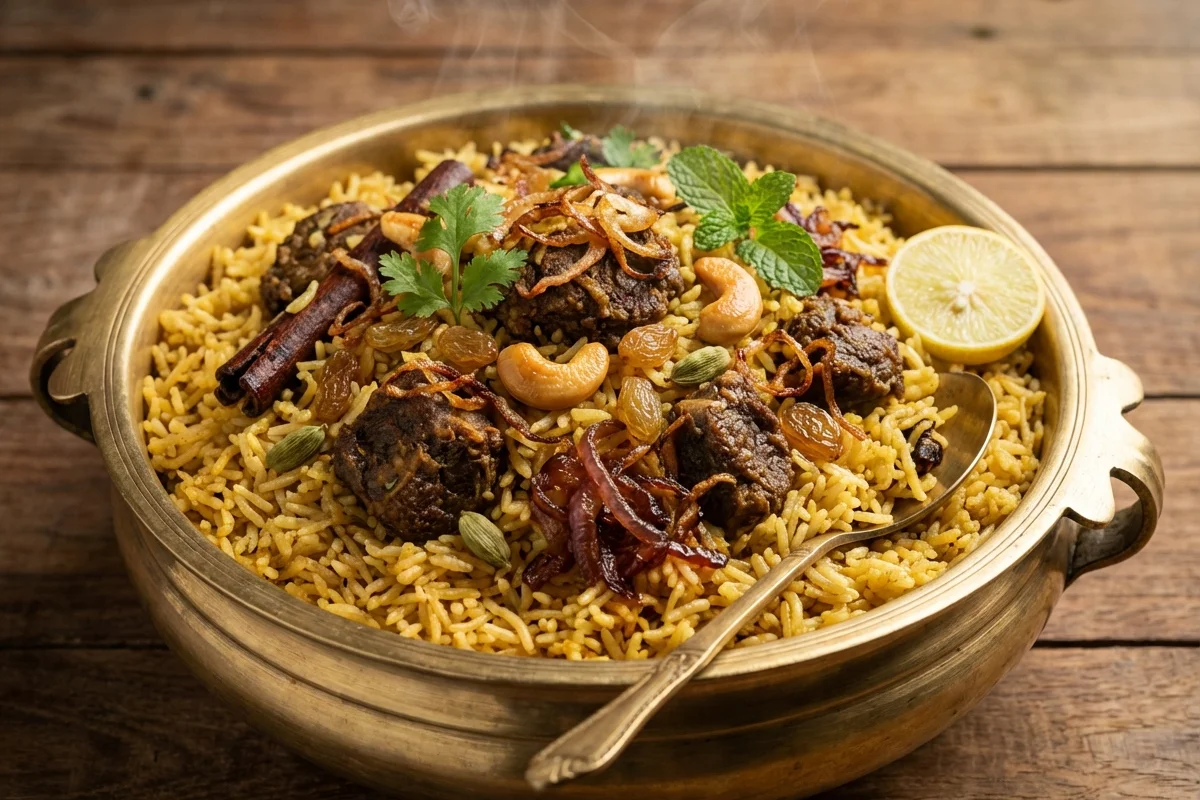
Kozhikodan Beef Biryani
A legendary biryani from the coast of Calicut, where tender chunks of beef are slow-cooked with fragrant Kerala spices and layered with fluffy, short-grain Kaima rice. The beef is marinated and cooked until melt-in-your-mouth, then sealed under a saffron-kissed rice blanket and left to steam in its own aroma. Smoky, spicy, and deeply comforting — this is a biryani with soul.
For 4 servings
- prep · ~30 min
Marinate the beef.
1.In a bowl, combine the beef cubes with 1 tbsp curd, 1 tsp turmeric powder, 0.5 tbsp red chili powder, 0.5 tsp salt, and 1 tsp ginger paste.2.Mix well to coat every piece and set aside for at least 30 minutes at room temperature.TIPOvernight marination in the fridge deepens the flavor massively. - fry · ~20 min
Fry the onions, cashews, and raisins.
1.Heat 0.75 cup of oil in a large skillet over medium heat.2.Add the sliced onions in batches and fry, stirring often, until deep golden brown and crisp (15-18 min).3.Remove onions with a slotted spoon and drain on paper towels.4.In the same oil, quickly fry the cashew nuts until golden, then the raisins until plump. Set aside.TIPDon't crowd the pan while frying onions — they steam instead of crisp. - pressure cook · ~40 min
Cook the beef masala.
1.Remove all but 3 tbsp of the onion-frying oil from the skillet.2.Add the cinnamon stick, cardamom pods, cloves, bay leaves, star anise, mace, and fennel seeds. Sauté until fragrant (30 sec).3.Add the remaining crushed ginger and garlic paste, and slit green chilies. Sauté for 1 minute.4.Tip in the marinated beef. Sear on high heat for 3-4 minutes until browned.5.Add the chopped tomatoes, remaining 0.5 tbsp red chili powder, 2 tbsp coriander powder, and the remaining whisked curd. Stir well.6.Pour in 2.5 cups of water, add 0.5 tsp salt, and stir. Close the pressure cooker and cook on medium heat for 4-5 whistles (about 25-30 min).7.Let the pressure release naturally. The beef should be fork-tender. Check the consistency — the gravy should be thick and clinging to the meat. If it's watery, simmer open for 5 minutes to reduce.TIPNatural pressure release stops the meat from becoming tough and stringy. - boil · ~10 min
Parboil the rice.
1.In a large pot, bring 4 cups of water to a rolling boil with the remaining 0.5 tsp salt, 1 tsp oil, and the juice of half a lemon.2.Add the soaked and drained Kaima rice.3.Cook until the rice is about 70% done — the grains should be slightly firm when pressed but not raw (roughly 5-6 min). Drain immediately in a colander.TIPKaima rice cooks fast — start checking the grain at 4 minutes. Overcooked rice makes a mushy biryani. - assemble · ~10 min
Layer the biryani.
1.Grease the bottom of the heavy-bottomed pot with a little ghee.2.Spread a thin layer of the beef masala at the bottom.3.Add one-third of the drained rice in an even layer over the beef.4.Sprinkle one-third of the fried onions, chopped coriander leaves, mint leaves, a pinch of garam masala, and a few drops of saffron water.5.Repeat the layers twice more — beef masala (if any left — most will be in the first two layers), rice, herbs, fried onions, garam masala, and saffron.6.Drizzle the remaining ghee, lemon juice, and rose water over the top. Arrange the fried cashews and raisins on the final layer.TIPKeep the layers light and airy — don't press the rice down. - steam · ~40 min
Seal and cook on dum.
1.Seal the rim of the pot with a thick strip of atta dough to trap the steam. Press the lid firmly on top.2.Place the pot on the lowest possible flame and cook for 25-30 minutes.3.You'll smell the biryani when it's ready. Turn off the heat and let it rest, still sealed, for another 10 minutes.TIPPlace a tava (flat griddle) under the pot if your stove's lowest flame is still too high — this prevents the bottom from scorching. - garnish · ~2 min
Break the seal and serve.
1.Crack open the atta seal. The aroma that bursts out is unforgettable.2.Gently fluff the biryani with a fork, scooping all the way to the bottom to bring up the beef masala, and mix lightly.3.Serve steaming hot on a platter.
What to keep in mind.
7 tips from the recipe — small details that make a real difference to the final dish.
- 1Use full-fat yogurt for marinating; low-fat yogurt can curdle under high heat and thin the gravy.
- 2Fry the onions in batches and remove them as soon as they turn deep golden; they continue to darken from residual heat.
- 3Kaima rice (or jeerakasala) has a distinct aroma and cooks in half the time of basmati — watch it closely.
- 4Do not skip the atta dough seal; it traps the steam completely and creates the signature dum aroma.
- 5Let the pressure cooker release naturally for at least 10 minutes — forced release can make beef chewy.
- 6Spread the rice gently in layers without pressing; compacted rice leads to a pasty texture instead of light, separate grains.
- 7If your stove's low flame is still high, place a flat tava or skillet under the biryani pot to avoid burning the bottom layer.
Adapt it for your goals.
Chicken version
Replace beef with 600 g bone-in chicken thighs. Skip pressure cooking; instead, cook the masala on the stovetop until chicken is just done (about 15 min) to avoid overcooking the delicate meat.
mutton versionMutton version
Use 500 g bone-in mutton (goat or lamb). Increase pressure-cooker whistles to 6–7 and let the meat rest in pressure for 15 minutes for a silkier texture.
lower oilLower oil
Reduce oil to ½ cup and use a non-stick pan for frying onions. Oven-crisp the sliced onions at 180°C for 15 minutes instead of deep-frying to cut oil significantly.
high proteinHigh protein
Add 200 g of paneer cubes (lightly fried) in the layering step and increase the yogurt to 3/4 cup. Perfect for post-workout meals or keto-adjacent diets.
Why this is on our healthy list.
High in Iron
Beef is a rich source of heme iron, which is more easily absorbed than plant-based iron and supports healthy blood and energy levels.
Digestive Spice Support
Fennel seeds, cardamom, and cloves in this biryani are traditionally used in Kerala cuisine to aid digestion and reduce bloating after a heavy meal.
Good Source of Protein
With 500 g of beef and yogurt in the marinade, each serving delivers a substantial amount of muscle-supporting protein.
Bone Health Minerals
The whole spices (cinnamon, mace, star anise) contain trace minerals like manganese and copper, which play a role in maintaining bone density.
Natural Anti-Inflammatory
Turmeric, ginger, and garlic are core to this recipe and are known for their anti-inflammatory and immune-supporting properties.
Heart-Healthy Fats
Ghee and the small amount of oil used here provide conjugated linoleic acid (CLA) and butyrate, which in moderate amounts support gut and heart health.
Frequently asked questions
Yes, but the texture will be different. Use 1½ cups basmati, soak for 20 minutes, and parboil only to 60% doneness — basmati takes longer and is less sticky.



.webp)


.webp)